

Internal controls & ICFR reviews in Dubai and UAE
Controls fail quietly, long before anyone notices.
A reconciliation that has been “mostly” reviewed for months. An approval workflow with one too many exceptions. A spreadsheet doing the job an ERP control should be doing. HLB HAMT’s Internal Controls & ICFR (Internal Control over Financial Reporting) review services are designed to catch exactly this: the gaps between how controls are documented and how they actually operate, before they surface as audit findings, financial misstatements or regulatory concerns.
- 25+
- years in the UAE
- 4,000+
- clients helped
- 300+
- in-house professionals

Strengthening governance, managing risks & driving business value
Internal Control over Financial Reporting (ICFR) is a critical framework ensuring financial statement accuracy and completeness. In the UAE’s thriving economy attracting foreign investments, a robust ICFR system signifies a company’s commitment to global best practices and transparency. This builds investor trust, eases capital access, and bolsters the company’s reputation.
HLB HAMT excels as a top ICFR service provider in the UAE, guiding businesses to establish and uphold strong internal control systems. With our expertise in financial integrity and compliance, we help companies navigate regulatory complexities, drive growth, and succeed in a competitive market.
Why internal controls & ICFR reviews matter
What weak controls cost
Weak internal controls rarely announce themselves. They show up later, as a fraud that went undetected, a financial restatement, or a qualified audit opinion. For UAE businesses, the stakes have risen further: regulators, external auditors and lenders increasingly expect documented evidence that controls exist and function, not just an assurance that they probably do. For companies preparing for IPOs, raising financing, or operating under CBUAE, CMA or ADGM/DIFC oversight, a credible ICFR review is often a precondition for moving forward at all.
- A fraud that went undetected
- A financial restatement
- A qualified audit opinion
What good controls give back
Beyond compliance, a well-controlled environment protects the business itself: fewer errors, faster and more reliable financial close cycles, and management that can trust the numbers it’s making decisions on.
- Fewer errors
- Faster and more reliable financial close cycles
Three jobs a control can do
Internal controls are the policies, procedures and checks that keep a business on course: they protect its assets, keep its records reliable and keep it within the rules that apply to it.
A sound control environment uses all three kinds below. A review checks that every risk that matters has the right kind of control, and that the control works.
Preventive controls stop an error or fraud before it happens.
Detective controls find an error or irregularity after it has happened.
Corrective controls put the problem right and stop it coming back.
Reporting on ICFR to regulators
Regulators now ask for more than an assurance that controls exist. Listed companies are expected to have a board-approved internal control and risk management framework, with their external auditors reporting on ICFR. Insurers, foreign branches included, report on their internal controls to the CBUAE through a management assessment report signed by the CEO and CFO, backed by an internal audit report on how well those controls operate.
We help management prepare that assessment and the evidence behind it, and our internal audit team can test the operating effectiveness the report relies on. Both reports go to the board or its committees, so they need to stand up to questions.
What a management assessment report sets out
- 01Key findings and the actions agreed
- 02The control framework adopted
- 03Progress on earlier findings
- 04Newly identified control gaps
- 05Controls from entity to process level
- 06How risks and controls are tested
- 07The key risks and their ratings
- 08Corrective actions and who owns them
UAE laws requiring ICFR adherence
Several UAE regulations underscore the significance of Internal Control over Financial Reporting (ICFR), including:
UAE Commercial Companies Law (2022)
This law mandates accurate financial statements and proper accounting records for all UAE companies.
Securities and Commodities Authority (SCA)
SCA’s Governance Code (latest version as of May 31, 2024) enforces IFRS compliance and effective internal controls for listed firms.
Specific entity considerations
ADAA Law No. 1 of 2017 for Abu Dhabi’s government entities emphasizes robust internal control frameworks, subject to potential newer regulations like ADAA resolution no. 88 of 2021.
Recent regulations
SCA Decision No. 2/R.M. of 2024: Investigate this recent decision for updated ICFR requirements for listed entities. Insurance Authority Circular No. 21 of 2019: Though not ICFR-specific, this circular can indirectly influence internal controls in the insurance sector.
Federal Decree-Law No. 56 of 2023
Stay informed about new ICFR obligations arising from this decree law to ensure full regulatory compliance.

Where controls most often give way
The gaps a review turns up again and again, and the ones that let errors, leakage and fraud through.
Segregation of duties
One person able to start, approve and record the same transaction.
Approvals and authority
Payments and commitments approved above someone’s limit, or with no approval on file.
Manual and repeated steps
Re-keying and duplicated checks that slow the close and invite mistakes.
Missing evidence
Reviews and sign-offs that happen but leave nothing an auditor can rely on.
Revenue leakage
Billing, discounts and credit notes that escape review, so income is lost unnoticed.
Rules not yet built in
Processes that don’t yet reflect the VAT, AML or governance requirements that apply to them.
Our internal controls & ICFR services
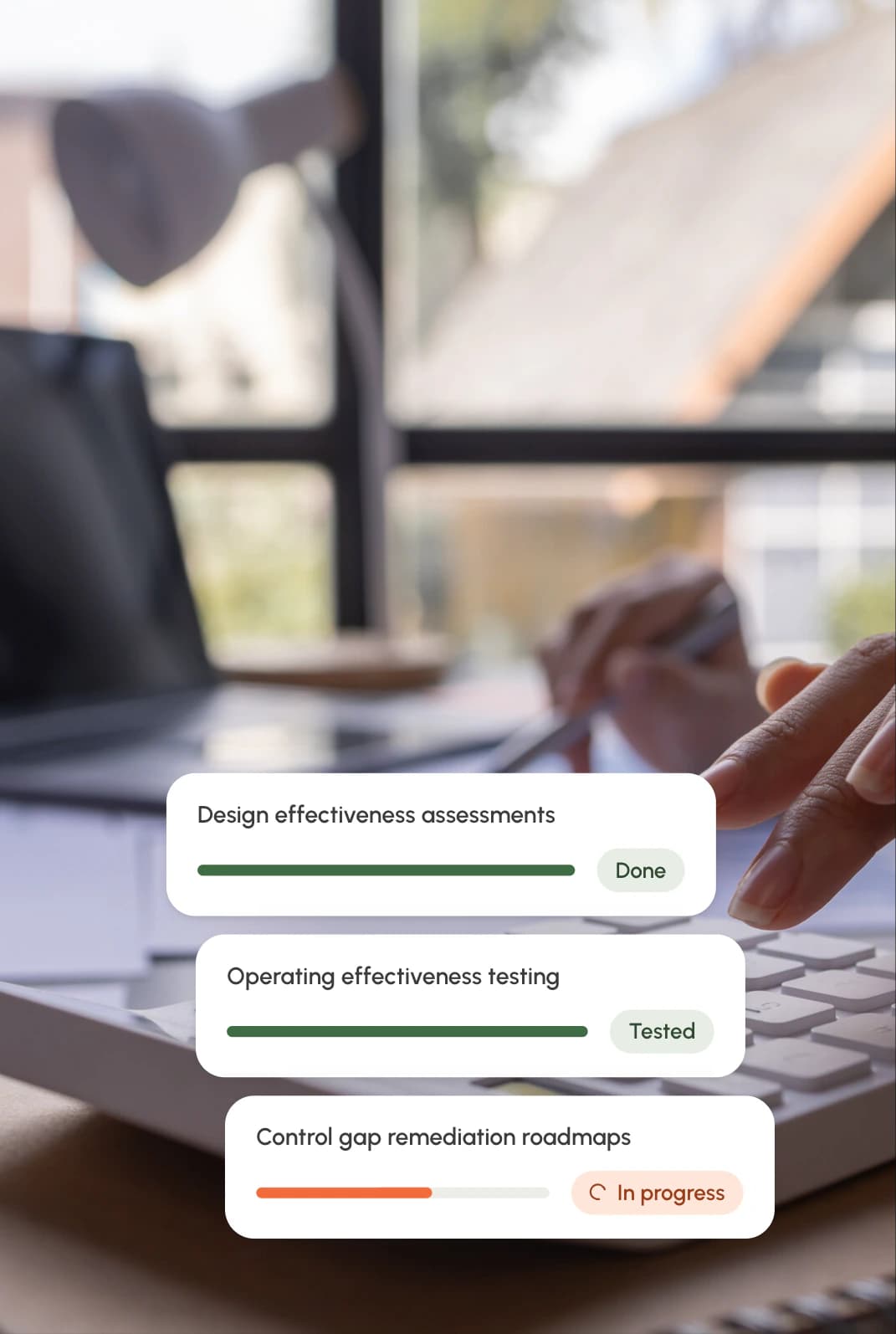
Design effectiveness assessments
Evaluating whether your control framework, as designed, is actually capable of preventing or detecting the risks it’s meant to address.
Operating effectiveness testing
Beyond design, we test whether controls are consistently performed in practice, using sampling and walkthrough techniques aligned with audit standards.
ICFR reviews
Assessing controls specifically over financial reporting processes (revenue recognition, journal entries, close and disclosures) to support statement integrity.
Control gap remediation roadmaps
Where gaps exist, we don’t just report them: we help design and prioritize the remediation actions needed, with realistic timelines and ownership.
Process & control documentation
We build (or refresh) control matrices, narratives and flowcharts that give management and auditors a clear, current picture of the control environment.
COSO-aligned methodology
Our reviews are structured around the COSO Internal Control – Integrated Framework, covering environment, risk, activities, communication and monitoring.
Control self-assessments
A questionnaire built around your processes, with a clear scoring method and a guide, so managers can test their own controls between reviews.
What an ICFR gap assessment looks at
Before a framework is built on or reported, we check it across four areas against the COSO framework, the one the SCA points listed companies to.
- Roles and sign-off
- Scope and testing
- Skills and ownership
- Evidence and records
Governance
Roles and sign-off
Who owns ICFR in each department, how results are reported and monitored, and what stands behind the CEO and CFO sign-off.
Process
Scope and testing
Materiality and scope; entity-level, process-level and IT general controls; how design is judged, samples chosen and gaps closed.
People
Skills and ownership
Training for the ICFR team, awareness for process owners, named points of contact, and duties kept apart within ICFR roles.
Documentation
Evidence and records
Standard documents, evidence that is ready when a tester asks, a testing calendar, signed-off control matrices and records kept.
Key features and benefits of ICFR
Mapping and impact assessment
Easily map business and IT controls, highlighting how deficiencies in one area (e.g., General IT Controls – GITCs) can affect another (e.g., IT Application Controls – ITACs).
Centralized platform
Gain a centralized hub for testing, reviewing, remediating issues, and collecting evidence, boosting efficiency and quality control.
Automated quality checks
Enforce system-level checks like mandatory reviewer sign-offs, missing assertions, and open comments, ensuring consistent audit quality.
Interactive dashboards
Stay up-to-date with interactive dashboards that track testing progress, control deficiencies, and open issues in real-time.
24/7 automated reporting
Get automated, real-time status reports and deficiency tracking, leading to faster assurance and higher quality results.
Predictable costs
Benefit from predictable fee structures that eliminate the uncertainty of time-and-materials pricing. Choose from multi-year agreements with lower first-year implementation costs or one-year flexible plans with higher initial fees.
Deep technical expertise
Leverage HLB HAMT decades of experience embedded within the ICFR as a Service methodology.
Streamlined communication
Facilitate seamless communication between HLB HAMT, in-house project leaders, and internal auditors.
Optimized workflows
Save time and effort with pre-configured workflows that minimize mobilization time.
Streamlined control management, enhanced audit quality, real-time visibility, increased efficiency, transparent pricing, expert support, improved communication and collaboration, and reduced time investment.
Our approach
Reviewing your controls
5 steps
Scoping & risk assessment
We identify the processes and financial statement line items where control failure would matter most and focus our review there first.
Walkthroughs & documentation review
We trace transactions end-to-end to understand how controls actually operate, not just how they’re described in policy documents.
Testing
We test both the design and the operation of key controls, using sample sizes and techniques appropriate to risk and materiality.
Gap analysis & reporting
Findings are rated by severity and mapped to specific processes, giving management a clear, prioritized action list rather than a generic report.
Remediation support
We work with process owners to design corrective controls and can revisit post-remediation to confirm effectiveness.
Building the ICFR framework
3 steps
Regulatory alignment and framework selection
We meticulously analyze applicable regulations and assist in choosing an ICFR framework aligning with global standards and regulatory mandates.
Thorough documentation and process mapping
Our experts meticulously document financial processes, spanning all functions, IT controls, and risk management, ensuring full transparency and accountability.
Comprehensive risk and control matrix development
We create a comprehensive matrix identifying risks and corresponding control measures, ensuring robust risk mitigation strategies.
Testing and reporting
3 steps
Rigorous control testing procedures
Our team conducts thorough testing to assess control design and effectiveness, ensuring the reliability of your financial reporting systems.
Gap analysis and continuous improvement
We conduct a detailed gap analysis to identify areas for enhancement, crafting a targeted improvement roadmap to align your ICFR framework with regulatory requirements and industry best practices.
Seamless regulatory reporting
HLB HAMT assists in the meticulous preparation and submission of reports to regulatory bodies, ensuring compliance with specific reporting standards and requirements.
At HLB HAMT, we tailor the ICFR implementation journey to meet your unique needs.
Discuss your controlsBenefits of an internal controls & ICFR review
Fewer surprises at year-end
Issues are identified and fixed well before external audit, reducing findings, delays and audit fees.
Stronger financial reporting integrity
Confidence that the numbers reaching the board and stakeholders are reliable.
Regulatory & lender readiness
Demonstrable control evidence for regulators, banks and investors.
Reduced fraud & error exposure
Structured controls close the gaps where fraud and error most commonly occur.
Clear ownership
Documented control matrices mean everyone knows who owns what: no more controls that exist “in theory.”
Let us assist you in constructing a robust internal control system that boosts transparency, instills investor trust, and enhances your financial reporting standards.
Internal audit’s vital role in strengthening ICFR
Regulatory insight collaboration
We foster cross-departmental collaboration to ensure a deep understanding of regulatory requirements across the organization.
Framework implementation and validation
Our team assists in implementing and rigorously testing the ICFR framework’s efficacy, aligning it with industry benchmarks and standards.
Gap identification and remediation
We conduct regular framework assessments, pinpointing areas for enhancement and recommending tailored strategies for continual improvement.

What makes HLB HAMT different
Embarking on the ICFR journey can be daunting, but you’re not alone. Our proficient internal audit team is equipped with the latest regulatory insights and industry best practices to ensure your ICFR framework is not just compliant, but also optimized for effectiveness.
Qualified professional reviews
Reviews conducted by CA, CIA and ACCA-qualified professionals with hands-on experience across diverse industries and control environments. Methodology applied consistently, ensuring a rigorous framework that is not adapted loosely per engagement.
Actionable remediation
Practical remediation guidance focused on operational improvement, not just a list of findings.
Scalable program support
Experience supporting both first-time control reviews and the optimization of mature ICFR programs.
Independent, evidence-based reporting
Clear, independent reporting that provides boards and audit committees with the confidence they need for effective oversight.
Meet the experts
The partner and senior managers who lead HLB HAMT’s internal controls and ICFR reviews.


Build a control environment you can trust
If you’re not fully confident your controls would hold up under scrutiny (from an auditor, a regulator or your own board), that’s worth finding out now, on your terms. Speak to HLB HAMT’s Internal Controls & ICFR specialists today.
Request a consultationWhat happens next
- We review your enquiry.
- We discuss your processes and reporting.
- We agree the scope of the review.
FAQ
Frequently asked questions
Contact HLB HAMT
Talk to us about your controls.
Tell us which processes and reporting you want reviewed. Our team will get back to you within one business day.
Talk to a team that understands the detail.
For new business enquiries, service questions or an introduction to our specialists, reach us directly or use the form.


Monday-Friday · 7:30 AM-5:30 PM GST

Explore More HLB Business Services
Looking for support beyond internal controls? Explore other HLB HAMT services that may match your business requirements.
 Need an internal audit function without building one?Internal audit run for you, or alongside your own team.Internal Audit Outsourcing & Co-Sourcing
 Need a clear view of the risks that matter?A risk framework built and embedded across the business.Enterprise Risk Management (ERM)
- Governance, risk and compliance in separate silos?One joined-up programme for governance, risk and compliance.Governance, Risk & Compliance (GRC)
- Adopting or applying a complex IFRS standard?IFRS requirements interpreted and put into practice.IFRS Advisory & Implementation
HLB HAMT Insights
Stay Ahead with Our Insights
Subscribe to HLB HAMT Insights, a monthly look at the critical issues shaping global business.