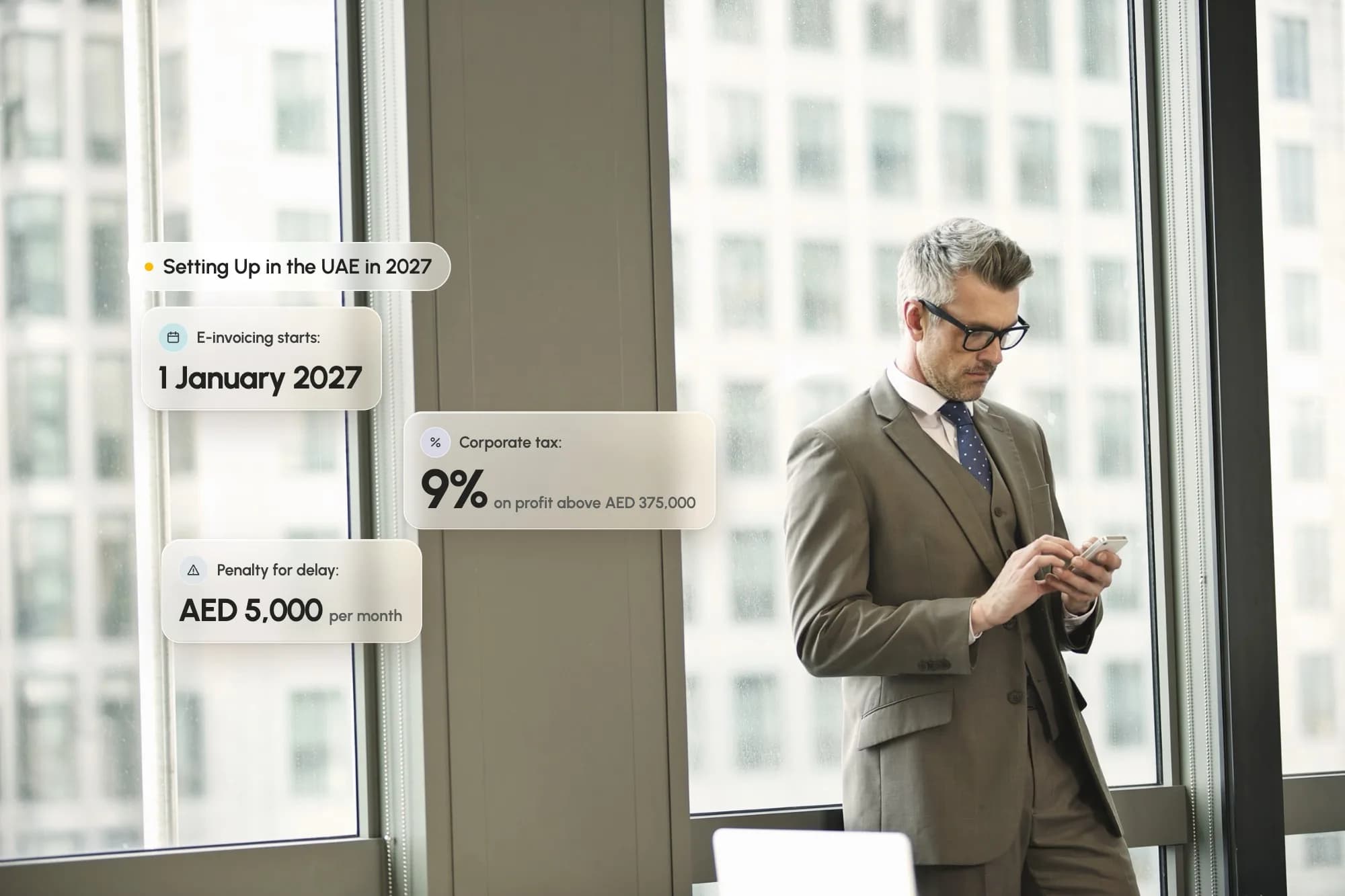



From 1 January 2027, the largest businesses in the UAE stop sending invoices as PDFs and start transmitting structured invoice data through an accredited channel that the Federal Tax Authority can see as each transaction happens. The format changes. What changes more is who is watching, and how quickly.
Most of the early conversation about e-invoicing has centred on software: which Accredited Service Provider to appoint, how to connect the ERP, which data fields the UAE specification requires. That work matters. But it treats e-invoicing as a systems project, when the harder question sits one layer down, in the accounting itself.

Near real time removes the quiet month-end
Today, a business can post an invoice, notice a VAT coding error two weeks later, and correct it before anyone outside the company ever sees it. The monthly close absorbs a great deal of that quiet repair work. Under continuous reporting, that margin narrows sharply. Once an invoice is transmitted through the accredited channel, its data has already reached the FTA. A wrong tax code, a mismatched tax registration number, or a misclassified supply is no longer an internal note to fix at month-end. It is a reported figure.
That is why e-invoicing is, at its core, a test of accounting discipline rather than IT. The businesses that struggle will not be the ones with the wrong software. They will be the ones whose master data is inconsistent, whose VAT treatment is decided case by case, and whose ledgers are reconciled late.

What “ready” means in the accounts
Readiness at the accounting level comes down to a few unglamorous things being right before go-live.
Customer and supplier master data has to be clean and complete, because the required invoice fields are populated from it.
VAT treatment has to be correct at the point the invoice is raised, because there is far less room to adjust it afterwards.
The chart of accounts and tax codes have to map cleanly to the reporting format.
And the ledger has to be reconciled often enough that errors surface in days, not quarters.
None of this is new accounting. It is the standard every set of books was always supposed to meet. E-invoicing simply removes the hiding places.
The timeline, and why appointment is not the finish line
The sequence is set.
- 01
1 July 2026
A voluntary pilot has been open since 1 July 2026.
- 02
1 January 2027
Businesses with annual revenue of AED 50 million or more fall into the first phase: they must appoint an Accredited Service Provider by 30 October 2026 and begin mandatory e-invoicing on 1 January 2027.
- 03
1 July 2027
Every other VAT-registered business follows, with ASP appointment due by 31 March 2027 and go-live on 1 July 2027.
Where this leaves finance teams
The practical move now, for a business in the first phase, is to treat the accounting as the long-lead item and start it alongside the ASP selection, not after it. A focused review of master data, VAT treatment and reconciliation routines will show what needs correcting while there is still time to correct it calmly. For businesses in the second phase, the extra months are an advantage only if they are used, and the same review is worth running well before March.

E-invoicing has been described as a systems project with a tax deadline attached. The more useful way to see it is as the moment your accounting stops being a private matter. The firms that come through it without disruption will be the ones whose books were already in order. The connection to the FTA is coming on a fixed date. The question worth asking in the boardroom is not whether the software will be ready, but whether the accounting behind it will be.