


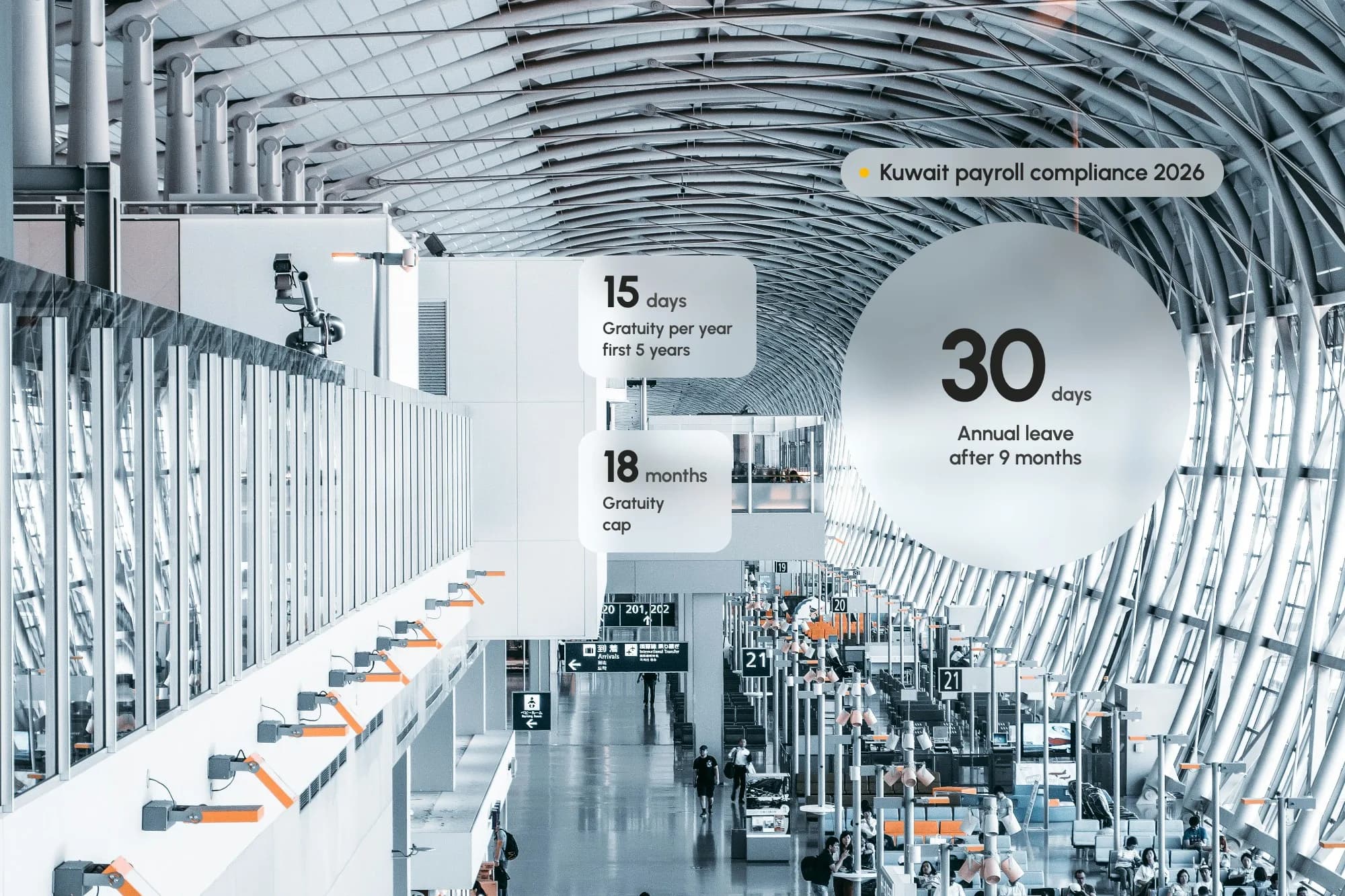
Key takeaways
- Essential guide to running compliant payroll in Kuwait in line with local labour laws
- Clear breakdown of Kuwait PIFSS pension regulations and employer contribution obligations
- Practical calculation guide for End of Service Benefits (EOS Gratuity) in Kuwait
- Overview of all statutory leave types and overtime premium rates under Kuwait Labour Law
- How Nova VU automates the full Kuwait payroll cycle with 100% compliance and zero manual errors
- API integration capabilities with SAP SuccessFactors, Oracle HCM, HiBOB, and Workday
- Why HLB HAMT is a trusted payroll outsourcing partner for businesses in Kuwait and the GCC
Managing payroll in Kuwait demands more than issuing monthly salary payments. Between Public Institution for Social Security (PIFSS) pension contributions for Kuwaiti employees, End of Service Gratuity obligations for expatriates, multi-tier overtime requirements, and a comprehensive set of statutory leave entitlements, Kuwait payroll compliance is a multi-layered responsibility with significant financial and legal consequences.
For HR Directors, CFOs, and operations leaders responsible for financial accuracy and operational excellence, the right payroll platform transforms a complex, time-consuming manual function into a fully automated, compliance-first payroll operation, delivering error-free processing and 100% statutory compliance on every cycle.

Payroll Run Summary
Employees Processed
PIFSS Contribution
Total on May 2026
EOS Gratuity accrual
Total Accrued Laibility
Statutory leave balances
Total Leave Days
Live Compliance Status
All Clear
12 May 2026 | 10:15 AM
Compliance Framework
Understanding the Kuwait Payroll Compliance Framework
Kuwait payroll is governed primarily by Kuwait Labour Law (Law No. 6 of 2010) and its amendments, with additional statutory obligations under the Public Institution for Social Security (PIFSS) for Kuwaiti nationals. The framework clearly distinguishes between two employee groups: Kuwaiti and GCC nationals, who are subject to mandatory
PIFSS pension contributions for Kuwaiti nationals and the respective countries' social security contribution policies for other GCC countries
Getting this classification right from day one is the most critical step in accurate Kuwait payroll processing. The key pillars of the compliance framework are:
PIFSS pension contributions for Kuwaiti nationals and social security contribution policies for other GCC countries
End of Service (EOS) Gratuity for expatriate employees
Statutory leave entitlements including annual, sick, maternity, Hajj, and Iddah leave
Overtime rules and premium pay rates under Kuwait Labour Law
Payroll accounting, accrual management, and MIS reporting aligned with financial governance requirements
Public Institution for Social Security (PIFSS): Contributions & Employer Obligations
The Public Institution for Social Security (PIFSS) is the Kuwaiti government authority responsible for administering social insurance and pension schemes for Kuwaiti nationals and eligible GCC employees. PIFSS contributions are mandatory and are calculated on monthly salaries, subject to a statutory cap of KWD 2,750 per month. Expatriate employees are not subject to PIFSS; End of Service Gratuity applies in their place.
PIFSS Contribution Structure
Contribution Category
Rate
- Employee Contribution
- 8% of monthly salary
- Employer Contribution
- 11.5% of monthly salary
- Additional Employee Contribution
- 2.5% applicable on salary up to KWD 1,500
Employer Obligations Under PIFSS
Employers bear full responsibility for:
Timely declaration of the relevant employee and monthly salary information.
Timely deduction of the employee’s PIFSS contribution through payroll
Remittance of both employer and employee contributions to PIFSS within statutory deadlines
Maintaining accurate contribution records and generating monthly PIFSS reports
How HLB HAMT Manages PIFSS Compliance
HLB HAMT handles all PIFSS contribution calculations as part of its Kuwait payroll outsourcing service, coordinates payment submissions to the PIFSS portal, and provides a dedicated monthly PIFSS contribution report. Clients never miss a statutory deadline.

Noura Al Mutairi · Head of HR
Global Payroll: Noura Al Mutairi, Head of HR · Ahmed Al Enezi, Operations Manager · Mariam Al Kandari, Finance Manager
Employee Contribution
8%
Company Contribution
11.5%
Total Contribution
19.5%
Wage Protection System (WPS)
Kuwait Wage Protection & Salary Payment Requirements
Unlike the UAE and several other GCC states, Kuwait does not operate a formal Wage Protection System (WPS). However, Kuwait Labour Law requires that all salary payments be made via bank transfer and within the agreed payment cycle, whether monthly or bi-weekly, depending on the nature of the employment contract. Salary disbursements must be made in Kuwaiti Dinars (KWD) to a KWD-denominated bank account.
Key Salary and Pay Structure Facts for Kuwait:
- Kuwait has issued minimum-wage requirements for covered private- and oil-sector employment. The Public Authority for Manpower previously specified KWD 75 per month for relevant contracts and work permits.
- There is no personal income tax in Kuwait; no tax deductions apply to employee salaries
- Bonuses, incentive payments, and commissions are not mandatory under Kuwait Labour Law. However, once contractually agreed, they must be honoured
- PIFSS pension contributions apply to Kuwaiti nationals, with respective countries' social security contribution policies applying to other GCC nationals.
- There is no limitation on the number of pay codes. Clients can add pay codes at any time in Nova VU at no additional charge
Bank Disbursement Automation
HLB HAMT's payroll system generates automated bank-ready salary disbursement files compatible with Kuwait banking requirements, ensuring payments are timely, accurately formatted, and fully reconciled with each payroll cycle without manual processing.

Kuwait end of service gratuity policy
End of Service Gratuity in Kuwait: Calculation, Accrual & Compliance
End of Service (EOS) Gratuity is one of the most significant statutory obligations in Kuwait payroll. It is a lump-sum benefit payable to eligible expatriate employees upon the completion or termination of their employment contract. Kuwaiti nationals are covered by PIFSS instead. Gratuity is calculated based on the employee's last-drawn basic salary, including all fixed allowances.
For employers, managing gratuity accurately is critical, not just for legal compliance but also to avoid financial misstatements, pass audits, and maintain employee trust. As workforces grow, manual gratuity tracking becomes error-prone and unsustainable. Automated accrual and reporting are essential.
How Is Gratuity Calculated in Kuwait?
Gratuity Entitlement by Length of Service
Length of Continuous Service · Gratuity Entitlement
First 5 years of service
15
days' salary per completed year
Beyond 5 years of service
1
month's salary per completed year
Maximum cap
1.5
years' total salary (18 months)
Alfred John
Spain · Expatriate
- End of Service Gratuity · auto-assigned by system
Ahmed Imam
Kuwait · National
- PIFSS Contribution – auto-assigned by system
Nadia Hameed
Egypt · Expatriate
- End of Service Gratuity · auto-assigned by system
Any periods of unpaid leave are deducted from the total length of service used in the gratuity calculation. HLB HAMT's Nova VU system automatically adjusts for unpaid leave days in both monthly accrual reports and final EOS settlement calculations.
What Is Included in the Final EOS Settlement?
End of Service Gratuity, calculated per Kuwait Labour Law
Repatriation or ticket allowance (where applicable per company policy or employment contract)
Payment in lieu of notice period, if applicable
Payment for any unutilised annual leave balance
Any outstanding salary, allowances, recoveries, or adjustments up to the last working day
HLB HAMT automates the full EOS workflow: classifying employees by nationality, allocating expatriates to gratuity provisions and relevant social security contributions to PIFSS, generating monthly accrual reports with journal vouchers (JVs), preparing detailed EOS calculation sheets, and providing annual gratuity summary reports for audit and MIS purposes.
Automated Allocation and Accrual
HLB Payroll System classifies employees based on nationality and applicable benefit schemes, then calculates monthly gratuity accruals using key payroll data such as hire date, basic salary, service period, and unpaid leave. It generates gratuity accrual reports and accounting-ready summaries, which are then pushed to Nova VU for review and validation
Salary Change Validation
When an employee’s basic salary changes, HLB Payroll System automatically recalculates the gratuity liability and updates the reports. Nova VU reviews these changes and identifies unusual variances or potential under- or over-accruals for further review.
EOS Calculation Sheets and Final Settlement
For employee exits, HLB Payroll System generates detailed EOS calculation sheets covering gratuity, leave encashment, final salary, and other settlement components. Nova VU validates the calculations and highlights anomalies before HR and finance approve the final settlement.
Technology-Driven Payroll Validation
Nova VU’s advanced Rules Engine reviews payroll and gratuity reports to detect anomalies, inconsistencies, and compliance exceptions. This validation layer helps employers improve payroll accuracy, strengthen compliance, and maintain an audit-ready payroll process with less manual review.
Statutory Leave Entitlements Under Kuwait Labour Law
Statutory leave refers to legally mandated employee leave entitlements under Kuwait Labour Law. Each leave type carries specific eligibility criteria, duration rules, and payment treatment. Employers must track all leave types accurately and ensure payroll adjustments reflect the correct entitlement for each leave taken. Incorrect treatment, particularly at the boundaries of paid versus unpaid entitlement, can result in both statutory breaches and payroll errors.
Statutory Leave Entitlements
Leave Type · Statutory Entitlement
- Annual Leave30 days30 days after 9 months of service
- Sick LeaveFirst 15 days – full pay| Next 10 days – 75% of pay| Next 10 days – 50% of pay| Next 10 days – 25% of pay| Final 30 days – unpaid
- Maternity Leave70 days
- Hajj Leave21 days during employment
- Compassionate Leave3 days
- Iddah Leave130 days
- Academic / Study LeaveAs per contract or applicable agreement
- Examination LeaveAs per applicable rules
Each leave category has specific payment rules that payroll systems must handle automatically. For example, sick leave beyond the fully paid threshold triggers half-pay or unpaid deductions a nuance that must be applied precisely to maintain statutory compliance and avoid underpayment or overpayment.
HLB HAMT's ESS Leave Management: The Employee Self-Service (ESS) portal enables employees to apply for leave online through predefined approval workflows aligned with each client's internal hierarchy. Once approved, leave integrates automatically with payroll, ensuring accurate salary adjustments, full statutory compliance, and complete visibility for HR teams and approvers.
Noura Al Mutairi · Head of HR
- Annual Leave18/30
- Sick Leave
- Others
Noura Al Mutairi
– Head of HR
- Pending
Ahmed Al Enazi –
Operations Manager
- Approved
Mariam Al Kandari
– Finance Manager
- Pending
Leave Approval Status
Line Manager
Approved
HR Manager
Approved
Country Head
Pending
Overtime Rules and Calculation Under Kuwait Labour Law
Under Kuwait Labour Law, overtime applies when an employee works beyond 8 hours per day or 48 hours per week. During Ramadan, the weekly working-hour threshold is reduced to 36 hours for Muslim employees. Overtime is typically calculated on the employee's basic salary, though HLB HAMT's Nova VU system can be configured to accommodate client-specific overtime bases, including calculations on basic salary plus selected fixed allowances.
Overtime Premium Rates in Kuwait
Overtime Category
Premium Rate
- Normal Overtime (beyond standard daily/weekly hours)
- 125% (1.25x) of regular hourly wage
- Weekly Rest Day (typically Friday)
- 150% (1.5x) OR alternative rest day + normal pay
- Public Holidays
- 200% (2x) double pay OR alternative next day + normal pay
HLB HAMT's overtime automation: Overtime is calculated as part of standard payroll processing based on approved hours from the client or via ESS portal submissions, with configurable approval hierarchies. Once approved, overtime feeds automatically into payroll. Clients receive a department-level overtime report, and overtime appears as a separate line item on each payslip.
Employee Benefits and Pay Components in Kuwait Payroll
Salary Components and Unlimited Pay Codes
Kuwait Labour Law does not prescribe specific mandatory salary components, giving employers flexibility in structuring pay packages. Common fixed components include basic salary, housing allowance, transport allowance, mobile allowance, and other contractual allowances. Variable components may include overtime, sales commissions, performance bonuses, incentive payments, and relocation allowances.
HLB HAMT's payroll system imposes no limitation on the number of pay codes that can be created. Clients may add pay codes at any time without additional charges, ensuring the system can always accommodate evolving compensation structures and business requirements.
Air Ticket Benefits and Bonus Accruals
HLB HAMT automates ticket benefit management end-to-end, calculating annual air ticket entitlements based on employees' grade and company policy, supporting different eligibility structures (self, self plus spouse, or full family), applying approved routes and standardised rates, and recording payments automatically in the designated payroll or anniversary month.

For bonus and incentive payments, Nova VU supports monthly accrual calculations, dedicated accrual reports and journal entries, and scheduled bonus payments aligned with the employer's payout calendar, ensuring accurate financial provisioning and transparent reporting
Payroll Accounting and MIS Reporting for Kuwait Operations
Payroll accounting is the process of recording, managing, and reporting all financial transactions related to employee compensation, including salaries, allowances, overtime, bonuses, employer contributions, and statutory accruals for EOS Gratuity, air tickets, and annual leave. Accurate payroll accounting is foundational to financial transparency, cost control, and audit readiness.
HLB HAMT's payroll accounting capabilities include:
Fully automated General Ledger (GL) posting integrated with client ERP and accounting systems via API
Seamless API integration with SAP SuccessFactors, Oracle HCM, HiBOB, Workday, and other enterprise platforms
GL mapping and cost allocation rules precisely aligned to each client's organisational structure and chart of accounts
Dynamic GL mapping to accommodate organisational changes, employee transfers, and policy updates in real time
Payroll accrual accounting for EOS Gratuity, air tickets, bonuses, incentive schemes, and annual leave
Detailed allocation of employee payroll costs across multiple departments, cost centres, or projects
Monthly payroll accounting integration ensuring real-time financial accuracy in every reporting period
Comprehensive audit support, full statutory tracking, and management MIS reports for executive decision-making
HLB HAMT's system is built to handle complex accounting scenarios without workarounds, including multiple GL codes for a single pay component, classification of payroll costs as direct or indirect expenses, and automatic reclassification when employees transfer between departments.
How Nova VU Automates
How HLB Payroll System and Nova VU Automate the Entire Kuwait Payroll Process
Nova VU is HLB HAMT's proprietary, fully automated payroll processing and compliance platform, built in-house by HLB HAMT's payroll technology team and purpose-engineered for GCC payroll environments, including Kuwait. It sits at the core of every client engagement, processing every record in every payroll cycle with precision and consistency.
Real-Time Error Detection and 100% Compliance Validation
Nova VU functions as an intelligent payroll validation engine. Before any data reaches the payroll calculation layer, Nova VU checks every single record, without exception, for structural integrity, compliance accuracy, and historical consistency. This automated pre-processing layer catches calculation errors, missing data, and compliance deviations before they can become payslip issues, delivering error-free payroll on every run.
Nova VU automatically handles:
PIFSS contribution calculations and eligibility checks for Kuwaiti and GCC nationals on every cycle
EOS Gratuity accrual computation and nationality-based employee classification (expatriate vs. Kuwaiti/GCC)
Statutory leave entitlement tracking and automatic payroll deduction adjustments for every leave type
Overtime rate application across all four premium tiers in compliance with Kuwait Labour Law
Regulatory compliance updates — when Kuwait payroll requirements change, Nova VU is updated accordingly, keeping clients perpetually compliant
Seamless HRMS & ERP Integration via API
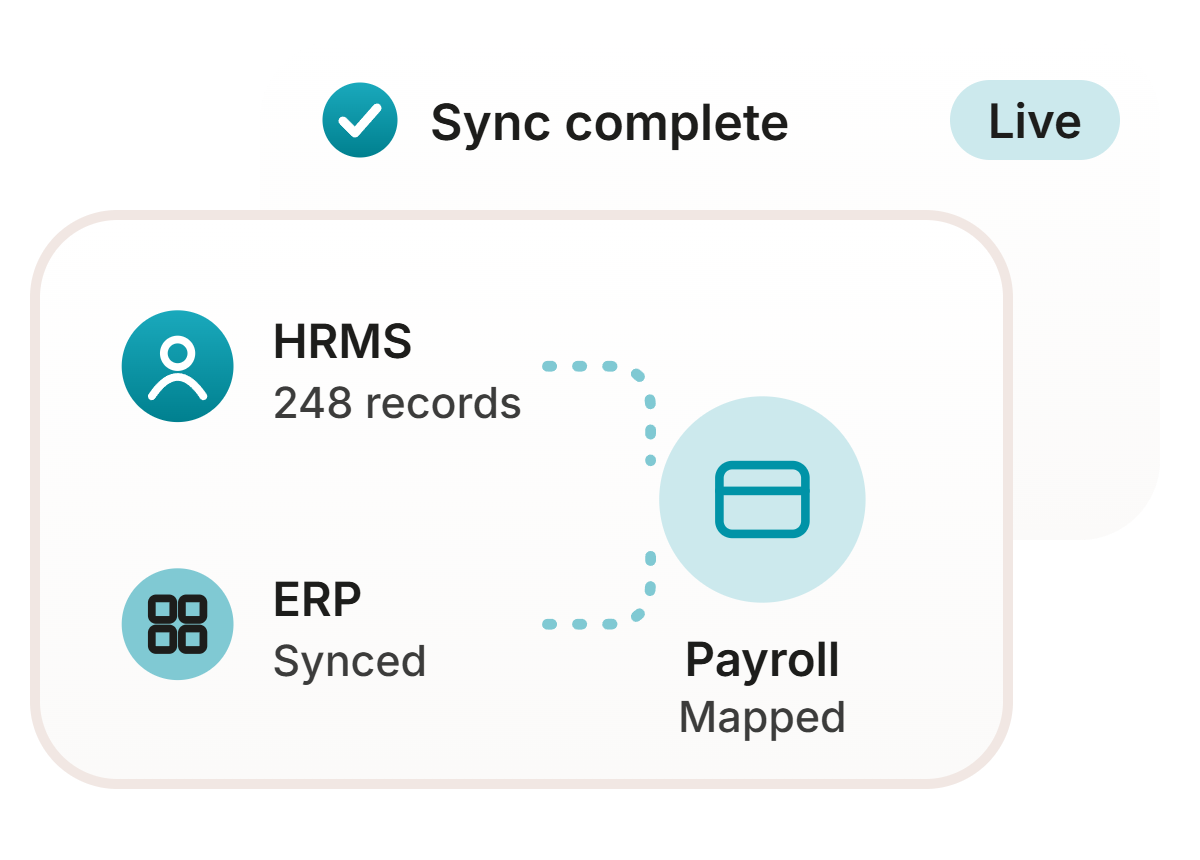
One of Nova VU's most powerful capabilities is bidirectional, real-time integration with leading HRMS and ERP platforms via API, eliminating manual data transfer and ensuring payroll is always based on the most current, approved HR data.
These integrations allow employee master data, attendance records, leave approvals, position changes, and all HR transactions to flow directly into Nova VU, removing manual entry, eliminating duplication errors, and creating a genuinely end-to-end automated payroll process. From an HR action to payslip generation, every step is connected, tracked, and auditable across all systems.
Employee Self-Service (ESS) Portal
Nova VU's integrated ESS portal gives employees and managers digital, mobile-accessible control over leave applications, overtime requests, payslip access, and routine HR transactions. Approval workflows are configured to mirror each client's internal hierarchy and authorisation policies. Once approved, all transactions feed directly and automatically into payroll, eliminating manual handoffs, processing delays, and the risk of missed updates between HR and payroll functions.
Time Savings and Efficiency Gains with Nova VU
By automating the full Kuwait payroll cycle, Nova VU delivers measurable, compounding time savings for HR and finance teams on every payroll run:
- Automated payroll runs replace manual spreadsheet-based calculations entirely
- Automated bank-ready salary disbursement files eliminate manual payment processing
- Automated PIFSS portal handling ensures pension contributions are filed accurately and on time
- Automated GL posting removes manual journal entry work for finance teams each month
- Automated compliance monitoring means no internal resource is spent tracking regulatory updates
- Automated EOS accrual reports and JVs replace end-of-month manual gratuity calculations
Organisations outsourcing Kuwait payroll to HLB HAMT can go live in as little as 10 business days for SME payrolls, with no minimum contractual commitment. Nova VU scales seamlessly from 1 employee to over 10,000, on the same platform, with the same compliance rigour.
 Mr. Muhammad Azhar IqbalHead of Finance
We were struggling with payroll errors and compliance gaps before HLB HAMT took over. Their team caught issues we did not even know existed and fixed our WPS setup within the first cycle. Reporting is now clear and audit ready.
HLB HAMT Payroll Outsourcing service
Why Outsource Kuwait Payroll to HLB HAMT?
HLB HAMT is one of the GCC's most experienced and trusted payroll outsourcing partners, with over 25 years of deep regional expertise. As a member of HLB International a top 8 global advisory network HLB HAMT combines international best practices with comprehensive, on-the-ground knowledge of Kuwait's payroll regulatory environment.
Go Live in 10 Days
SME payrolls activated in as little as 10 days, without operational disruption.
No Minimum Commitment
Stay because it works, not because you're tied in by contract.
Scales 1 → 10,000+
Same platform supports a single hire or an enterprise of 10,000 employees.
HRMS integration
Connects with Oracle, SAP SuccessFactors, and your in-house systems end-to-end
Audit-ready always
Clean reports, clear calculations, and full statutory trail on demand.
ISO 27001 · SOC 2
Highest standards of data security and quality management certification.
HLB HAMT transforms Kuwait payroll from a compliance burden into a controlled, automated, and insight-driven function, freeing HR and finance teams to focus on strategic growth while Nova VU manages every payroll obligation with precision.
ISO 27001
ISO 9001
ISAE 3402 / SOC 2
HLB International — Top 8 Global Network
FAQ
Frequently Asked Questions
- Payroll Register
- Payroll Reconciliation Report
- Headcount Reconciliation Report
- Bank Payment File and Payment Summary
- PIFSS Contribution Report
- Gratuity Accrual Report
- Leave Liability Report
- Overtime Report
- General Ledger (GL) Journal Entries
- Year-to-Date (YTD) Payroll Summary
- Cost Centre Allocation Report
- Payroll Submission and Approval Confirmations
In addition, HLB HAMT provides a comprehensive suite of audit and management reports, including Gratuity Yearly Summary, Annual Payroll Summary, Salary Increment Summary, Joiner and Leaver Reports, Payroll Variance Reports, Statutory Compliance Reports, and other customized reports to support audits, management reporting, and financial reconciliation.
About the Author

Sajin Rasheed
Partner – Payroll & HR · HLB HAMT
Sajin has been associated with HLB HAMT since 2005. He heads the Payroll Outsourcing Division and is responsible for making strategic decisions for the overall Division. He has over 20 years of experience in the field of finance and payroll. His dynamic initiatives at HLB HAMT have been pioneering for the industry. Under his leadership, the division commenced its transformational journey, reaching out to customers across the GCC and MEA region.