


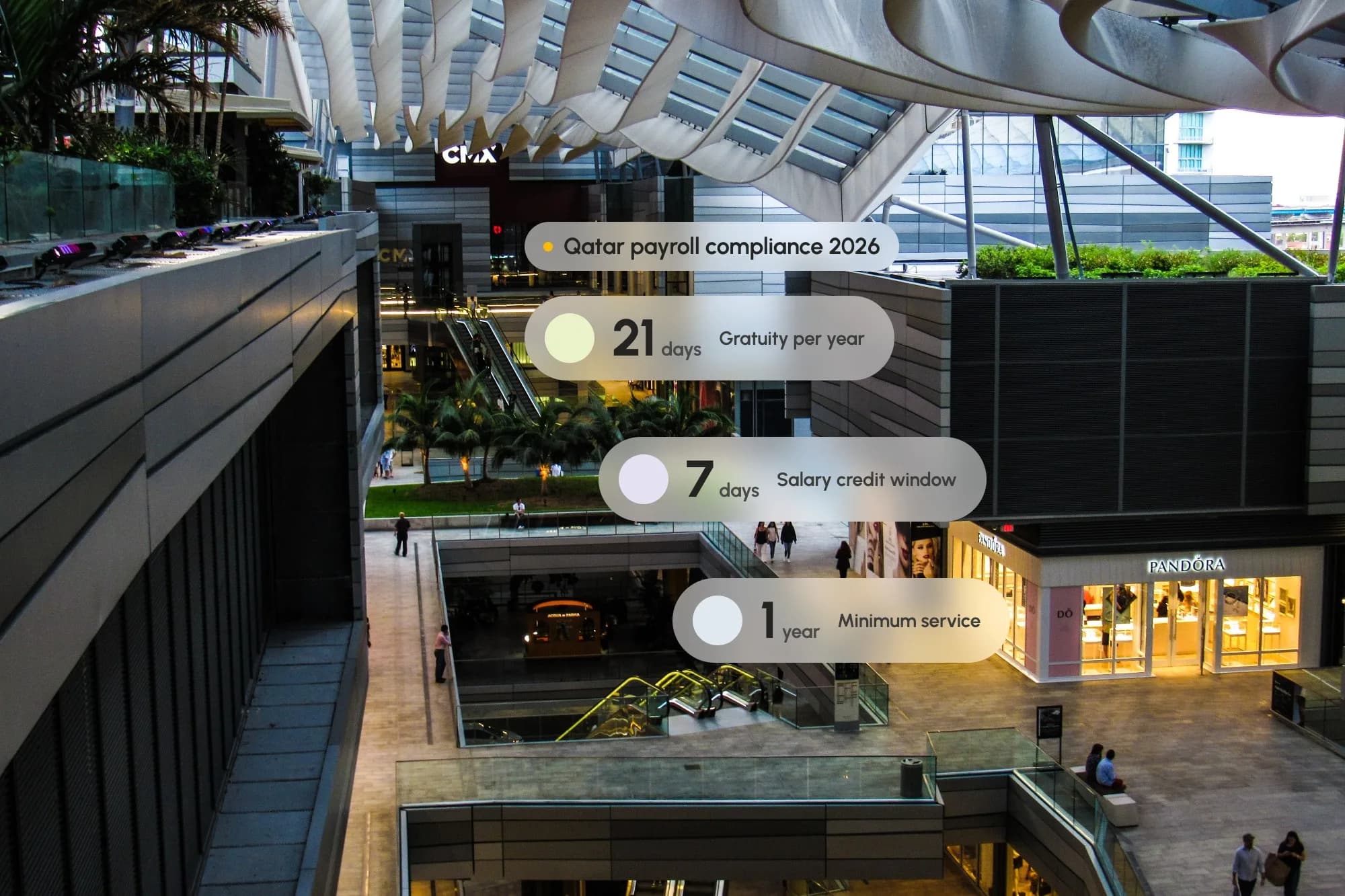
Key takeaways
- Understand GRSIA contribution rates and employer obligations in Qatar
- Learn how the Wage Protection System (WPS) works and how HLB HAMT manages it
- Grasp End of Service Gratuity calculations, accruals, and final settlement components
- Navigate statutory leave entitlements under Qatar Labour Law
- Discover how Nova VU automates Qatar payroll end-to-end from data validation to GL posting
- Understand API-based integrations with SAP SuccessFactors, Oracle HCM, HiBOB, and Workday
Managing payroll in Qatar is not simply a matter of transferring salaries. It is a multi-layered compliance function that governs employee rights, social insurance obligations, end-of-service entitlements, wage protection, and financial reporting all underpinned by an evolving regulatory environment that demands both accuracy and speed. For HR leaders, CFOs, and finance managers of companies operating in Qatar, managing payroll errors can trigger regulatory penalties, employee disputes, and serious legal exposure.
This comprehensive guide covers every dimension of Qatar payroll processing from GRSIA contribution rates and WPS compliance to gratuity calculations, statutory leave, and payroll accounting. It also explains how HLB HAMT's proprietary Nova VU platform fully automates the entire Qatar payroll cycle, ensuring 100% compliance, zero errors, and seamless integration with leading HRMS and ERP systems, including SAP SuccessFactors, Oracle HCM, HiBOB, and Workday.

Payroll Run Summary
Employee Count
GRSIA Filing Status
WPS Status
Total Gratuity Liability
QAR 5.86M
As of 2 Jun 2026
GRSIA Contributions
1. General Retirement and Social Insurance Authority (GRSIA)
The General Retirement and Social Insurance Authority (GRSIA) is Qatar's statutory social insurance framework, providing financial protection through old-age pensions, disability pensions, and survivors' benefits for businesses operating in Qatar. GRSIA compliance is a foundational payroll obligation and failure to register, calculate correctly, or remit on time can create direct financial and regulatory consequences.
GRSIA Contribution Rates in Qatar
GRSIA contributions for Qatari nationals are calculated at 21% of pensionable salary, comprising 7% from the employee and 14% from the employer. Contributions must be remitted no later than the fifth day of the following month.
GCC nationals working in Qatar are covered under the GCC Unified Insurance Protection System, with contribution rates and requirements determined by the applicable social insurance laws of their home country.
Employee
Employer
Total
Contributor
Employee
- Rate
- 7%
- Basis
- Pensionable basic salary
Contributor
Employer
- Rate
- 14%
- Basis
- Pensionable basic salary
Contributor
Total
- Rate
- 21%
- Basis
- Maximum cap: QAR 100,000/month
How HLB HAMT Manages GRSIA Compliance
As part of its Qatar payroll outsourcing service, HLB HAMT handles the complete GRSIA compliance lifecycle:
Full GRSIA portal administration — including monthly processing and system updates
Registration of new hires and deregistration of departures in the GRSIA portal
Accurate calculation of both employee and employer GRSIA contributions in every payroll cycle
Initiation and coordination of monthly GRSIA remittances to meet statutory deadlines
Production of dedicated monthly GRSIA contribution reports for client records and audit trails
Wage Protection System
2. Qatar Wage Protection System (WPS)
The Wage Protection System (WPS) is an electronic wage-monitoring framework administered by Qatar's Ministry of Labour in coordination with the Qatar Central Bank and approved financial institutions. It generally requires private-sector employers and workers subject to Qatar Labour Law No. 14 of 2004 to process wages through approved banking channels within seven days of the contractual due date. The standard WPS regime does not generally cover government employees, domestic workers, or employees governed by the Qatar Financial Centre's separate employment framework, whose categories are subject to their respective regulations.
How HLB HAMT Supports WPS Compliance
Company registration on the WPS system, coordinated on behalf of clients
Preparation and delivery of WPS salary files in the precise format required by the Qatar Central Bank and the client's bank
Validation of WPS files to ensure full compliance with regulatory specifications prior to submission
Ongoing support for WPS-related queries and file reconciliation
Nova Vu
WPS File Generation · June 2026 Run
HLB HAMT
Employee Transfer File
742 records
Employee Records
A. Al-Kaabi
- IBAN
- QA58 DOHB 0000 1234 5678 9012
- Net Pay (QAR)
- 14,200
- Status
- ✓ Validated
Employee Records
D. Fernandes
- IBAN
- QA21 QNBA 0000 9876 5432 1098
- Net Pay (QAR)
- 6,850
- Status
- ✓ Validated
Employee Records
M. Rahman
- IBAN
- QA77 CBQK 0000 4567 8901 2345
- Net Pay (QAR)
- 5,120
- Status
- ✓ Validated
Employee Records
J. Villanueva
- IBAN
- QA09 MARK 0000 — incomplete
- Net Pay (QAR)
- 4,300
- Status
- ✕ IBAN Error
Employee Records
S. Al-Marri
- IBAN
- QA34 DOHB 0000 1122 3344 5566
- Net Pay (QAR)
- 18,600
- Status
- ✓ Validated
741 of 742 records validated · 1 held for IBAN correction
✓ File validated and ready for submission
SIF format confirmed · Bank routing codes verified · Total QAR 5,847,900 across 741 records
Submit to Bank
Generated by Nova Vu · HLB HAMT Payroll Operations
File Ref: WPS-QA-06-2026
End of Service Gratuity
3. End of Service Gratuity in Qatar
End of Service Gratuity (EOSG) is a mandatory, one-time payment made to employees at the conclusion of their employment whether through resignation, termination, or contract expiry. Qatar Labour Law mandates gratuity for all employees who have completed a minimum of one year of service. For businesses, this means maintaining accurate monthly accruals and producing precise final settlement calculations that withstand audit scrutiny.

How Is End of Service Gratuity Calculated in Qatar?
Gratuity in Qatar is calculated at a minimum of 21 days of basic salary per year of completed service, applied only to the basic wage (excluding allowances):
Qatar Gratuity Formula
Gratuity = (Basic Monthly Salary ÷ 30) × 21 × Years of Service
Minimum qualifying service: 1 year
Calculation basis: Basic salary only — allowances are excluded
Prorated for partial years of service (last year calculated proportionally)
Unpaid leave periods are deducted from total service for gratuity purposes
End of Service Settlement: What Is Included?
End of Service Gratuity — calculated per Qatar Labour Law
Repatriation or air ticket — where applicable per contract or company policy
Notice period salary — or payment in lieu of notice
Payment for unutilised annual leave balance
Outstanding earnings, allowances, adjustments, or recoveries
Unprocessed salary up to the employee's last working day
How HLB HAMT Automates Gratuity Management
- 01
Monthly gratuity accrual reports — automatically generated for every employee
- 02
Accounting entries and monthly journal vouchers (JV) for gratuity provisions
- 03
Automatic deduction of unpaid leave periods from service calculations
- 04
Categorisation of employees by nationality to correctly apply gratuity vs. social security provisions
- 05
Detailed EOS calculation sheets prepared in full compliance with Qatar Labour Law
- 06
Annual gratuity summary reports for audit, MIS, and due diligence purposes
- 07
Direct support in resolving audit queries and compliance reviews
End of Service Gratuity
Statutory Leave
4. Statutory Leave Entitlements Under Qatar Labour Law
Qatar Labour Law establishes clear statutory leave entitlements that all employers must honour. Understanding and correctly applying these entitlements in payroll is critical both for legal compliance and for accurate salary deduction calculations.
Leave Entitlements & Pay Status
Leave Type · Entitlement · Pay Status
- Annual Leave21 days21 days (under 5 years service); 28 days (5+ years) · Full pay
- Sick LeaveFirst 2 weeks: Full pay • Next 4 weeks: Half pay • Weeks 7–12: Unpaid · Tiered
- Maternity Leave50 daysFull pay
- Hajj LeaveUp to 2 weeks (once per employment)Unpaid
Noora Al-Marri
– Admin
- Pending
Khalid Al-Thani
Operations Manager
- Approved
Mariam Al-Kuwari
Finance Manager
- Pending
Noora Al-Marri · Admin
- Annual Leave18/30
- Sick Leave12/120
- AppliedPending
How HLB HAMT's ESS Portal Automates Leave Tracking
Employees apply for leave online through the ESS portal — no paper forms required
Approval workflows are pre-configured based on the client's reporting hierarchy and internal policies
Once approved, leave is automatically synced with payroll — ensuring salary deductions are calculated accurately without manual intervention
The system automatically escalates sick leave pay from full pay to half pay to unpaid as per Qatar Labour Law thresholds
Leave balances are updated in real time and visible to approvers, HR teams, and employees
Full leave history is maintained for audit compliance and labour inspection purposes
Statutory Leave Entitlements
Overtime Rules
5. Overtime Rules and Payroll Calculations in Qatar
Overtime in Qatar generally applies when an employee works beyond eight hours per day or 48 hours per week. During Ramadan, the standard limit is six hours per day or 36 hours per week under Qatar Labour Law:
Standard overtime :
Basic hourly wage plus at least 25%, equivalent to at least 125% of the basic hourly rate.
Night overtime (9:00 PM – 6:00 AM):
Basic hourly wage plus at least 50%, equivalent to at least 150%. This rule does not apply to shift workers.
Weekly rest days:
An employee must receive a replacement rest day and the compensation prescribed by Article 75, including an increment of at least 150% over the basic wage.
Official holidays:
Work performed on a statutory holiday is compensated under the weekly-rest-day rules in Article 75.
How HLB HAMT Handles Overtime in Payroll Processing
Detailed overtime reports showing hours worked, approved hours, and corresponding amounts by employee and department
Overtime displayed as a separate, clearly labelled line item on each employee's payslip
System configuration to support client-specific overtime logic — including calculations based on basic salary plus selected fixed allowances where required
Overtime submission, approval, and integration fully automated through the ESS portal with predefined approval workflows
Salary, Pay Cycle
6. Qatar Payroll Structure: Salary, Pay Cycle & Minimum Wage
Salary Components in Qatar
Qatar Labour Law does not prescribe fixed salary components. Employers have flexibility in structuring compensation packages, which typically include:
Fixed components:
Basic salary, housing allowance, transport allowance, and other defined allowances
Variable components:
Overtime, sales commissions, bonuses, incentives, relocation allowances, and mobile allowances
HLB HAMT's payroll system supports an unlimited number of pay codes clients can add any number of earnings and deduction components at any time, with no additional charges.
Pay Cycle and WPS Requirements
Salaries in Qatar are paid monthly, with payments required to be credited to employees' bank accounts within 7 days after the end of the pay period, via the WPS system. All payments must be made in Qatari Riyals (QAR) to a QAR bank account.
Minimum Wage in Qatar (2026)
Qatar Minimum Wage Requirements
- Basic minimum wage: QAR 1,000 per month (all employees, including domestic workers)
- Housing allowance (if accommodation not provided): minimum QAR 500/month
- Food allowance (if meals not provided): minimum QAR 300/month
- Total minimum package (without accommodation or food): QAR 1,800/month
Statutory Deductions in Qatar
Qatar imposes no personal income tax. Salary deductions are strictly regulated under Qatar Labour Law and are permitted only in specific circumstances such as loans agreed with the employer, fines, damages, social security contributions (for Qatari nationals), or court-ordered deductions. Total deductions may not exceed 50% of an employee's monthly wages.
Bonus and Incentive Accruals
While bonuses are not mandatory under Qatar Labour Law, many employers operate structured bonus or incentive schemes. HLB HAMT's system supports monthly bonus accruals, separate accrual reports and journal entries, and scheduled bonus payments aligned with the employer's payout calendar ensuring accurate financial provisioning and transparent MIS reporting.
Payroll Accounting
7. Payroll Accounting and MIS Reporting in Qatar
Payroll accounting is the process of recording, managing, and reporting all financial transactions related to employee compensation, including salaries, allowances, bonuses, deductions, employer contributions, and statutory accruals. Accurate payroll accounting is critical for financial transparency, budget control, audit readiness, and regulatory reporting under Qatar's corporate governance framework.
How HLB HAMT Delivers Payroll Accounting and MIS Reporting
Fully automated General Ledger (GL) posting all entries generated automatically.
GL mapping and cost allocation rules aligned with each organisational structure, department, project, and entity structure
Dynamic GL mapping to accommodate organisational changes and policy changes
Monthly payroll accounting ensuring real-time financial accuracy
Payroll accrual accounting covering EOS Gratuity, air tickets, provisions, bonus and incentive accruals, and annual leave.
Enhanced audit support with clean reconciliations, clear statutory tracking, and MIS-ready reports
Handling Complex Payroll Accounting Scenarios
- Allocation of employee costs across multiple departments, cost centres, or projects
- Multiple GL codes mapped to a single pay component
- Classification of payroll expenses as direct or indirect costs
- Reclassification of expenses following employee transfers or restructuring.
Nova VU Automation
8. How Nova VU Automates the Entire Qatar Payroll Process
Nova VU is HLB HAMT's proprietary, fully automated payroll processing platform, built in-house by HLB HAMT's payroll technology team. Purpose-built for GCC payroll compliance requirements, Nova VU sits at the core of HLB HAMT's payroll outsourcing model, serving as the intelligent layer that transforms raw HR data into fully validated, compliant, and auditable payroll output.

Every payroll cycle processed by HLB HAMT for Qatar clients runs through Nova VU from data ingestion to payslip generation and GL posting. No record goes unverified. No calculation is left to chance.
Real-Time Payroll Validation and Error Detection
Nova VU functions as a payroll data validation and anomaly detection engine. Before any data enters the payroll calculation layer, Nova VU performs a multi-point check on every single record covering:
Structural validation: Checking for missing mandatory fields, duplicate records, and format errors
Compliance checks: Verifying GRSIA eligibility, WPS validity, minimum wage thresholds, and leave balance accuracy
Historical consistency: Comparing current inputs against prior cycle data to flag unusual variances such as sudden salary spikes or duplicate payments
Automatic alerts: Flagging errors before the payroll run, not after — eliminating costly post-run corrections
The result is a 100% error-checked payroll output that is ready for the disbursement stage delivering the error-free payroll that finance and HR teams require.
 Mr. Muhammad Azhar IqbalHead of Finance
Switching our payroll to HLB HAMT removed a lot of manual work from our team. WPS runs happen on time every month, and their support team responds fast whenever we have a query. It has been a smooth transition from our old process.
Seamless HRMS and ERP Integration via API
Nova VU integrates with all major HRMS and ERP platforms through secure, bidirectional API connections eliminating manual data re-entry and ensuring payroll always reflects the latest HR records:
API integration means that employee onboarding, salary revisions, transfers, and departures recorded in your HRMS are automatically reflected in the next payroll cycle with zero manual intervention. Payroll GL outputs are simultaneously pushed back into your ERP, keeping financial records accurate and current in real time.
Employee Self-Service (ESS): Empowering Your Workforce
A fully integrated Employee Self-Service (ESS) module that puts routine HR interactions directly in the hands of employees and their managers:
Leave application and approval workflows — configurable to your organisational structure.
Overtime capture, submission, and manager approval — fully automated
Digital payslips accessible anytime, anywhere
Air ticket benefit tracking and payment scheduling
Real-time leave balance visibility for employees and line managers

Why HLB HAMT
Why Choose HLB HAMT for Qatar Payroll Outsourcing?
Outsourcing payroll is a strategic decision not just an operational convenience. When you partner with HLB HAMT for Qatar payroll processing, you gain a team of dedicated specialists, a technology platform built for GCC compliance, and a service model designed for the demands of modern businesses operating in Qatar.
Go Live Fast
: Live in as little as 10 days for SME payrolls fast, non-disruptive onboarding.
No Lock-In:
No minimum contractual commitment. Stay because it works, not because the service works.
Fully Scalable
: Processes payroll for 1 to 10,000+ employees with no reduction in accuracy.
100% Compliant
: Automated regulatory tracking and Qatar Labour Law alignment in every payroll cycle.
Error-Free Payroll
: Real-time validation and anomaly detection engine, so no payroll reaches disbursement unverified.
Time Savings
: Eliminates hundreds of hours of manual GRSIA, WPS, GL, and leave administration annually.
Audit-Ready
: Clean reports, clear calculations, and a full statutory audit trail ready for inspection.
25+ Years GCC Expertise
: Deep hands-on experience across Qatar and the wider GCC payroll landscape.
Integrated Services
: Payroll aligned with business tax, audit, and other advisory capabilities for Qatar corporate tax.
HLB International — Top 8 Global Network
Member of HLB International a top-8 global advisory network with local Qatar presence.
FAQ
Frequently Asked Questions
- Payroll Register
- Payroll Reconciliation Report
- Headcount Reconciliation Report
- Bank Payment File and Payment Summary
- GRSIA Contribution Report
- Gratuity Accrual Report
- Leave Liability Report
- Overtime Report
- General Ledger (GL) Journal Entries
- Year-to-Date (YTD) Payroll Summary
In addition, HLB HAMT provides a comprehensive suite of audit and management reports, including Gratuity Yearly Summary, Annual Payroll Summary, Salary Increment Summary, Joiner and Leaver Reports, Payroll Variance Reports, Statutory Compliance Reports, and other customized reports to support audits, management reporting, and financial reconciliation.
About the Author

CMA Muhammed Naseer
Associate Director – Payroll · HLB HAMT
Cost and Management Accountant (CMA), ICMAI · 16+ years in finance, payroll and HR compliance
Naseer is a qualified Cost and Management Accountant (CMA) from the Institute of Cost and Management Accountants of India (ICMAI) and a seasoned payroll specialist with over 16 years of professional experience in Finance, Payroll Processes, and HR Compliance.
As an Associate Director of Payroll at HLB HAMT, he works closely with a diverse portfolio of multinational and regional clients, developing strong and long-standing relationships through consistent service excellence and a deep understanding of organizational needs. He currently oversees comprehensive payroll operations for companies across the GCC, ensuring accuracy, statutory compliance, and robust process optimization.