


Key takeaways
- What statutory leave entitlements are under Kuwait Labour Law
- The different types of leave and employee eligibility criteria
- How to calculate leave salary and accruals correctly
- Key compliance requirements for leave tracking and payroll integration
- Common mistakes employers make—and how to avoid them
- Best practices for managing leave within payroll systems
- How HLB HAMT Employee Self Service streamlines leave management
- How HLB HAMT acts as a best payroll partner to ensure accurate, compliant leave management
Kuwait’s Labour Law sets out one of the most detailed statutory leave frameworks in the GCC, from a 30-day annual leave entitlement to four months and ten days of iddah leave for widowed employees. For HR and payroll teams, miscalculating even one of these entitlements can trigger compliance exposure, employee grievances, or costly errors at End-of-Service settlement. This guide breaks down every category of statutory leave in Kuwait for 2026, explains how each entitlement is calculated and paid, and shows how HLB HAMT’s Employee Self Service (ESS) platform automates the entire leave-to-payroll cycle, so nothing falls through the cracks.

Proper leave management does more than keep employees satisfied. For employers operating in Kuwait, it is central to:
- Ensuring compliance with Kuwait Labour Law
- Avoiding payroll discrepancies and disputed deductions
- Maintaining accurate, audit-ready employee records
- Supporting employee well-being, retention, and trust
Yet as workforces grow, tracking multiple leave types, accrual rules, and their downstream payroll impact becomes increasingly complex, particularly for companies still relying on spreadsheets.
Types of Statutory Leave in Kuwait
Types of Statutory Leave in Kuwait at a Glance
Under Kuwait Labour Law, employees are entitled to several categories of statutory leave, each governed by its own eligibility rules, duration, and pay structure:
- Annual Leave30 days per yearafter completing 9 months of service
- Sick Leaveper year, on a tiered pay scale
- Maternity Leave70 days fully paid
- Hajj Leave21 days fully paid(once during employment)
- Compassionate Leave3 daysfor the death of a first- or second-degree relative
- Academic / Study LeavePaid leave to pursue a higher qualification
- Iddah LeaveFully paid for Muslim widows; 21 days for non-Muslim widows
- Examination LeaveAdditional paid leave to sit recognised examinations
Each of these entitlements carries its own eligibility criteria, payment rules, and payroll implications, explored in detail below.
Annual Leave Entitlement in Kuwait
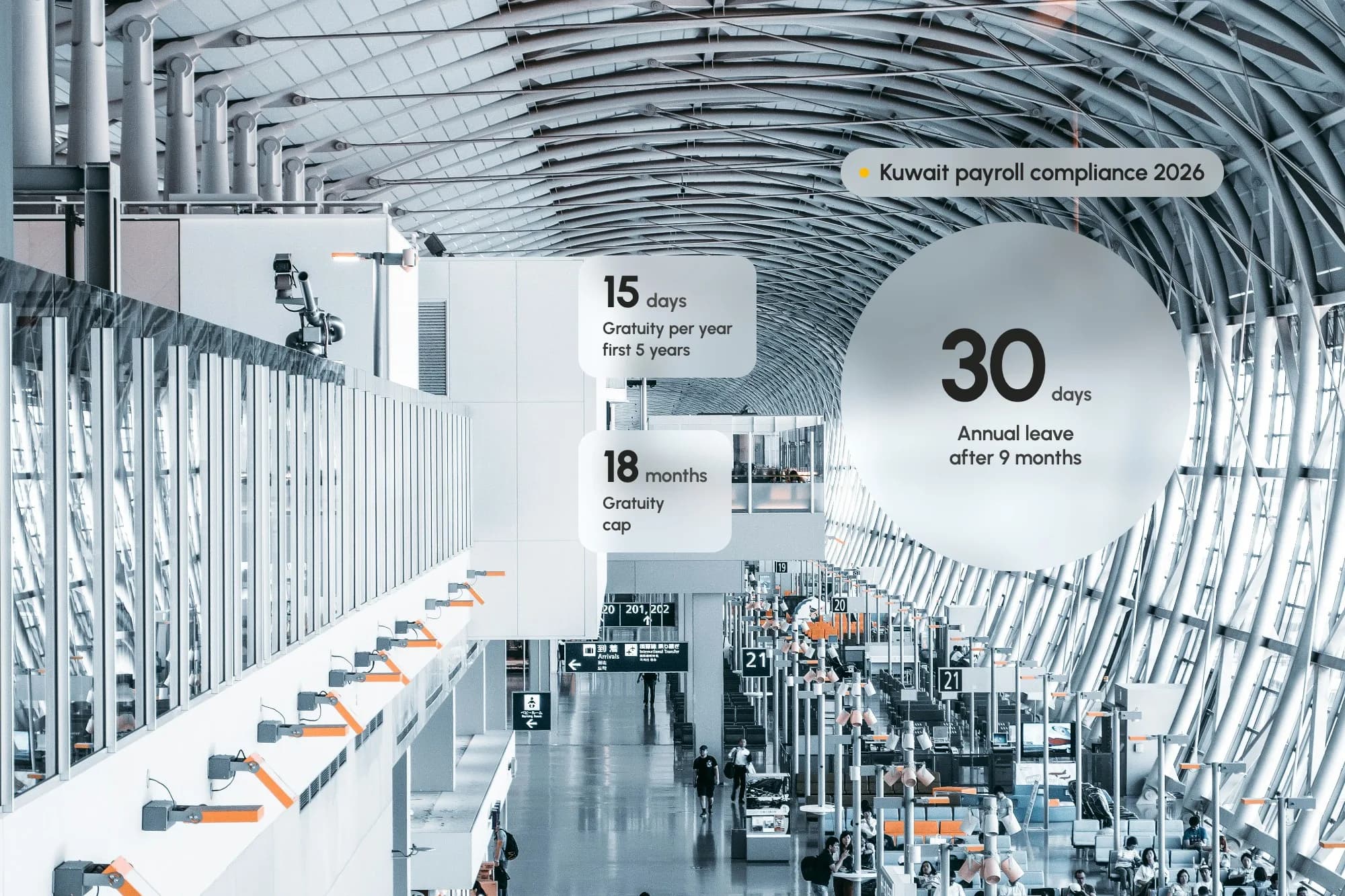
Employees in the Kuwait private sector are entitled to 30 days of annual leave per year, with the entitlement for the first year of employment beginning once the employee has completed at least 9 months of continuous service.
Is Annual Leave Calculated on Calendar Days or Working Days?
What Happens to Unused Annual Leave When an Employee Leaves?
Any employee who leaves the organisation, whether through resignation or termination, is legally entitled to compensation for unused annual leave. This amount must be calculated accurately and included in the final settlement. A correctly configured payroll system will automatically incorporate this into the End-of-Service (EOS) calculation, including the outstanding leave balance as of the employee’s last working day, in line with Kuwait Labour Law.
Can Carry-Forward and Expiry Rules Be Customised?
Yes, and this is where many in-house systems fall short. A properly configured payroll platform should be able to accommodate company-specific carry-forward limits and expiry rules, such as writing off unused leave after a defined period or allowing employees to carry forward a capped number of days (for example, a maximum of 5 days) into the following year. These rules should be configurable without requiring custom development each time a policy changes.
Annual Leave Balance
34 DaysAhmed Al Doseri · Operations Manager
- Applied 16 Days
- Pending 7 Days
- Balance 11 Days
Sick Leave in Kuwait: Entitlement and Pay Scale
Kuwait Labour Law provides employees with up to 75 days of sick leave per year, paid on a sliding scale that decreases as the absence continues
- Full pay · First 15 days
- 75% of pay · Next 10 days
- 50% of pay · Next 10 days
- 25% of pay · Next 10 days
- Unpaid · Final 30 days
Sick Leave (Unpaid) vs Unpaid Leave: What Is the Difference?
How Are Sick Leave Claims Classified and Processed?
When an employee submits a sick leave request, the number of days already taken determines how it is categorised: fully paid, partially paid, or unpaid, in line with the tiered structure above. Employers can also configure whether a medical certificate is mandatory for approval and define approval hierarchies according to their internal policies. Handled manually, this tiered classification is one of the most error-prone aspects of leave management.
Maternity Leave Entitlements Under Kuwait Labour Law
Female employees in Kuwait are entitled to 70 days of fully paid maternity leave, structured as follows:
Pre-delivery: Up to 30 days before the expected delivery date
Post-delivery: 40 days after delivery
Can an Employee Take Additional Leave After Maternity Leave Ends?
Yes. Upon request, an employee may be granted up to 4 months of unpaid extended maternity leave after exhausting her 70-day paid entitlement.
Does Unpaid Maternity Leave Count Toward Service and Gratuity?
Yes. Any period taken as unpaid extended maternity leave is included when determining the employee’s overall period of service and is also counted when calculating gratuity at the end of service.
Are Nursing Breaks Provided After Returning to Work?
Yes. A working woman returning from maternity leave is entitled to a two-hour daily break during working hours to feed her baby.
Can an Employer Terminate an Employee on Maternity Leave?
Maternity Leave Status · Hessa Al Rashidi · Admin Executive
70-day fully paid maternity leave
- Pre-delivery30 days
- Post-delivery40 days
Submitted
Manager Approved
HR Approved
Active - On Leave
Other Leaves
Other Statutory Leave Types Every Employer Must Track
Beyond annual, sick, and maternity leave, Kuwait Labour Law provides for several additional leave categories that employers must configure correctly within their payroll system.

Hajj Leave
An employee who has completed two continuous years with the same employer is entitled to 21 days of fully paid leave to perform Hajj, provided they have not performed Hajj before. This is a once-in-employment entitlement and must be tracked accordingly.
Compassionate Leave
Employers must grant 3 days of special paid leave in the event of the death of a first- or second-degree relative.
Academic / Study Leave
An employer may grant an employee paid academic leave to pursue a higher qualification in their field of work, provided the employee commits to returning and working for the employer for a period equal to the leave taken, up to a maximum of five years.
Iddah Leave
Examination Leave
Employees are also entitled to additional paid leave to sit recognised examinations connected to their studies, subject to supporting documentation.
Each of these entitlements has its own eligibility window, frequency limits, and payroll treatment. These details are easy to overlook in a manual leave register but straightforward to enforce in a correctly configured system.
Common Payroll Mistakes Kuwait Employers Make With Leave Management
Even well-intentioned HR teams fall into recurring traps when managing statutory leave manually:
Miscalculating or misinterpreting leave entitlements
Ignoring the payroll impact of unpaid leave
Incorrect leave salary calculations
Failing to compensate unused leave at exit
Lack of integration between HR records and payroll
Poor documentation and inconsistent approval workflows
Ignoring company-specific policy configuration
Falling out of step with Kuwait Labour Law updates
Mismanaging the classification of sick leave
Having no clear rules for leave carry-forward
Individually, each of these may seem minor. Collectively, they are among the most common findings in payroll audits and the most common sources of disputes at End-of-Service settlement.
How HLB HAMT’s Employee Self Service (ESS) Automates Leave Management
HLB HAMT’s Employee Self Service (ESS) portal is designed to remove manual leave administration from HR and payroll teams entirely, while giving employees a simple, self-service experience.

Online Applications and Configurable Approval Workflows
Employees apply for leave directly through the ESS portal. Approval workflows and hierarchies are predefined according to each company’s internal policies — for example, a request can be routed through a line manager, department manager, and HR manager in sequence, with full visibility of where each application stands at any given moment.
Automatic Payroll Integration
Once a leave request is fully approved, it flows directly into payroll, with any applicable salary deductions calculated automatically. There is no manual re-entry, no spreadsheet reconciliation, and no risk of an approved leave request being missed in the next payroll cycle.
Automated End-of-Service Calculations
The system automatically incorporates outstanding leave balances into End-of-Service calculations, ensuring gratuity and final settlement figures are accurate and aligned with Kuwait Labour Law, without manual intervention.
Configurable Leave Types and Rules
Clients can define an unlimited number of leave types to match their internal policies, with rules configurable at the company, position, or individual employee level. These include carry-forward limits, expiry periods, and custom approval hierarchies for each leave type.
Automated Sick Leave Classification
The ESS automatically classifies sick leave into fully paid, partially paid, and unpaid categories based on the number of days already taken, applying Kuwait’s tiered pay structure without manual calculation. Whether medical certificates are required for approval is also configurable.
Leave Approval Status
Noor Al Zayani · Finance Manager
Submitted
Line Manager
Approved
Dept. Manager
Approved
HR Manager
Pending
Payroll
Awaiting
Seamless Integration with HRMS and ERP Systems via API
For organisations already running an HRMS or ERP platform, HLB HAMT’s ESS connects via API to systems including SAP SuccessFactors, Oracle HCM, HiBOB, and Workday. Employee master data, leave balances, and approved leave transactions sync automatically between systems, eliminating duplicate data entry, keeping HR and payroll records consistently aligned, and giving finance teams a single source of truth across the employee lifecycle.

The Result: Time Saved, 100% Compliance, Error-Free Payroll
For employers, the cumulative effect of this automation is significant:
Time savings
HR teams no longer need to chase paper forms, spreadsheets, or email approvals. Leave processing that once took days can be completed in minutes
100% statutory compliance
Every leave type is calculated according to Kuwait Labour Law, with entitlements, pay tiers, and EOS treatment applied consistently
Error-free payroll
Automatic integration between leave and payroll removes the manual re-entry errors that cause disputed payslips and EOS disputes
Full visibility and audit trail
Every leave application, approval, and payroll adjustment is logged and available for review by HR, finance, and auditors
- Annual leave
- Sick leave
- Maternity leave
3 employees currently on approved leave this month
A monthly team leave calendar showing approved annual, sick, and maternity leave across the workforce at a glance, helping managers plan resourcing around leave commitments.
 Levi’sMr. Shanshan Cong
My experience in working with this team is very much a positive one. Their professionalism is refreshing. Thank you for making the Payroll process a very pleasant experience.
Why HLB HAMT
Why Kuwait Employers Choose HLB HAMT for Payroll Outsourcing
Go live in as little as 10 days
Including statutory leave configuration mapped to your existing policies
No minimum contractual lock-in
Clients stay because the service works, not because they are tied in
Scalable from 1 to 10,000+ employees
The same platform and controls, regardless of headcount
Deep payroll accounting and MIS capability
Integrated with Kuwait’s Wage Protection System (WPS) and PIFSS contribution reporting
25+ years of regional payroll expertise
an in-house team that has configured virtually every leave scenario in the market
Audit-ready, always
clean reports, transparent calculations, and full statutory trails for audits, PAM inspections, and due diligence
Integrated professional services
Payroll aligned seamlessly with HLB HAMT’s tax, audit, and advisory functions
ISO 27001, ISO 9001, and ISAE 3402 (SOC 2) certified
Data security and process integrity verified to international standards
Member of HLB International
Top 8 global advisory and accounting network
Stop Reconciling. Start Controlling.
If leave management in your organisation is still a manual, spreadsheet-driven process, or if your last End-of-Service settlement involved an uncomfortable conversation about unused leave days, it is time to upgrade the system, not the spreadsheet.
Talk to HLB HAMT’s payroll team for a confidential review of your current leave configuration and a live demonstration of our Employee Self Service portal in action. There is no commitment and no minimum contract, just a clear assessment of where your compliance gaps may exist and how a properly configured payroll partner can help close them.

Talk to HLB HAMT’s payroll team for a confidential review of your current leave configuration and a live demonstration of our Employee Self Service portal in action. There is no commitment and no minimum contract — just a clear assessment of where your compliance gaps may exist, and how a properly configured payroll partner closes them for good.
FAQ
Frequently Asked Questions
About the Author

Muhammed Jabir
Assistant Manager · HLB HAMT
Muhammed Jabir is Assistant Manager — Payroll at HLB HAMT, with deep expertise in UAE Labour Law compliance, end-of-service settlement, and payroll system implementation. He works closely with HR and finance leaders across the GCC to design statutory-leave configurations that are audit-ready and built to scale.