

Role-based AML/CFT training in Dubai and the UAE
Role-based AML/CFT training for boards, MLROs, compliance teams and front-line staff, aligned with the UAE 2025 regulatory framework.
- 25+
- years in the UAE
- 4,000+
- clients helped
- 300+
- in-house professionals

AML/CFT training turns written controls into day-to-day behaviour.
HLB HAMT delivers role-based programmes for boards, senior management, MLROs, compliance teams, front-line staff and operations teams across the UAE. Content is aligned with Federal Decree-Law No. (10) of 2025, Cabinet Resolution No. (134) of 2025, the applicable supervisory rulebook and the entity’s own policies.
Why AML training matters
A requirement and a control
Training is a regulatory requirement and a core operating control. Staff must understand the risks relevant to their role, recognise suspicious activity and know how to escalate concerns.
- Understand the risks
- Recognise suspicious activity
- Escalate concerns
The 2025 transition
The 2025 transition increases the need for targeted refresher training. Programmes should address proliferation financing, strengthened targeted financial sanctions requirements, governance changes and any sector-specific obligations that affect the workforce.
- Proliferation financing
- Targeted financial sanctions
- Governance changes
Where training programmes fall short
Staff can't explain the basics
Asked about red flags or who to escalate a concern to, front-line staff have no clear answer.
No proof it happened
Sessions run without a register, materials on file or an assessment of what people understood.
One deck for everyone
A generic presentation sent to all staff, with nothing on your sector or their role.
The board is left out
The people who approve the framework miss the session meant for them.
New joiners start untrained
New staff begin onboarding customers before their induction training.
The programmes below are built to close each of these gaps.
Our AML/CFT training services
Board & senior management briefings
Governance obligations, personal accountability, approval duties under the 2025 Regulations, and key strategic oversight questions.
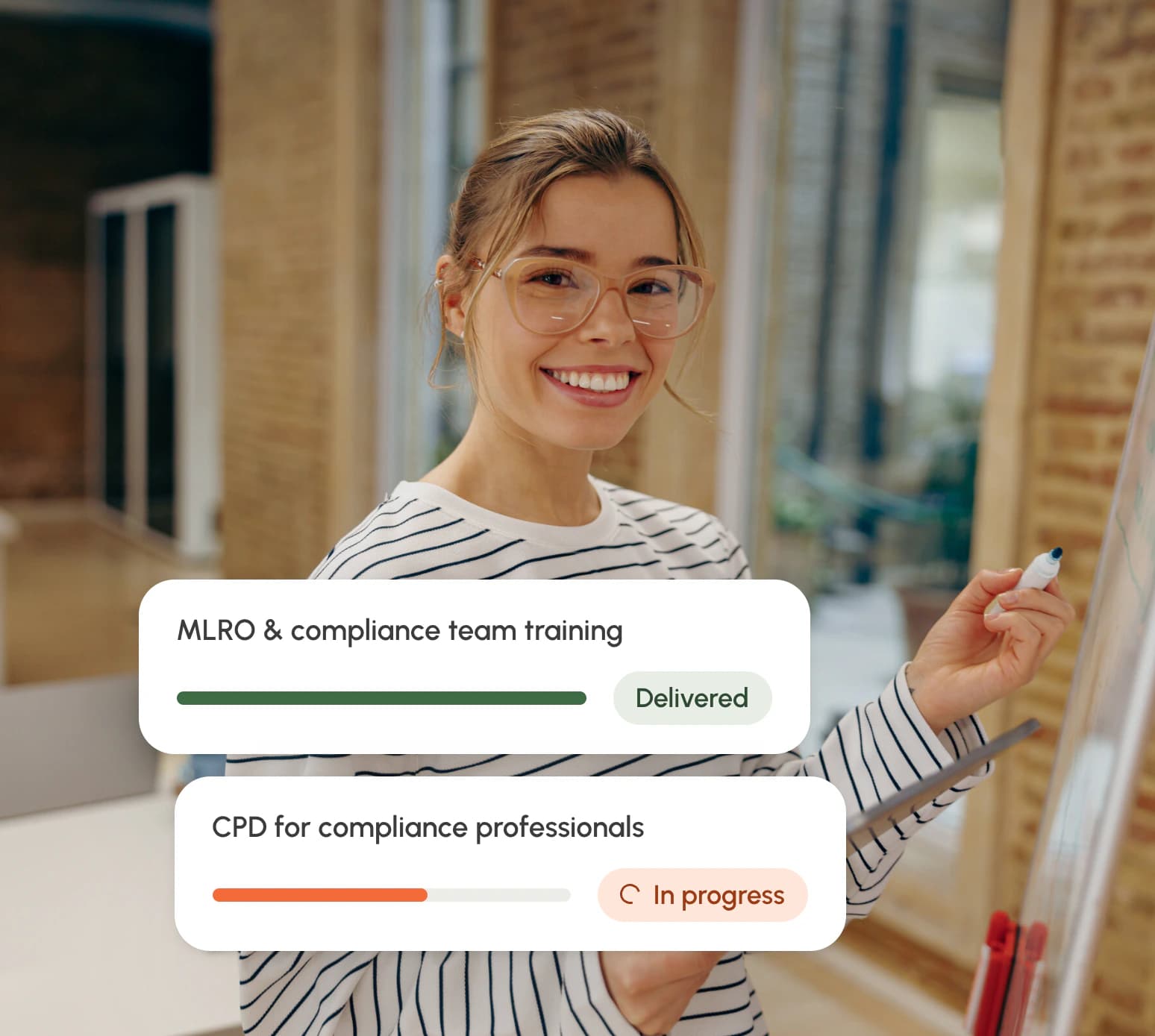
MLRO & compliance team training
Technical deep-dives into the 2025 framework, STR decision-making, goAML, TFS/PF obligations, EWRA methodology and inspection management.
CPD for compliance professionals
Ongoing development covering regulatory updates, emerging risks, and sector-specific typologies for experienced practitioners.

Front-line & operations training
Practical, scenario-based training on identifying red flags, correct escalation paths, tipping-off risks and handling unusual activity.
Induction AML/CFT training
Baseline foundational training for new joiners to ensure compliance awareness before undertaking operational responsibilities.
Sector-specific programmes
Tailored content for banking, insurance, capital markets, virtual assets, real estate, DPMS and professional services using relevant, high-risk typologies rather than relying on generic material.

Legislative update sessions
Focused training on the latest requirements introduced by Federal Decree-Law No. (10) of 2025 and Cabinet Resolution No. (134) of 2025.
Needs analysis & annual plans
Development of role-based training matrices and annual calendars linked directly to your EWRA, job functions and risk exposure.
Roles that are easy to miss
Finance and accounts
On joining, then yearly
Third-party and split payments, unusual refunds and overpayments, cash, and payer details that don't match the customer.
Onboarding and KYC teams
Before handling files alone
Verifying people and companies, finding the beneficial owner, judging whether a document can be relied on and rating the customer.
Screening and monitoring analysts
Before handling alerts alone
Name matching, clearing or escalating a potential match, investigating an alert and recording why it was closed.
HR
On joining, then yearly
Screening staff, assigning training to new joiners and people changing role, and keeping the training records up to date.
IT and system administrators
Before major system changes
Access rights, audit logs, the data feeding screening and monitoring systems, and how a system failure is escalated.
Red flags we teach by sector
Real estate
- Third-party payments
- Cash deals
- Layered buyers
- Cross-border buyers
Precious metals and stones
- Rapid buy-and-sell
- Split payments
- Cash purchases
- Unclear ownership
Company and trust services
- Nominee arrangements
- Layered offshore structures
- Ownership changes
Legal and accounting firms
- Matters in scope
- Client money
- Engagement acceptance
Banks and exchange houses
- Monitoring alerts
- Correspondent exposure
- PEPs at scale
- Report quality
Virtual assets
- Travel-rule data
- Wallet indicators
- Transaction speed
What the training covers
The legal framework
The offences, what the law expects of the business and its people, and the penalties, in plain language.
Your own risks
The risks in your enterprise-wide risk assessment, linked to the national and sector risk assessments.
Customer due diligence
Identifying and verifying customers in practice, and monitoring the relationship over time.
Enhanced due diligence
What triggers closer checks, how to question source of funds and wealth, and who must approve.
Beneficial ownership
Finding who really owns or controls a customer, including through nominees and layered structures.
PEPs and sanctions
Spotting politically exposed persons, screening against sanctions lists and freezing without delay.
Red flags in your sector
Typologies and indicators from your own industry, from property deals to precious metals.
Escalation and reporting
The internal route, the compliance officer's decision, goAML filing and the ban on tipping off.
Record keeping
What staff must capture and keep, and why records must be retrievable when asked for.
When to train, and what to keep
Outside the yearly cycle
Events that call for training
- A change in the law or your supervisor's guidance
- A new product, market or delivery channel
- A new joiner or a move into a higher-risk role
- An audit or inspection finding
- A material update to your risk assessment
Evidence
What an inspector asks to see
- The attendance register, signed or logged
- The agenda and materials delivered
- The date and length of each session
- The trainer and their credentials
- Assessment results, where a test was used
- Completion certificates for each participant
How a programme runs
Needs assessment
We look at your licence, supervisor, risk assessment, organisation chart and any inspection findings, and map which roles need what.
Curriculum
Board briefings, MLRO technical sessions and front-line training are designed separately so each audience receives relevant depth and practical scenarios.
Delivery
Sessions sized for attention. Relevant typologies, enforcement themes and sector examples help participants understand how requirements apply in practice, through exercises, escalation decisions and red-flag discussions.
Assessment
Short knowledge checks for each role support participation and evidence of learning, and warn early where a control is not understood.
Annual plan
A calendar for the year, refreshed when the law, your supervisor's guidance or your business changes.
Benefits of working with HLB HAMT
Regulatory obligation, properly discharged
Training coverage, content and records that satisfy your supervisor's requirements and survive inspection testing.
Practical detection capability
Staff are better able to identify red flags, ask appropriate questions and escalate concerns correctly.
Current workforce knowledge
Ensure your teams are operating on the 2025 framework, not the repealed one.
Reduced personal & corporate exposure
Informed senior management and staff materially reduce the failures that drive enforcement.
Efficient delivery
In-person, virtual or hybrid delivery across the UAE, scheduled around your operations and phased for multiple locations, shifts and audience groups.

Policies and systems establish the framework, while trained employees apply it in practice.
Why choose HLB HAMT for AML/CFT training
Practitioner-led training
Sessions are delivered by specialists who conduct AML/CFT audits, EWRAs, gap assessments and remediation work across UAE sectors.
Current 2025 framework
Content is maintained continuously against the 2025 framework, supervisory guidance and current UAE enforcement actions.
Evidence-based design
Assessment and documentation are designed as inspection evidence, not just completion certificates.
Integrated programme alignment
Training can be based on your own policies, EWRA and escalation procedures so staff learn the controls they are expected to operate.

Meet the experts
Certified anti-money laundering specialists who lead HLB HAMT’s AML/CFT work.


Train your people on the AML/CFT framework in force.
If your workforce was last trained under the previous law, a structured update can address the 2025 requirements and role-specific responsibilities. Contact HLB HAMT to plan a training programme for your board, compliance function and operational teams.
What happens next
- We review your enquiry.
- We discuss your teams, roles and training history.
- We propose a training plan.
FAQ
Frequently asked questions: AML/CFT training in the UAE
Contact HLB HAMT
Talk to us about AML/CFT training.
Tell us who needs training and when they were last trained. Our team will get back to you within one business day.
Talk to a team that understands the detail.
For new business enquiries, service questions or an introduction to our specialists, reach us directly or use the form.


Monday-Friday · 7:30 AM-5:30 PM GST

Explore More HLB Business Services
Looking for support beyond AML/CFT compliance? Explore other HLB HAMT services that may match your business requirements.
 Need AML/CFT policies that fit your business?Policies and procedures written for your risks and regulator.AML/CFT Policies & Procedures
 Need to assess your money-laundering exposure?Your business-wide ML/TF risk assessed and documented.Enterprise-Wide Risk Assessment (EWRA)
- Due for an independent AML/CFT review?Your AML/CFT programme independently tested.AML/CFT Independent Audit
- Need a qualified MLRO?An experienced MLRO for your business, on an outsourced basis.Outsourced MLRO Services
HLB HAMT Insights
Stay Ahead with Our Insights
Subscribe to HLB HAMT Insights, a monthly look at the critical issues shaping global business.