

Key takeaways
- What Bahrain End of Service (EOS) Gratuity is and who qualifies for it
- How to calculate gratuity accurately based on service period and salary
- Why monthly gratuity accruals and financial reporting are important.
- Key compliance requirements under Bahrain Labour Law
- Common employer mistakes related to Bahrain gratuity and how to avoid them
- Best practices for managing gratuity through payroll systems
- How professional payroll partners like HLB HAMT support accuracy, compliance and audit readiness
25+
Years of GCC Payroll Expertise
100%
Statutory Compliance Rate
10 Days
Average Go-Live Time
10,000+
Employees Supported
Bahrain Gratuity Rules at a Glance
Bahrain End-of-Service Gratuity — 2026 Rules
Area
2026 Rule
- Who is covered
- Mainly non-Bahraini / expatriate employees who are not covered under Bahrain's standard social insurance pension scheme.
- Bahraini and GCC nationals
- Generally covered through social insurance contributions rather than direct employer-paid gratuity.
- Service before March 1, 2024
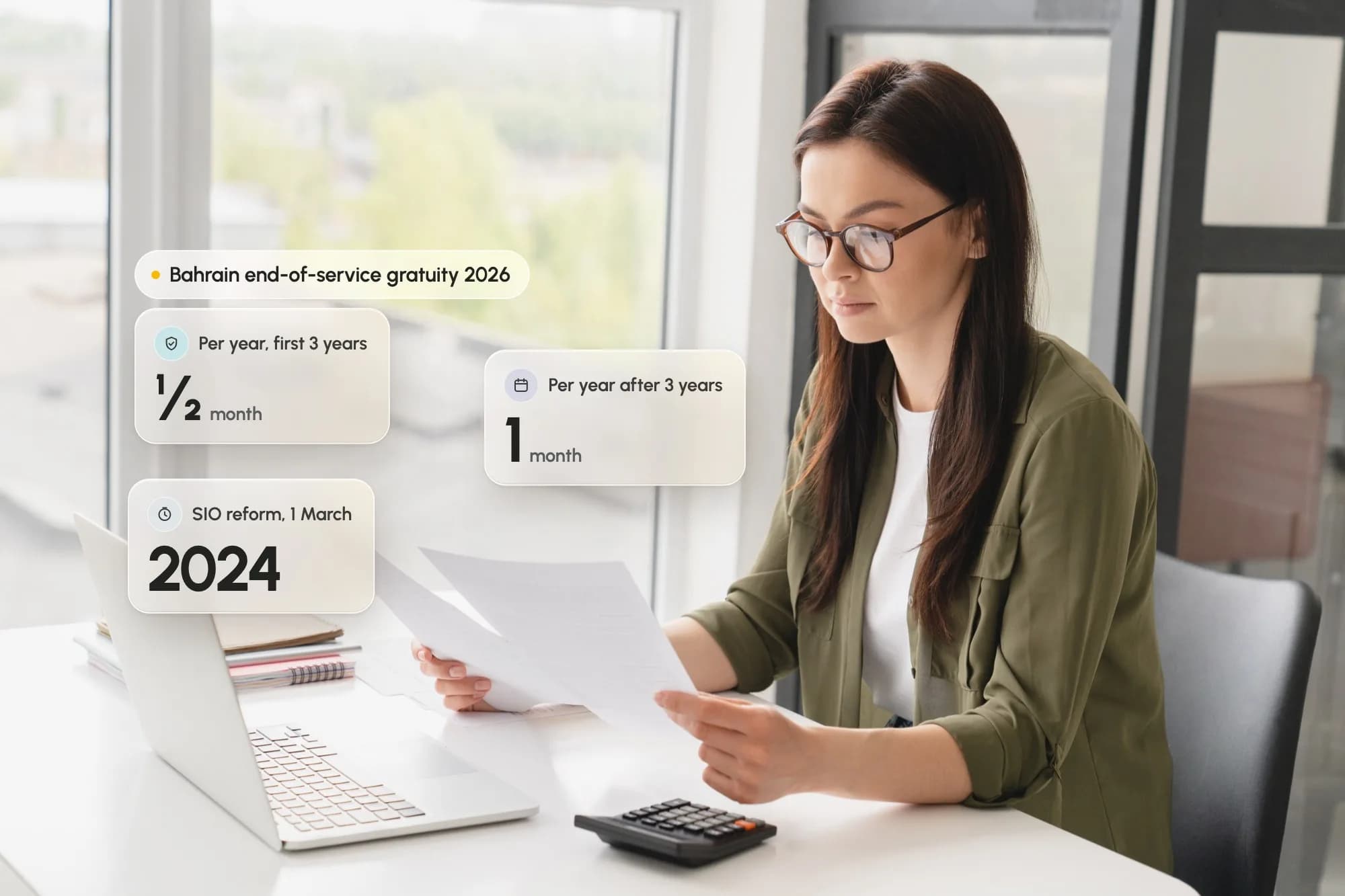
- The employer remains directly responsible for gratuity accrued up to February 29, 2024.
- Service from March 1, 2024 onwards
- Employers must make monthly end-of-service contributions through Bahrain's Social Insurance Organisation (SIO).
- Who pays the employee after March 1, 2024
- The employee claims the post-reform benefit through SIO at the end of service.
- Accrual rate: first 3 years
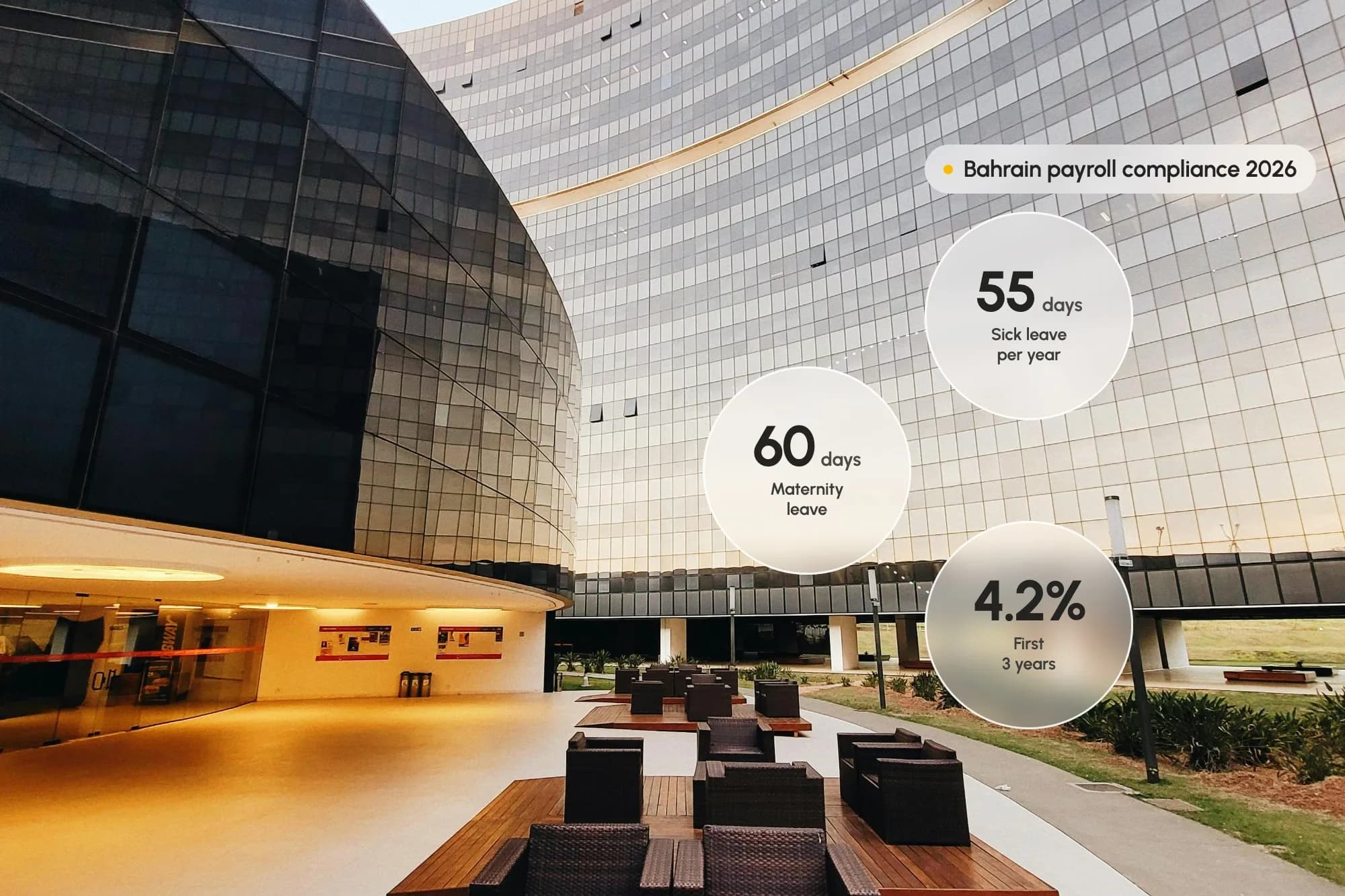
- Half a month's wage per year of service, commonly reflected as a 4.2% monthly contribution.
- Accrual rate: after 3 years
- One month's wage per year of service, commonly reflected as an 8.4% monthly contribution.
- Calculation basis
- Generally based on the employee's last basic wage, plus social allowance where applicable. Employers should confirm the applicable wage basis for SIO reporting.
- Unpaid leave
- Unpaid leave is deducted from the service period used for gratuity calculation.
- Employer compliance action
- Track pre- and post-March 2024 liabilities separately, submit and update employee wage data with SIO, pay monthly contributions and maintain audit-ready payroll records.
Gratuity Accural Summary
Employee Count
New Joinees (YTD)
Resignations (YTD)
Average Service (Years)
Total Accured Liability
BHD 7,468.58
As of 30 Apr 2026
Why Bahrain End-of-Service Gratuity Demands Your Attention
Gratuity is not a discretionary benefit in Bahrain. It is a statutory obligation. Under Bahrain Labour Law, employers must calculate, accrue and settle end-of-service (EOS) gratuity correctly for eligible employees. Errors can lead to financial misstatements in company accounts, failed audits and potential tribunal exposure. Despite its importance, gratuity remains one of the most error-prone areas of payroll across the GCC. Incorrect salary bases, missed unpaid leave adjustments, delayed SIO contributions and a lack of monthly accruals are among the common compliance failures we encounter at HLB HAMT. These issues are avoidable with the right processes and controls.

This guide explains how Bahrain end-of-service gratuity works, who is eligible, how it is calculated and how HLB HAMT's Nova VU payroll platform automates the process to help organisations remain compliant, audit-ready and protected from unnecessary liabilities.
What Is Bahrain End-of-Service Gratuity
What Is Bahrain End of Service Gratuity?
End of Service (EOS) gratuity in Bahrain is a statutory lump-sum benefit payable to eligible employees upon the termination or completion of their employment contract. It is governed by Bahrain Labour Law and applies specifically to non-Bahraini (expatriate) employees who are not covered under the Bahrain Social Insurance Organisation (SIO) pension scheme.
Who Is Eligible?
Gratuity entitlement applies to:
All expatriate employees who are not enrolled in the Bahrain SIO pension system
Bahraini nationals and GCC nationals enrolled in their respective social insurance schemes are covered through the SIO contribution system rather than receiving direct employer-paid gratuity.
The March 2024 SIO Reform: What Has Changed
From March 1, 2024, Bahrain introduced a significant structural reform to the funding of end-of-service benefits for expatriate employees. Under this reform
Service up to February 28, 2024:
Gratuity remains the employer's direct liability and is calculated and settled as a lump sum when the employee exits.
Service from March 1, 2024 onwards:
Employers are required to make monthly SIO contributions towards the end-of-service entitlement. When employment ends, the employee claims the benefit directly from SIO rather than receiving it from the employer.
This dual-period treatment requires payroll systems to track and account for two distinct gratuity liabilities simultaneously. HLB Payroll System is designed to manage this process automatically.
Bahrain SIO Gratuity Reform
Dual-Period Treatment for Expatriate Employees
Employer-Paid EOS Model
End of Service Benefits paid by Employer
Reform effective Date
1 March 2024
SIO-Contribution Model
Gratuity managed through SIO (Social Insurance Organization)
How Is Bahrain End-of-Service Gratuity Calculated?
Gratuity is calculated based on the employee's last drawn basic salary, with different accrual rates depending on the length of service
Year 1 – Year 3
Year 4 onwards
Service Period
Year 1 – Year 3
- Accrual Rate
- ½ month's basic salary per year
- Example (BHD 800 Basic)
- BHD 400 per year
- Monthly Accrual
- BHD 33.33 / month
Service Period
Year 4 onwards
- Accrual Rate
- 1 full month's basic salary per year
- Example (BHD 800 Basic)
- BHD 800 per year
- Monthly Accrual
- BHD 66.67 / month
Example Calculation
Worked Example — Employee with 5 Years of Service
Basic Salary: BHD 800/month | Service Period: 5 years
- First 3 years → 3 × (BHD 800 × 0.5) = BHD1,200BHD
- Next 2 years → 2 × BHD 8001,600BHD
- Total Gratuity Payable: BHD2,800BHD
HLB Payroll System performs this calculation automatically for every employee during each payroll cycle. It applies the correct stepped rate, deducts unpaid leave and updates the accrued liability in real time. No spreadsheets or manual calculations are required. No manual errors.
Success Stories That Speak for Themselves

Levi’s
Mr. Shanshan Cong

My experience in working with this team is very much a positive one. Their professionalism is refreshing. Thank you for making the Payroll process a very pleasant experience.
Gratuity Accrual Policy
Why Monthly Gratuity Accrual Is Non-Negotiable
Many companies make the mistake of treating gratuity as a one-time settlement calculated only when an employee leaves. This approach creates serious financial risks

Balance sheet misstatements :
The liability is not recognised until it becomes payable.
Cash flow surprises:
Large, unbudgeted gratuity settlements can affect liquidity
Audit failures :
The absence of monthly accrual records can raise concerns during audits.
Compliance exposure:
Regulators and auditors expect appropriate accrual records to be maintained.
The best practice, followed by HLB HAMT, is to accrue gratuity every month as the liability builds, record the corresponding accounting entry and maintain a complete audit trail from the employee's joining date to their exit date.
Common Mistakes
Common Gratuity Mistakes Employers Must Avoid
These are some of the errors we frequently encounter when onboarding new payroll clients in Bahrain
Using gross salary instead of basic salary as the calculation base
Failing to deduct unpaid leave from the total service period
Not accruing gratuity monthly and treating it only as a lump-sum payment at exit.
Applying a single flat accrual rate across all service periods instead of the stepped structure
Missing the recalculation trigger when an employee receives a salary revision
Omitting SIO contributions for post-March 2024 service periods
Failing to maintain audit-ready documentation and journal vouchers
Bahrain Payroll Processing & Outsourcing
How HLB Payroll System and Nova VU Support Bahrain Gratuity Processing
Automated Allocation and Accrual
HLB Payroll System classifies employees based on nationality and applicable benefit schemes. It then calculates monthly gratuity accruals using key payroll data such as hire date, basic salary, service period and unpaid leave. The system generates gratuity accrual reports and accounting-ready summaries, which are then sent to Nova VU for review and validation
Salary Change Validation
When an employee's basic salary changes, HLB Payroll System automatically recalculates the gratuity liability and updates the reports. Nova VU reviews these changes and identifies unusual variances or potential under-accruals and over-accruals for further review.
EOS Calculation Sheets and Final Settlement
When an employee leaves, HLB Payroll System generates detailed EOS calculation sheets covering gratuity, leave encashment, final salary and other settlement components. Nova VU validates the calculations and highlights anomalies before HR and finance approve the final settlement.
Technology-Driven Payroll Validation
Nova VU's advanced Rules Engine reviews payroll and gratuity reports to detect anomalies, inconsistencies and compliance exceptions. This validation layer helps employers improve payroll accuracy, strengthen compliance and maintain an audit-ready payroll process with less manual review.
Gratuity Automation Pipeline
- 01
Employee Onboarding
- 02
Nationality Classification
- 03
Monthly Accrual Calculation
- 04
SIO/Direct Provision Routing
- 05
Journal Voucher Generation
- 06
Report Output
- 07
EOS Settlement
Nationality-Based Routing — Automatic
HLB Payroll System automatically classifies each employee based on nationality and routes them to the appropriate statutory benefit treatment
Daniel López
Nationality: Spain · End of Service Gratuity
- Hire Date
- 12 Mar 2021
- Basic Salary
- BHD 1,850
- Years of Service
- 4.1 years
- Gratuity Accured
- BHD 5,720
Saeed Mansoori
Nationality: Bahrain · SIO Contribution
- Hire Date
- 01 Jun 2020
- Basic Salary
- BHD 2,250
- Scheme
- SIO
- Monthly Contribution
- BHD 585
Amelia Watson
Nationality : American · End of Service Gratuity
- Hire Date
- 15 Aug 2019
- Basic Salary
- BHD 3,200
- Years of Service
- 4.2 years
- Gratuity Accured
- BHD 9,850
This automatic classification helps ensure that employees are not assigned incorrect benefit categories, contributions are not missed and gratuity calculations are handled correctly from the start of employment through final settlement.
HRMS & ERP Integration: Seamless, Real-Time and API-Powered
Nova VU connects to your existing HR and enterprise systems through secure, documented APIs. This eliminates duplicate data entry and helps keep payroll and HR records synchronised.
- SAP SuccessFactors
- API Integration
- Oracle HCM
- API Integration
- Workday
- API Integration
- HiBOB
- API Integration
Integration Capabilities Include:
HRMS and ERP integration.
Gratuity Reports Delivered by HLB HAMT
Transparency and audit readiness are built into every HLB HAMT payroll engagement. For Bahrain end-of-service gratuity, your finance and HR teams receive the following reports

Report
What It Covers
Frequency
- Monthly Gratuity Accrual Report
- Opening balance, monthly accrual, payments and closing balance.
- Every payroll cycle
- Year-to-Date (YTD) Gratuity Summary
- Cumulative accrual and payment records for audit purposes.
- Quarterly / Annual
- EOS Calculation Sheet
- Detailed breakdown upon termination, pro-rated to the day.
- On exit
- SIO Contribution Statement
- Monthly SIO remittance for expatriate employees (post-March 2024).
- Monthly
- Accounting Journal Vouchers (JV)
- Debit and credit entries for gratuity accrual and settlement.
- Monthly
- Audit-Ready MIS Package
- Complete statutory records for inspections and due diligence.
- On request
All reports are delivered in your preferred format, including Excel, PDF or directly through API integration with your ERP. They are aligned with your accounting system's chart of accounts, whether you use SAP, Oracle, SuccessFactors or another platform.
HLB HAMT Advantages
Why Businesses in Bahrain Choose HLB HAMT for Payroll Outsourcing
Choosing a payroll partner is not just a technology decision. It is also a compliance and risk management decision. HLB HAMT combines regulatory knowledge, enterprise-grade technology and proven service delivery to support organisations operating in Bahrain.
Go Live in 10 Days
Fast onboarding without long-term contractual lock-in. Stay because the service works, not because you are tied in.
Scales with You
From 1 to 10,000+ employees, Nova VU scales with your organisation without operational disruption or manual re-engineering.
ISO 27001 | ISO 9001 | ISAE 3402
A certified security and quality framework designed to protect your data and support high operational standards.
HLB International Network
Member of a top-8 global advisory network, bringing global best practices together with strong local GCC expertise.
Audit-Ready, Always
Clean reports, accurate calculations and complete statutory records for audits, inspections and investor due diligence.
25+ Years Local Expertise
Deep understanding of Bahrain Labour Law, GCC payroll regulations and regional business practices.
Speak with an HLB HAMT payroll specialist today. We can go live in as little as 10 days.
FAQ
Frequently Asked Questions: About Bahrain End-of-Service Gratuity 2026
About the Author

Muhammed Jabir
Assistant Manager · HLB HAMT
Muhammed Jabir is Assistant Manager — Payroll at HLB HAMT, with deep expertise in UAE Labour Law compliance, end-of-service settlement, and payroll system implementation. He works closely with HR and finance leaders across the GCC to design statutory-leave configurations that are audit-ready and built to scale.