

Key takeaways
- What statutory leave entitlements are available under Bahrain Labour Law
- The different types of leave and employee eligibility criteria
- How to calculate leave salary and accruals correctly
- Key compliance requirements for leave tracking and payroll integration
- Common mistakes employers make and how to avoid them
- Best practices for managing leave within payroll systems
- How HLB HAMT Employee Self-Service streamlines leave management
- How HLB HAMT acts as a payroll partner to support accurate, compliant leave management
Managing statutory leave in Bahrain is not simply an HR administrative task. It is a legal obligation with direct payroll and financial consequences. Employers who miscalculate annual leave accruals, misclassify sick leave tiers or fail to include unused leave in end-of-service settlements risk regulatory penalties, employee disputes and audit failures under Bahrain Labour Law.
This guide covers everything you need: a complete breakdown of every statutory leave type in Bahrain in 2026, how to calculate entitlements correctly, the compliance pitfalls that cost employers the most, and how HLB HAMT’s Employee Self-Service (ESS) platform transforms leave management into an automated, audit-ready process that integrates directly with your existing HRMS or ERP.

Types of Statutory Leaves in Bahrain
What Is Statutory Leave in Bahrain?
Statutory leave is legally mandated time off, paid or unpaid, that every private-sector employer in Bahrain must provide under Labour Law No. 36 of 2012 and its amendments. Entitlements vary by leave type, employee nationality, religion, gender and length of service.
For employers, proper leave management is critical across four dimensions:

Legal compliance with Bahrain Labour Law requirements
Payroll accuracy, as
leave directly impacts monthly salary calculations
Employee records, as
leave history is referenced in end-of-service settlements
Employee well-being and retention, as
transparent and fair leave management builds trust
Bahrain Statutory Leave Entitlements at a Glance (2026)
Below is a summary of the statutory leave types applicable to private-sector employees in the Kingdom of Bahrain. Each leave type has specific eligibility criteria, duration and payment rules, all of which must be accurately reflected in your payroll system.
Bahrain Statutory Leave Entitlements
Leave Type · Entitlement · Pay Status · Eligibility
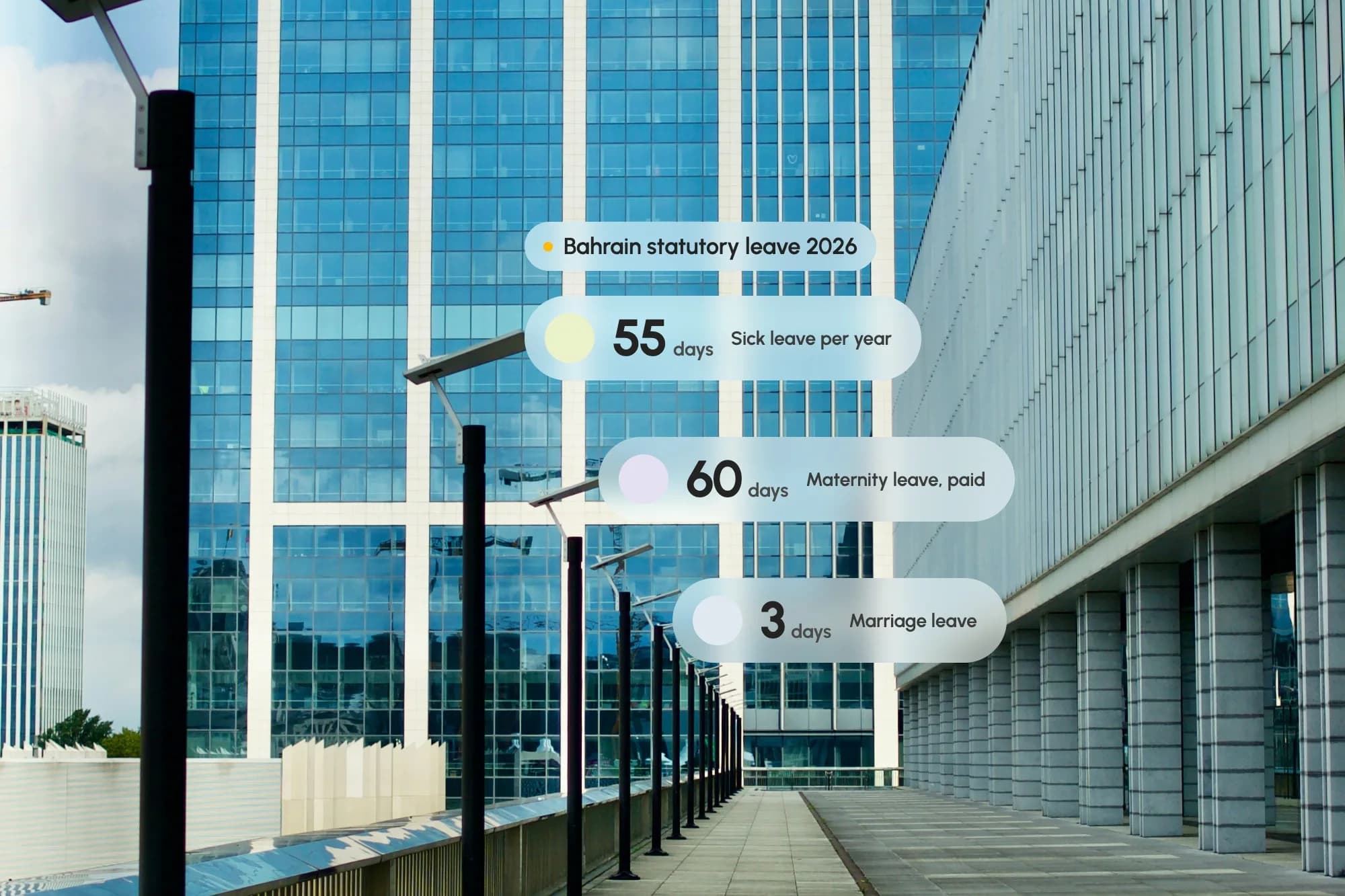
- Annual Leave30 calendar days/yearFully paid · After 1 year of continuous service
- Sick Leave55 days/year (tiered)Full / Half / Unpaid · After 3 continuous months of service, subject to required medical certification
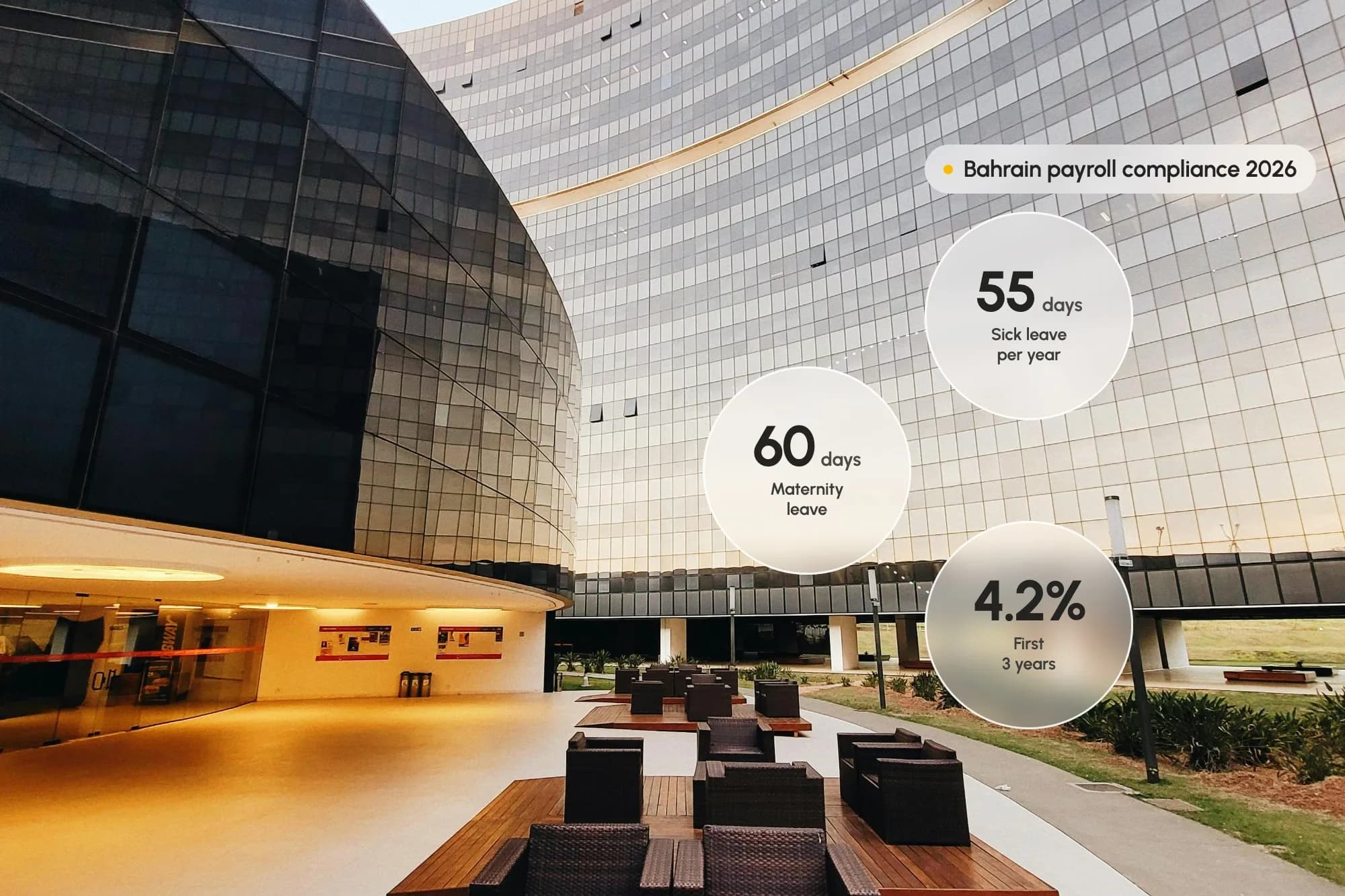
- Maternity Leave60 days + up to 15 unpaid daysFully paid (core 60 days) · Female employees
- Paternity Leave1 dayFully paid · Male employees upon the birth of a child
- Marriage Leave3 daysFully paid · All employees upon marriage
- Hajj Leave14 daysFully paid · Muslim employees; 5+ years of service; must not have performed Hajj before
- Compassionate Leave3 daysFully paid · Death of spouse or relative up to fourth degree, or death of spouse's relative up to second degree
- Iddah Leave30 days (Muslim)Fully paid · Female employees upon husband's death
Annual Leave in Bahrain
Entitlement and Eligibility
Every private-sector employee in Bahrain is entitled to 30 calendar days of fully paid annual leave per year after completing one year of continuous service with the same employer. Annual leave is calculated in calendar days, not working days. This means weekends and public holidays that fall within the leave period are counted as part of the 30-day entitlement.
Carry-Forward and Leave Expiry Rules
Unused annual leave may be carried forward to the following year. HLB HAMT’s payroll and ESS solution can configure company-specific leave policies where permitted, while preserving statutory minimum entitlements and legal restrictions. For example, a company may allow a maximum of five days to be carried forward into the next year, with any remaining balance written off after a defined period. These rules must be clearly documented in the employment contract or internal HR policy and applied consistently.
Compensation for Unused Leave at End of Service
Upon resignation or termination, employees are legally entitled to receive payment for all accrued but unused annual leave, calculated using the applicable statutory wage basis. HLB HAMT’s system automatically includes outstanding leave balances in the End-of-Service (EOS) settlement calculation, eliminating the need for manual tracking.
Total Entitlement
Your annual leave entitlement for the leave year
Carry Forward
Leave days carried forward from previous year
Leave Applied
Leave days already applied (approved)
Pending Approval
Leave days pending manager approval
Balance Remaining
11DAYS
Your available annual leave balance
Sick Leave in Bahrain: The Three-Tier Structure
Employees who have completed three continuous months of service are entitled to statutory sick leave, provided the illness is supported by the required medical certificate. Sick leave in Bahrain operates on a tiered payment model over a maximum of 55 days per year
Sick Leave Pay Structure
Pay · Days · Notes
- Full pay 15 Days · Days 1 – 15 · Salary at 100%
- Half pay 20 Days · Days 16 – 35 · Salary at 50%
- No pay 20 Days · Days 36 – 55 · Unpaid, but counts towards the service period and EOS gratuity
Sick Leave Unpaid vs. General Unpaid Leave: A Critical Distinction
General unpaid leave, by contrast, may be excluded from service period calculations depending on the applicable rules and employer policy.
Medical Documentation and Approval Configuration
HLB HAMT’s ESS platform allows employers to configure whether medical documentation is mandatory for sick leave requests and define multi-level approval workflows based on each company’s internal hierarchy. The system automatically categorises approved sick leave into the correct pay tier, fully paid, half-paid or unpaid, based on the total number of days utilised during the year. No manual calculation is required.

Maternity Leave in Bahrain
Core Entitlement: 60 Days Fully Paid
Female employees in Bahrain are entitled to 60 calendar days of fully paid maternity leave. This is a statutory minimum, and employers cannot offer less. The entitlement can be extended as follows:
Up to 15 additional days of unpaid leave (upon request)
Combination with accrued annual leave, should the employee choose to extend her absence
Nursing Breaks Post-Delivery
After returning from maternity leave, a female employee is entitled to paid nursing-care periods during working hours. The statutory entitlement varies according to the child's age: two periods of at least one hour each until the child reaches six months and two 30-minute periods from six months to one year. The periods may be combined, subject to the applicable statutory provisions.
Termination Protection During Maternity Leave
Unpaid Maternity Leave and Service Period
Any period taken as unpaid maternity leave is included in the calculation of the employee’s total service period and counts towards end-of-service gratuity, consistent with the treatment of unpaid sick leave days.
Maternity Leave Application
Leave Duration · 60 DaysTrack status of your Maternity Leave Application · Appled Date 12 Jun 2026
- Full Pay Period 60 days · 01 Aug 2026 – 01 Oct 2026
- Start Date · 01 Aug 2026
- End Date · 01 Oct 2026
Approval Workflow
Line Manager
Step 01
HR Manager
Step 02
Bahrain Payroll
Step 03
Other Leave
Other Statutory Leave Types in Bahrain
Paternity Leave
Male employees are entitled to one day of fully paid paternity leave upon the birth of a child. While one day may appear modest, this is a statutory entitlement and must be recorded and processed correctly through payroll.
Marriage Leave
All employees are entitled to three days of fully paid leave upon marriage. This is granted once and must be supported by appropriate documentation.
Compassionate Leave
In the event of the death of an employee’s spouse or a relative up to the fourth degree, the employee is entitled to three days of fully paid leave. The same three-day entitlement applies in the event of the death of the employee’s spouse's relative up to the second degree.
Hajj Leave
Muslim employees who have not previously performed Hajj and have completed at least five consecutive years of service with the same employer are entitled to fully paid Hajj leave:
14
working days
This leave is granted only once during an employee’s tenure with the organisation. Employers may determine the number of employees granted Hajj leave each year based on operational requirements.
Iddah Leave
A Muslim female worker has the right to one month of leave on full pay if her husband dies. She is also entitled to complete the Eddah period using her annual leave for three months and ten days. If she does not have an annual leave balance, she is entitled to leave without pay.
HLB HAMT’s payroll system automatically applies the appropriate Iddah duration based on the employee’s religion as recorded in the system, supporting accurate payroll processing without manual configuration for each case.
Bahrain Payroll Processing & Compliance
Simplify Your Bahrain Payroll and Compliance
Common Mistakes Employers Make in Managing Bahrain Leave
The following errors are among the most frequently identified during payroll audits and EOS settlements for Bahrain-based businesses. Each represents both a compliance risk and a potential financial liability:
Treating Annual Leave as Working Days
Annual leave must be calculated in calendar days under Bahrain Labour Law. Using working days results in an incorrect calculation of employee entitlements.
Misclassifying Sick Leave Tiers
Applying full pay for all sick leave days or failing to switch to half pay on Day 16 creates payroll inaccuracies in both directions
Excluding Unused Leave from EOS Settlements
Outstanding leave balances are a statutory payment obligation at the end of service. Omitting them creates immediate legal exposure.
Undocumented Carry-Forward Rules
Inconsistently applied or undocumented leave carry-forward policies leave employers vulnerable to retrospective claims.
Disconnected HR and Payroll Systems
When leave is tracked in one system and payroll is processed in another without integration, errors accumulate with every cycle.
Weak or Informal Approval Workflows
Leave approved verbally or through WhatsApp, with no system audit trail, can create disputes at the end of service or during Ministry inspections.
Failing to Differentiate Bahraini vs. Non-Bahraini Entitlements:
Hajj leave duration differs based on the applicable eligibility rules. Applying a single rule without considering those differences can create both under-entitlement and over-entitlement scenarios.
Ignoring Labour Law Amendments
Bahrain Labour Law is updated periodically. Leave policies must be reviewed and reconfigured whenever legislative changes take effect.
Success Stories from Our Valued Clients

Levi’s
Mr. Shanshan Cong

My experience in working with this team is very much a positive one. Their professionalism is refreshing. Thank you for making the Payroll process a very pleasant experience.
Leave Management
How HLB HAMT's Employee Self-Service Platform Automates Leave Management
HLB HAMT’s Employee Self-Service (ESS) solution is purpose-built to eliminate the manual complexity that makes leave management a compliance burden. From the initial leave application through to payroll processing and EOS settlement, every step of the leave lifecycle is automated, configurable and audit-ready.

Self-Service Leave Applications: No Paperwork, No Email Chains
Employees submit leave requests directly through the ESS portal from any device, at any time. Each leave type is pre-configured with the relevant Bahrain statutory entitlement rules, so employees can see exactly how many days they have available before applying. There is no paperwork, no email routing and no risk of requests being lost or left unacknowledged.
Configurable Multi-Level Approval Workflows
No two organisations share identical approval hierarchies. HLB HAMT’s ESS allows each client to define its own multi-tier approval chain, for example: Line Manager → Department Manager → HR Manager. Approvers receive real-time system notifications and can approve, reject or escalate requests directly from the portal, creating a complete, timestamped audit trail for every leave decision.
Automatic Payroll Integration — Zero Manual Intervention
Once a leave request is fully approved through the workflow, the ESS system automatically passes the data to payroll. This means:
Sick leave tiers are correctly calculated (full pay, half pay and unpaid) without manual re-entry
EOS settlements automatically include the employee's outstanding leave balance as at the last working day
Monthly payroll runs reflect accurate leave deductions, with no retrospective corrections or reconciliation cycles
Payroll deductions for unpaid leave are applied automatically, eliminating manual payroll journal entries
Configurable Leave Rules by Company, Position or Employee
HLB HAMT’s system allows unlimited leave types to be created and configured at the company, department, position or individual employee level. Carry-forward limits, leave expiry rules, medical documentation requirements and department-specific approval hierarchies can all be managed within a single, centralised system.
Real-Time Leave Tracking, Reporting and Team Calendar Visibility
HR managers and authorised personnel have complete, real-time visibility into leave balances, utilisation trends and team availability. The system’s team calendar view allows workforce planners to manage resourcing across departments, eliminating the "How many days do I have left?" queries that consume HR bandwidth and enabling data-driven leave planning.
Leave Approval Workflow
Line Manager
Step 01 · Approved
Department Manager
Step 02 · Approved
HR Manager
Step 03 · Pending
Integration with Global HRMS and ERP Systems via API
One of the most significant operational challenges for growing businesses is data fragmentation, where leave data lives in one system and payroll processing happens in another. The result is duplicate data entry, reconciliation delays and compliance gaps that compound with every payroll cycle.
HLB HAMT addresses this through robust, bi-directional API integration with leading HRMS and ERP platforms:
These integrations create a single source of truth across HR and payroll. When an employee’s leave policy changes in SuccessFactors, it is reflected in payroll without manual intervention. When a new employee is onboarded in Workday, their leave entitlements are automatically provisioned in HLB HAMT’s system. The outcome: less reconciliation, fewer errors and greater confidence that the information in the HRMS matches what payroll processes.
HLB HAMT Advantages
Why Leading Employers in Bahrain Choose HLB HAMT
HLB HAMT is not a generic payroll processor. We are a specialist payroll outsourcing and advisory firm with over 25 years of GCC experience, ISO-certified processes and an in-house team that has configured the leave scenarios faced by businesses in the Bahrain market. Here is what that means in practice:
Rapid implementation:
Go live in as little as 10 days, including full statutory leave configuration mapped to your existing HR policies
No minimum lock-in:
Clients stay because the service performs, not because contractual obligations force them to
Scalable from 1 to 10,000+ employees:
same platform and controls support organisations of different sizes, regardless of headcount
25+ years of GCC payroll expertise:
In-house specialists with experience across the leave configurations encountered in the Bahrain market.
Audit-ready always:
Clean reports and complete statutory audit trails for regulatory inspections and due diligence
ISO 27001, ISO 9001, and ISAE 3402 (SOC 2) certified:
Data security and process integrity verified against international standards
Member of HLB International:
A top-eight global advisory network, bringing global best practices to every GCC payroll engagement
Integrated professional services
Payroll aligned seamlessly with tax, audit and advisory services, giving you one trusted partner with a broad range of capabilities.
Talk to HLB HAMT’s payroll team today for a confidential review of your leave configuration and a live demonstration of the Employee Self-Service portal. No commitment. No minimum contract. Just a clear assessment of potential compliance gaps and a proven platform to help address them.
FAQ
Frequently Asked Questions – Bahrain Statutory Leave 2026
- Annual leave tracked correctly
- Sick leave tiers configured
- Maternity leave entitlement mapped
- Hajj leave eligibility validated
- Leave balances accrued monthly
- Leave encashment included in EOS settlement
- Payroll integration active
- Approval workflows documented
About the Author

Muhammed Jabir
Assistant Manager · HLB HAMT
Muhammed Jabir is Assistant Manager — Payroll at HLB HAMT, with deep expertise in UAE Labour Law compliance, end-of-service settlement, and payroll system implementation. He works closely with HR and finance leaders across the GCC to design statutory-leave configurations that are audit-ready and built to scale.