

Key takeaways
- SIO contribution rates for Bahraini nationals and expatriates, including the 2024 EOSB fund reform
- Full statutory leave entitlements and overtime rules under Bahrain Labour Law
- How Nova VU automates the entire Bahrain payroll cycle
- Why leading organisations trust HLB HAMT as their Bahrain payroll partner
- WPS requirements and how to maintain LMRA compliance
- End of Service Benefit calculation and what changed from 1 March 2024
- API integrations with SAP SuccessFactors, Oracle HCM, HiBOB and Workday
Introduction: Why the Bahrain Payroll Process Demands Precision
Managing payroll in Bahrain is not simply a back-office routine; it is an important compliance responsibility. Between mandatory SIO contributions, the LMRA-governed Wage Protection System, the reformed End of Service Benefit (EOSB) framework, and statutory leave entitlements under Bahrain Labour Law No. 36 of 2012, payroll errors can result in regulatory penalties, employee disputes, and reputational risks.
For CFOs, HR Directors, and business owners operating in Bahrain, the question is no longer whether to manage payroll accurately, but whether to handle it in-house or through a specialist partner with the right technology and regulatory expertise.

This guide answers the key questions about the Bahrain payroll process and explains how HLB HAMT's Nova VU payroll automation platform supports compliance, reduces manual errors, and delivers an integrated end-to-end payroll experience through existing HRMS or ERP systems.
Bahrain · Last Updated: June 10 2026 | 10:24 AM
SIO Contributions
WPS Compliance
Leave Balance
Net Salary
SIO Contributions, What Every Employer in Bahrain Must Know
The Social Insurance Organisation (SIO) is Bahrain's statutory social insurance body, responsible for managing pension, occupational injury, and unemployment insurance for eligible employees. SIO compliance is an essential part of the Bahrain payroll process for private-sector employers.
SIO Contribution Rates (2026)
Bahraini National
Expatriate (Insurance)
Expatriate EOSB Fund
Category
Bahraini National
- Employer
- 18%
- Employee
- 8%
- Total
- 26%
- Remarks
- Full pension + occupational + unemployment
Category
Expatriate (Insurance)
- Employer
- 3%
- Employee
- 1%
- Total
- 4%
- Remarks
- Occupational hazard & unemployment only
Category
Expatriate EOSB Fund
- Employer
- 4.2% / 8.4%
- Employee
- —
- Total
- 4.2% / 8.4%
- Remarks
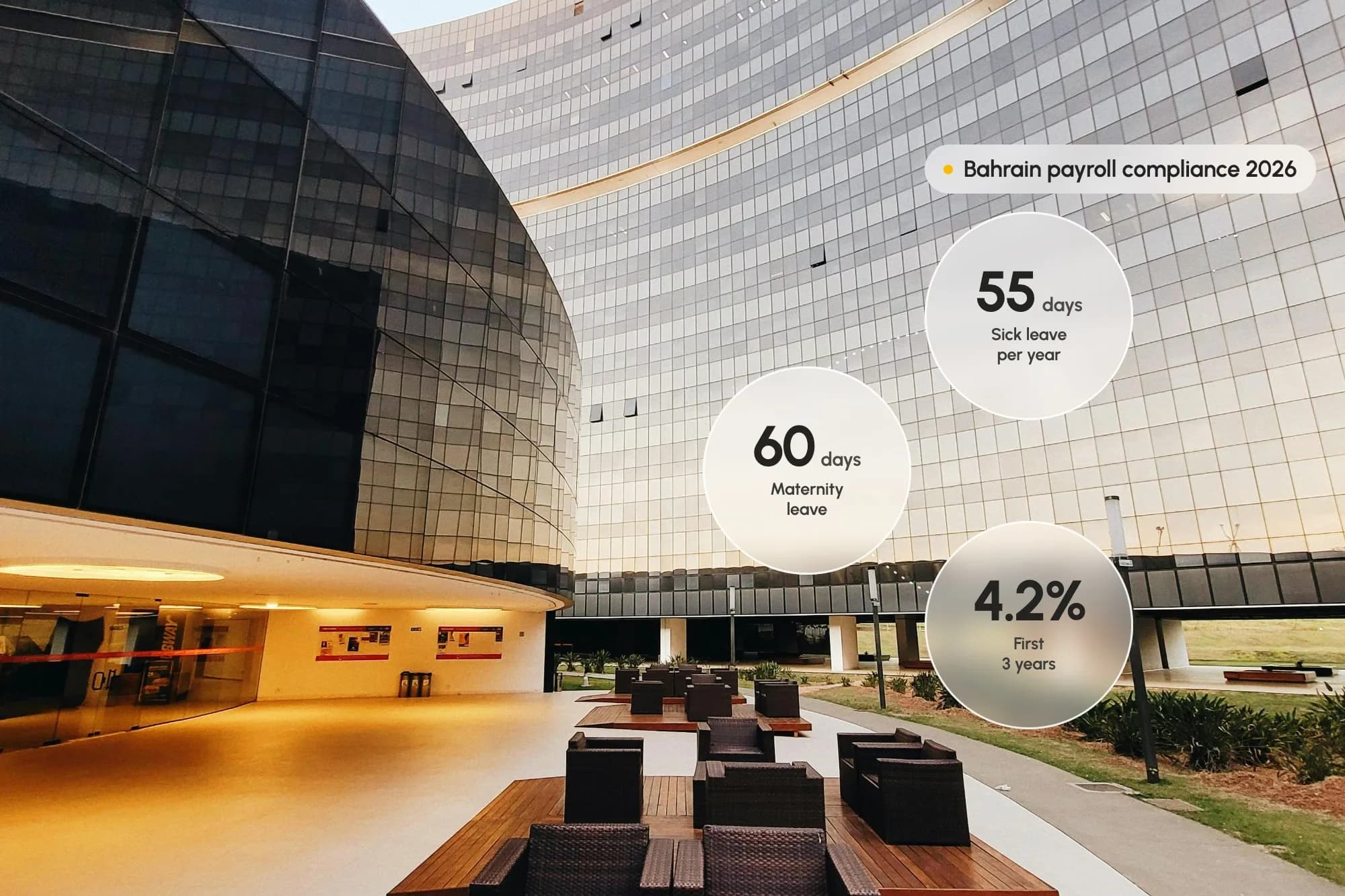
- 4.2% for the first 3 years; 8.4% thereafter (from 01 March 2024)
The SIO-Based EOSB Fund Reform (Effective 1 March 2024)
Before March 2024, expatriate employees received their End of Service Gratuity as a direct lump-sum payment from the employer upon termination. This changed under Bahrain's 2024 reform.
From 1 March 2024, employers must make monthly contributions to the SIO on behalf of eligible expatriate employees. These contributions fund end-of-service entitlements through the SIO system, replacing the previous employer-funded lump-sum model for service periods covered by the new system. Service accrued before 1 March 2024 retains the previous gratuity treatment, while service from 1 March 2024 onwards falls under the new funded model.
Fatima Al Khalifa · Head of HR
Bahrain Wage Protection System (WPS) – Compliance and Automated Processing
Bahrain's Wage Protection System (WPS) is a regulatory framework overseen by the Labour Market Regulatory Authority (LMRA) to support the accurate and timely payment of employee wages. Employers must maintain accurate employee and salary information, complete applicable WPS requirements, and process wages electronically through approved banks and financial institutions in accordance with LMRA and Central Bank of Bahrain requirements.
Bahrain’s enhanced Wage Protection System strengthens electronic wage-payment and monitoring requirements for private-sector employers. Employers should maintain accurate employee and wage information and follow the LMRA procedures applicable to their establishment and financial institution.
✓ HLB HAMT WPS Automation
HLB HAMT's payroll team manages the full WPS compliance lifecycle, including monthly file generation, WRP appointment support, LMRA portal uploads, and exception management. These processes are supported by Nova VU's automated WPS file engine, helping clients maintain accurate and timely payroll submissions. Clients achieve 100% WPS compliance with zero internal effort.

Bahrain
Payroll File Upload Status
LMRA submission
Total Employees
Compliance Health
100%
Date : 30 June 2026
Department
No. Employees
Status
- Administration
- 23
- Completed
- Operations
- 144
- Completed
- Sales
- 127
- Processing
- Internal IT
- 18
- Completed
Success Stories from Our Valued Clients

Levi’s
Mr. Shanshan Cong

My experience in working with this team is very much a positive one. Their professionalism is refreshing. Thank you for making the Payroll process a very pleasant experience.
Statutory Leave Entitlements Under Bahrain Labour Law
Bahrain Labour Law No. 36 of 2012 establishes statutory leave entitlements for eligible private-sector employees. Correctly applying and tracking these entitlements is an important part of every payroll cycle, particularly because leave directly affects payslip calculations, deductions, and accruals.
Employee Leave Entitlements
Leave Type · Entitlement · Pay Status · Eligibility
- Annual Leave30 calendar days/yearFully paid · After 1 year of continuous service
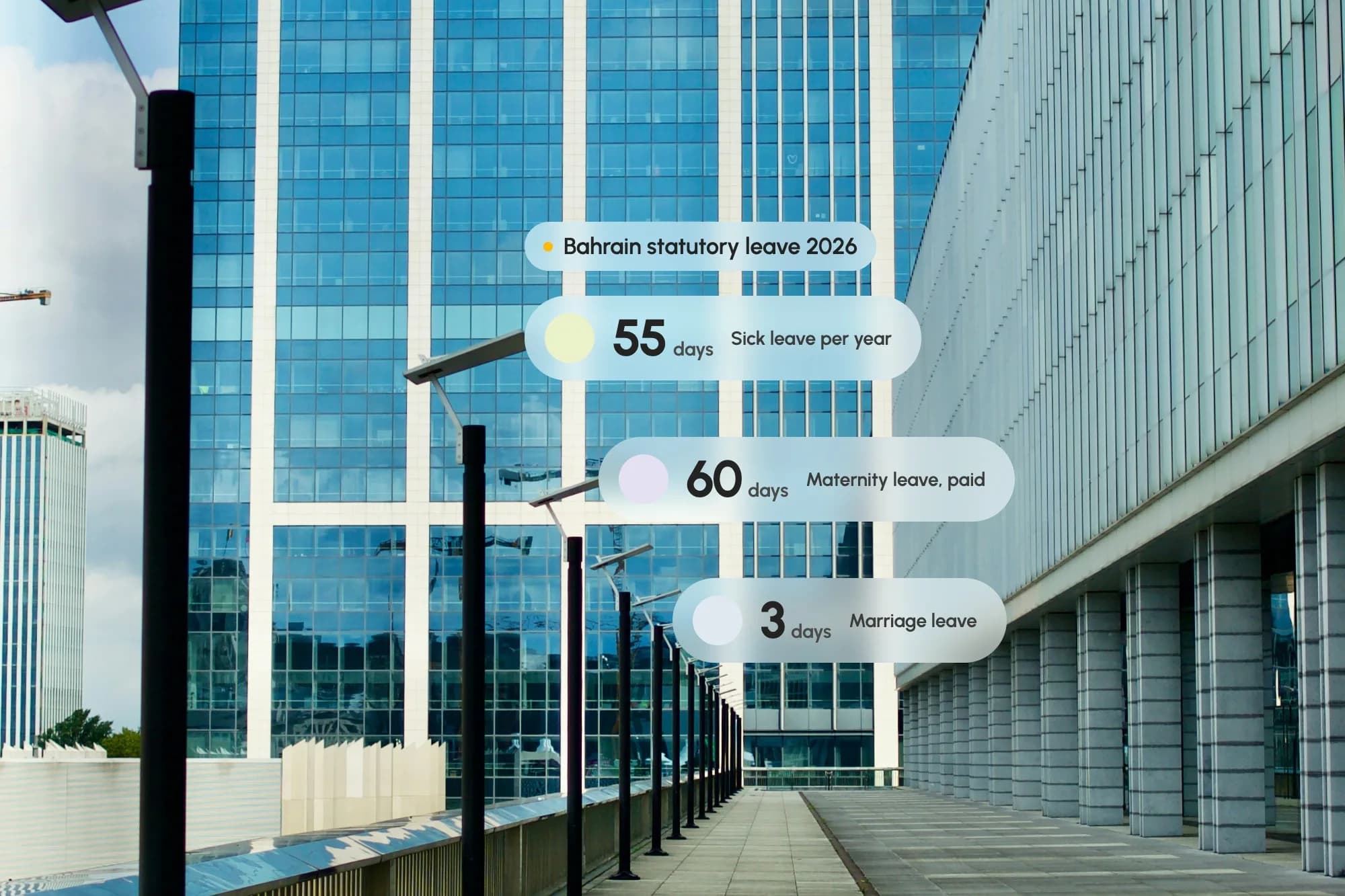
- Sick Leave55 days/year (tiered)Full / Half / Unpaid · All employees
- Maternity Leave60 days + up to 15 unpaidFully paid (core 60 days) · Female employees
- Paternity Leave1 dayFully paid · Male employees on birth of child
- Marriage Leave3 daysFully paid · All employees upon marriage
- Hajj Leave14 daysFully paid · Muslim employees; 5+ years of service; first-time Hajj
- Compassionate Leave3 daysFully paid · Death of spouse or relative up to fourth degree, death of spouse's relative up to second degree
- Iddah Leave30 (Muslim)Eligible Muslim female employees upon husband's death
Sick Leave: Understanding the Tiered Pay Structure
Sick leave in Bahrain operates on a tiered structure of up to 55 days per year, subject to the applicable statutory requirements and medical certification. Nova VU applies these tier thresholds automatically in each payroll run, eliminating manual calculation and compliance risk.
- Days 1–15: Fully paid 15 days
- Days 16–35: Half pay 20 days
- Days 36–55: Unpaid 20 days
✓ ESS Portal for Leave Management
HLB HAMT's Employee Self-Service (ESS) portal allows employees to apply for leave online through predefined approval workflows. Once approved, leave information is automatically integrated into payroll, triggering the appropriate deductions or zero-pay flags based on leave type and entitlement balances. Managers and HR teams also receive real-time visibility into leave status and balances across the organisation.

Overtime in Bahrain, Calculation Rules and Automated Processing
Under Bahrain Labour Law No. 36 of 2012, employees are entitled to overtime compensation for hours worked beyond the standard working hours. Overtime is calculated using the employee's applicable wage basis, and the compensation rate depends on when the overtime occurs.
Bahrain Overtime Rates
Rate
When It Applies
- 125% of normal hourly wage
- When It Applies Overtime worked during regular daytime working hours
- 150% of normal hourly wage
- When It Applies Overtime worked during night hours Work performed on weekly rest days and public holidays is subject to separate statutory compensation provisions.
Overtime calculations are based on the applicable statutory wage calculation rules. HLB HAMT's payroll system supports standard and customised overtime calculation logic, including calculations that incorporate fixed allowances where company policy requires.
✓ Automated Overtime via ESS
Employees submit overtime requests directly through the HLB HAMT ESS portal. Approved hours are automatically transferred to the payroll engine, which applies the appropriate rate multiplier, generates detailed overtime reports by department, and presents overtime as a clearly labelled line item on employee payslips.
This reduces manual data entry and improves payroll accuracy.
Salary Structure, Pay Cycle, and Statutory Deductions in Bahrain
Salary Payment Cycle and Currency
Salaries in Bahrain are typically paid monthly or bi-weekly, depending on the employment contract. Salary payments are generally processed in Bahraini Dinar (BHD) through approved payment channels in accordance with applicable requirements. Nova VU supports multi-frequency payroll runs and automatically generates LMRA-compliant payment files in the required format.
Nova VU supports multiple payroll frequencies and generates the required payment files, helping businesses manage salary processing accurately and efficiently.
Salary Components — Fixed and Variable
Bahrain Labour Law does not prescribe a universal list of mandatory salary components beyond the applicable wage requirements. In practice, salary structures typically consist of:
Fixed Components:
Basic salary, housing allowance, transport allowance, and other defined allowances
Variable Components:
Overtime, sales commissions, performance bonuses, incentives, relocation allowances, and mobile allowances
HLB HAMT's payroll system supports an unlimited number of fixed and variable pay codes. New pay codes can be added during the contract, allowing flexibility as business requirements evolve.
Statutory Deductions and Tax Position
Bahrain does not levy personal income tax on employee salaries, so personal income tax deductions do not apply. The primary statutory deduction is SIO contributions, applicable to Bahraini and GCC nationals. Pension contributions are the only mandatory deductions from gross pay for qualifying employees.
The primary statutory payroll contributions include applicable SIO contributions for eligible Bahraini and GCC national employees, along with the relevant insurance and EOSB contributions for eligible expatriate employees.
Employers must calculate and account for the applicable contributions based on employee eligibility and the relevant statutory rules.
End of Service Benefits in Bahrain, Entitlements and Calculations
End of Service (EOS) benefits in Bahrain represent one of the most important payroll compliance obligations for employers, particularly following the dual-model framework introduced under the March 2024 reform.
Gratuity Accrual Rates (Expatriate Employees)
First three years of service
Half a month's basic salary, plus social allowance where applicable, excluding other allowances and benefits, for each completed year of service.
From the fourth year onwards
One full month's basic salary, plus social allowance where applicable, excluding other allowances and benefits, for each completed year of service.
For service up to 28 February 2024, gratuity remains a direct employer liability and is payable as a lump sum upon termination. For service from 1 March 2024 onwards, the monthly SIO EOSB fund contributions covered in the SIO section fund the entitlement through the SIO system.
Bahrain EOS & Payroll
EOS Settlement Components
A full end-of-service settlement in Bahrain typically includes:
End of Service Gratuity calculated in line with Bahrain Labour Law
Repatriation air ticket (where applicable under the employment contract or company policy)
Notice-period salary, or payment in lieu of notice
Payment for all eligible unused annual leave days
Outstanding earnings, allowances, or applicable recoveries
Unpaid salary accrued up to the last working day
Payroll Accounting and MIS Reporting in Bahrain
Payroll accounting is the process of accurately recording and reporting employee compensation transactions in an organisation's financial statements. This includes salaries, overtime, allowances, deductions, employer contributions, accruals, and SIO obligations.
For businesses in Bahrain, accurate payroll accounting is important for financial transparency, audit readiness, cost control, and compliance with the Kingdom's evolving regulatory requirements. It also supports management reporting, budgeting, and intercompany cost allocation.
HLB HAMT Payroll Accounting Capabilities
Fully automated General Ledger (GL) posting, reducing the need for manual journal entries.
Dynamic GL mapping aligned with organisational structures, including automatic reconfiguration for employee transfers or restructuring
Cost allocation across multiple departments, projects, or cost centres
Support for multiple GL codes per single pay component
Classification of payroll costs as direct or indirect — in line with audit and management reporting requirements
Monthly accrual accounting for EOS gratuity, annual leave, air ticket provisions, and bonus or incentive accruals
Enhanced compliance reporting, audit-ready payroll trails, and management dashboards
✓ Seamless ERP Integration
Nova VU integrates directly with Oracle ERP, SAP, and other accounting platforms, enabling automated GL postings immediately after payroll approval without manual data re-entry. Every journal entry is traceable, audit-ready, and aligned with the organisation's cost centre structure.

How Nova VU Automation
How Nova VU Automates the Entire Bahrain Payroll Process
Nova VU is HLB HAMT's proprietary, in-house-built payroll automation platform, engineered specifically for GCC payroll complexity. It is not a generic off-the-shelf payroll tool. Nova VU is built, maintained, and continuously enhanced by HLB HAMT's payroll technology team, giving clients a platform that evolves alongside GCC regulatory requirements.
Nova VU HRMS and ERP Integration Capabilities
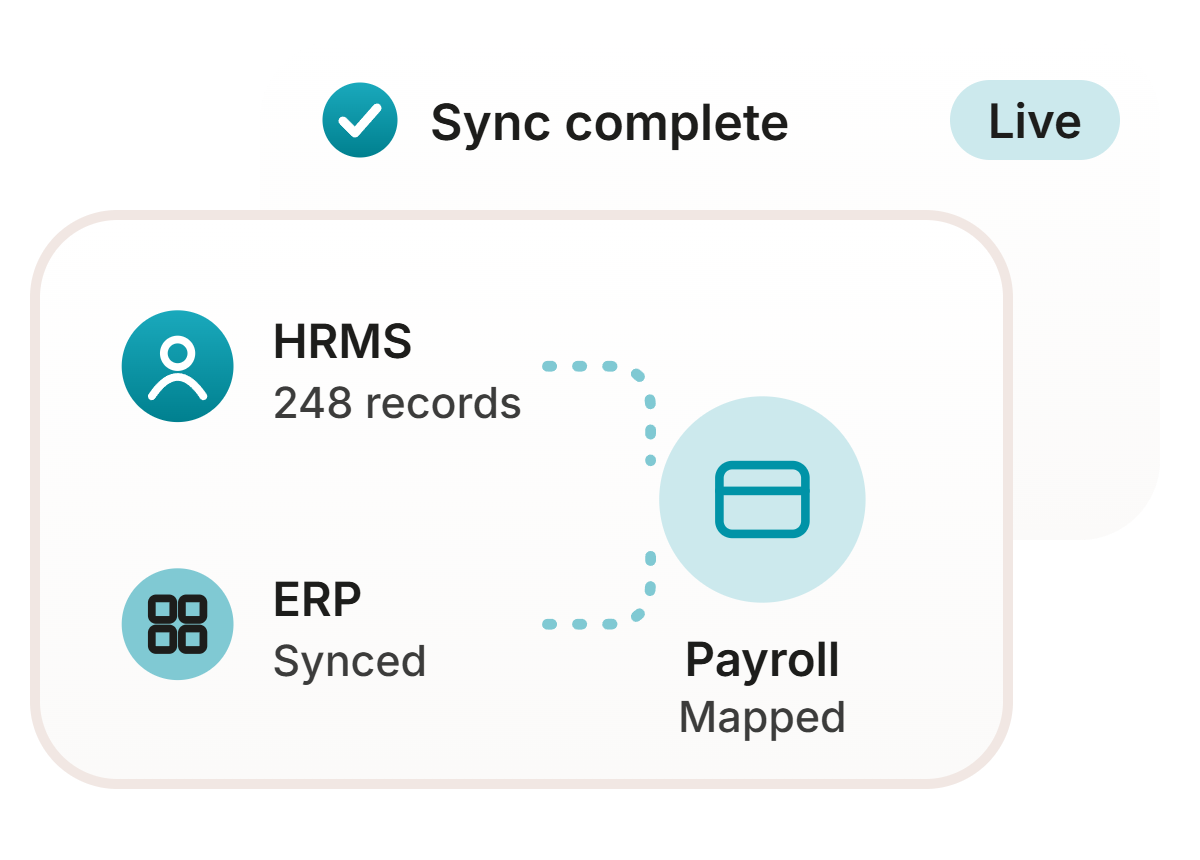
Nova VU connects directly with the HRMS and ERP systems organisations already use through secure API integrations. This eliminates duplicate data entry, reduces manual errors, and creates a seamless flow of information between HR, finance, and payroll.
Why Choose HLB HAMT for Bahrain Payroll Outsourcing?
HLB HAMT brings together 25+ years of GCC payroll expertise, proprietary technology through Nova VU, and integrated advisory capabilities to support organisations with their payroll requirements.
Go Live in 10 Days
SME payrolls can be activated in as little as 10 days without operational disruption.
No Minimum Commitment
Stay because the service works, not because you are tied into a contract.
Scales 1 → 10,000+
The same platform supports a single employee or an enterprise with more than 10,000 employees.
HRMS integration
Connects with Oracle, SAP SuccessFactors, and in-house systems end-to-end
Audit-ready always
Clean reports, clear calculations, and complete statutory trails when required.
ISO 27001 · SOC 2
Information security and quality management standards supporting secure payroll operations.
Stop managing Bahrain payroll compliance manually. Let Nova VU handle SIO, WPS, leave, overtime, EOS, and GL posting automatically, accurately, and on time. Join organisations across the GCC that trust HLB HAMT as their payroll outsourcing partner.
FAQ
Frequently Asked Questions
- Payroll Register
- Payroll Reconciliation Report
- Headcount Reconciliation Report
- Bank Payment File and Payment Summary
- SIO Contribution Report
- Gratuity Accrual Report
- Leave Liability Report
- Overtime Report
- General Ledger (GL) Journal Entries
- Year-to-Date (YTD) Payroll Summary
- Cost Centre Allocation Report
- Payroll Submission and Approval Confirmations
In addition, HLB HAMT also provides additional audit and management reports, including Gratuity Yearly Summary, Annual Payroll Summary, Salary Increment Summary, Joiner and Leaver Reports, Payroll Variance Reports, and Statutory Compliance Reports.
- Register eligible employees with SIO
- Process salaries through Bahrain WPS
- Remit applicable SIO contributions on time
- Track statutory leave balances
- Calculate overtime correctly
- Maintain EOSB records
- Reconcile payroll accounting monthly
- Maintain audit-ready payroll documentation
About the Author

Sajin Rasheed
Partner – Payroll & HR · HLB HAMT
Sajin has been associated with HLB HAMT since 2005. He heads the Payroll Outsourcing Division and is responsible for making strategic decisions for the overall Division. He has over 20 years of experience in the field of finance and payroll. His dynamic initiatives at HLB HAMT have been pioneering for the industry. Under his leadership, the division commenced its transformational journey, reaching out to customers across the GCC and MEA region.