


Key takeaways
Essential factors for running compliant payroll in the DIFC in line with DIFC labor regulation
Clear guidance on UAE social security regulations and compliance obligations
Practical guidance DEWS scheme in the DIFC
Overview of statutory leave and employee benefits under DIFC labor regulation
How structured payroll accounting supports better financial control, transparency, and reliable MIS reporting
How HLB HAMT acts as a trusted payroll partner, helping organisations manage UAE payroll processing with confidence, compliance, accuracy, and meaningful reporting
A DIFC company with 30 employees. One payroll cycle. Up to 27 expatriate DEWS contribution rows, three GPSSA entries for UAE nationals and at least three edge cases: a mid-month joiner, a leaver and a probation confirmation. Handled manually, that workload consumes four to six hours of spreadsheet reconciliation, with potential sources of error at every stage. Handled through Nova VU, HLB HAMT’s payroll orchestration software, the same cycle becomes a supervised 30-minute review of pre-validated outputs.
That difference, from a half-day exercise in manual compliance to a half-hour audit of automated results, is what DIFC payroll compliance looks like in 2026 for organisations that have structured it correctly. This guide explains what those compliance obligations are, how HLB HAMT meets them on behalf of clients, and precisely where Nova VU transforms the process from reactive administration into a controlled, scalable and audit-ready function.

Payroll Cycle - June 2026
Cycle Status: Validated
Employee Data Ingestion
DEWS / GPSSA Classification
Contribution Calculation
Bank File Generation
GL Posting
Why DIFC Payroll Compliance Is Different and More Demanding
The Dubai International Financial Centre, established in 2004, is not a standard UAE free zone. It operates as a fully independent financial jurisdiction with its own legal framework, employment law and mandatory benefits schemes. Payroll in the DIFC is not governed by UAE Federal Labour Law in the same way as mainland or standard free zone companies. It has distinct requirements for end-of-service benefits, social security obligations, statutory leave entitlements and financial reporting.
For CFOs and HR directors managing DIFC-registered entities, this means that off-the-shelf payroll knowledge rarely translates cleanly. DIFC payroll compliance requires specific expertise across four interconnected pillars: DEWS administration, GPSSA management for UAE nationals, statutory leave governance, and payroll accounting. Getting any one of these wrong can result in consequences ranging from regulatory penalties to inaccurate financial statements.
DIFC DEWS
DEWS: The End-of-Service Benefits Scheme Unique to DIFC
What Is DEWS and Who Does It Apply To?
The DIFC Employee Workplace Savings (DEWS) plan replaced the traditional end-of-service gratuity model for DIFC-registered employers from 1 February 2020. It is a mandatory defined-contribution scheme that applies to eligible expatriate employees working under DIFC jurisdiction. UAE nationals and GCC nationals are excluded, as they are covered under separate mandatory social security schemes (GPSSA).

DEWS is the default workplace savings scheme for eligible DIFC employees, unless an applicable exemption or approved alternative Qualifying Scheme applies. Employers must verify employee eligibility, complete the required enrolment and meet the applicable contribution deadlines.
- All employees working under DIFC jurisdiction
- Expatriate employees only (non-UAE and non-GCC nationals)
- UAE and GCC nationals excluded, as they are covered under GPSSA instead
How Are DEWS Contributions Calculated?
DEWS contributions are based on the employee’s monthly basic salary and are tiered according to length of service.
5.83%
of monthly basic salary for employees with fewer than 5 years of service
8.33%
of monthly basic salary for employees with 5 or more years of service
These rates must be applied correctly in every cycle. A salary revision, unpaid leave period or service milestone crossing the five-year threshold will change the calculation for that employee. Manual processes leave these adjustments vulnerable to oversight. An automated orchestration layer enforces them as hard rules.
Note: Calculated on monthly basic salary per DEWS regulations.
5.83%
Of Basic Salary
Under 5 Years Service
8.33%
Of Basic Salary
Above 5 Years Service
How Nova VU Automates DEWS Compliance: Seven Stages, Zero Manual Handoffs
Nova VU is HLB HAMT’s proprietary payroll orchestration software. It is not the payroll engine, and it is not an Employee Self-Service (ESS) portal. Those are separate, purpose-built systems. Nova VU is the orchestration layer that connects data inputs, compliance rules, contribution calculations, file generation and financial posting into a single automated, fully audited pipeline.
- 01
Payroll Data Ingestion
Validate completeness, flag anomalies before processing.
- 02
Nationality Classification
Routes expatriates to DEWS and UAE nationals to GPSSA, enforced as a hard rule.
- 03
Contribution Calculation
Applies the 5.83% or 8.33% tier and adjusts for unpaid leave and salary changes.
- 04
DEWS Upload File
Generates a portal-ready file in the exact prescribed format.
- 05
Reconciliation & Validation
Flags discrepancies before submission, not after.
- 06
Audit Trail Capture
Every transaction is timestamped and traceable by employee and cycle.
- 07
GL Posting
Journal entries are posted automatically once contributions are confirmed.
30 min
Supervised Review
A DIFC team of 30 employees — a cycle that previously demanded 4–6 hours of manual spreadsheet reconciliation completes as a supervised 30-minute review of pre-validated outputs via Nova VU.
Social Security Contribution (GPSSA)
GPSSA: Social Security Compliance for UAE Nationals in DIFC
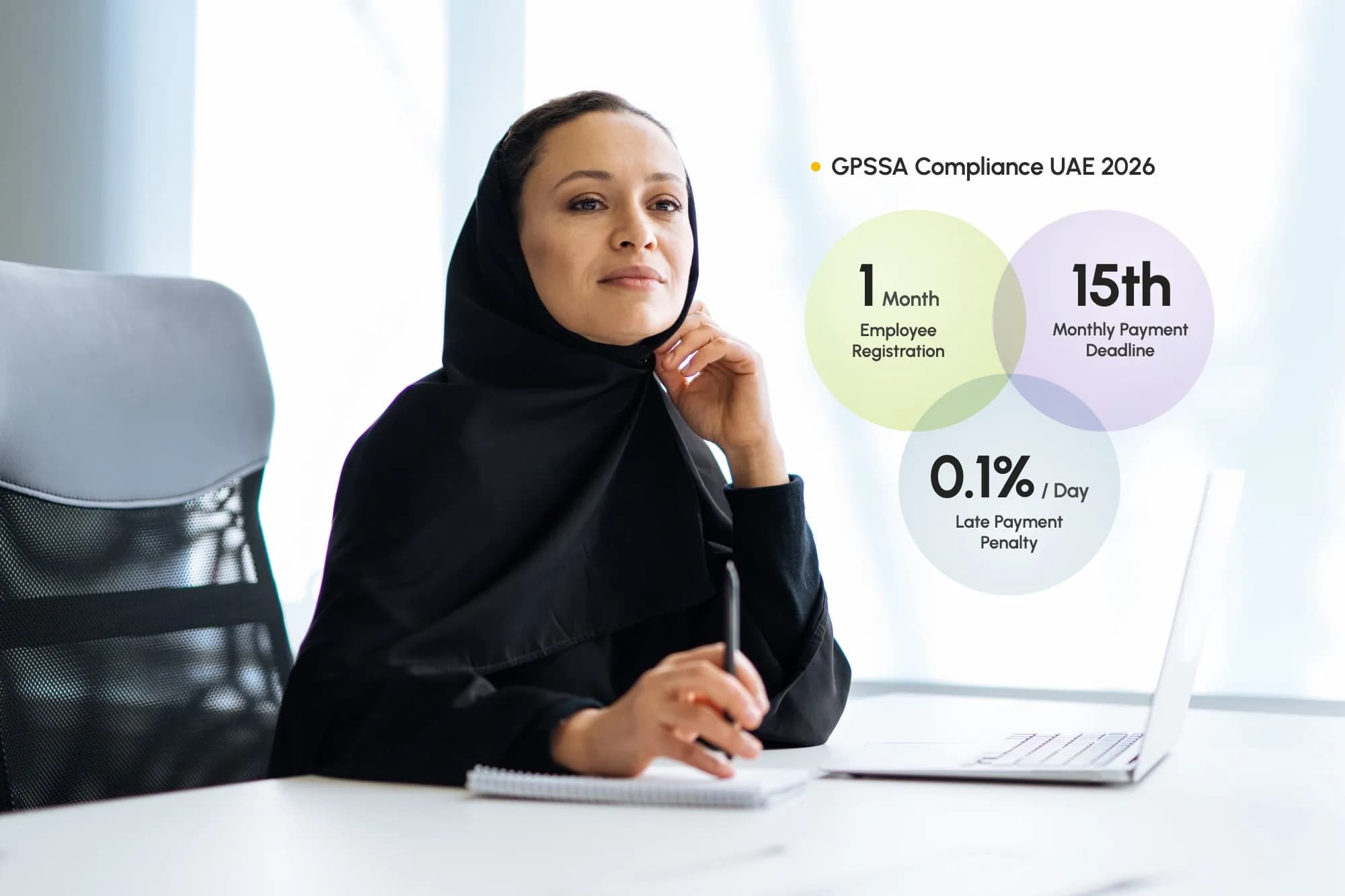
While DEWS covers expatriate employees, UAE nationals employed in the DIFC fall under the General Pension and Social Security Authority (GPSSA). Employers must register UAE national employees with GPSSA within one month of joining and meet monthly contribution obligations without exception. Failure to meet registration and contribution deadlines may result in penalties and ongoing compliance risks.
GPSSA Contribution Rates: Old Law vs. New Law
Attribute
Old Law — Federal Law No. 7 of 1999
New Law — Federal Law No. 57 of 2023
- Employee Contribution
- 5%
- 11%
- Employer Contribution
- 12.5%
- 12.5%–15%
- Government Contribution/Support
- 2.5% of the employer contribution for eligible private-sector Emiratis
- 2.5 percentage points of the employer contribution for eligible private-sector Emiratis with a contribution account salary below AED 20,000
- Total Contribution Rate
- 20%
- 26%
- Maximum Contribution Account Salary
- AED 50,000*
- AED 70,000
- Applicable To
- UAE nationals employed before October 2023
- UAE nationals joining the job market from October 2023
How HLB HAMT Manages GPSSA Compliance for DIFC Clients
HLB HAMT’s payroll team manages all GPSSA obligations end to end as part of its DIFC payroll outsourcing service.

Registration of new UAE national hires with GPSSA within the statutory one-month deadline
Deregistration of leavers from the GPSSA portal
Pro forma invoice validation and monthly contribution calculation
Coordination of timely GPSSA payments to meet regulatory deadlines
Dedicated monthly GPSSA contribution reports for client records
Oliver Bennett
Nationality: German · DIFC DEWS
- Hire Date
- 12 Mar 2021
- Basic Salary
- AED 14,000
- Years of Service
- 4.1 years
- DEWS Amount Contributed
- AED 40,040
Saeed Mansoori
Nationality: Emirati · GPSSA - Social Security
- Hire Date
- 01 Jun 2020
- Basic Salary
- AED 30,000
- Scheme
- Scheme: GPSSA
- GPSSA Contribution
- AED 5250
Amelia Watson
Nationality : American · DIFC DEWS
- Hire Date
- 15 Aug 2019
- Basic Salary
- AED 11,500
- Years of Service
- 6.7 years
- DEWS Amount Contributed
- AED 64,675
Wage Protection System (WPS)
WPS in the DIFC: What Employers Need to Know
 Levi’sMr. Shanshan CongGeneral Manager
My experience in working with this team is very much a positive one. Their professionalism is refreshing. Thank you for making the Payroll process a very pleasant experience.
Statutory Leave Entitlements Under DIFC Employment Regulations
DIFC Employment Law prescribes clear minimum leave entitlements that must be reflected accurately in payroll calculations. Errors in leave administration directly impact payroll accuracy and expose organisations to compliance risks.
TYPE
Annual Leave
Duration 20 working days/year
Pay level Full pay
Key conditions Standard entitlementTYPE
Sick Leave
Duration 10 + 20 + 30 days
Pay level Full / Half / Unpaid
Key conditions First 10 days full pay; next 20 days half pay; maximum 30 days unpaidTYPE
Maternity Leave
Duration 33 + 32 working days
Pay level Full / Half pay
Key conditions First 33 days full pay; next 32 days half payTYPE
Paternity Leave
Duration Up to 5 working days
Pay level Full pay
Key conditions After 12 months of continuous employmentTYPE
Hajj Leave
Duration Up to 21 days
Pay level Unpaid
Key conditions Once per employment; 1 year of service required
HLB HAMT maintains comprehensive leave records for all employees and applies automatic payroll adjustments based on leave type and entitlement in line with DIFC regulations. Where an employee exceeds a paid leave entitlement, the payroll system applies the correct deduction, whether half-pay or unpaid, without manual recalculation.
An Employee Self-Service portal allows employees to apply for leave online, with configurable approval workflows that trigger automatic payroll integration once leave is fully approved.
DIFC Statutory Leave Entitlements Summary
- Full paid
- Half paid
- Unpaid
- 20 days total
Annual Leave
- Full paid
- 20 days
- 60 days total
Sick Leave
- Full paid
- 10 days
- Half paid
- 20 days
- Unpaid
- 30 days
- 65 days total
Maternity Leave
- Full paid
- 33 days
- Half paid
- 32 days
- 5 days total
Paternity Leave
- Full paid
- 5 days
- 21 days total
Hajj Leave
- Unpaid
- 21 days
Payroll Accounting and MIS Reporting: The Financial Intelligence Layer
Payroll accounting is the process of recording, managing and reporting all financial transactions related to employee compensation, including salaries, allowances, bonuses, deductions, employer contributions, accruals and social security obligations. For DIFC-registered companies, accurate payroll accounting is the foundation of financial transparency, cost control and audit readiness.

HLB HAMT Payroll Outsourcing Service
What HLB HAMT Delivers in Payroll Accounting
Automated GL Posting
Real-time financial accuracy across every payroll cycle.
ERP Integration
Oracle, SAP, SuccessFactors and other major platforms.
GL Mapping & Cost Allocation
Multi-department and multi-project allocation.
Dynamic GL Mapping
Adapt to organisational changes without reprocessing.
Accrual Accounting
DEWS/EOS, air ticket, bonus and leave accruals.
Audit & MIS Support
Enhanced compliance and management reporting.
Nova VU drives the GL posting layer in this process. Once payroll is processed and DEWS contributions are confirmed, the orchestration software automatically generates and posts the corresponding journal entries, eliminating the manual interface between payroll processing and financial reporting.
HLB HAMT Advantages
Why DIFC Organisations Choose HLB HAMT for Payroll Outsourcing
HLB HAMT’s DIFC payroll outsourcing service is a structured, technology-enabled compliance partnership backed by 25 years of UAE payroll expertise and certified to ISO 27001, ISO 9001 and ISAE 3402 (SOC 2) standards.
Go Live in as Little as 10 Days
for SME payrolls, with zero disruption to existing operations
No Minimum Contractual Commitment
organisations stay because the service works, not because they are locked in
Scalable from 1 to 10,000+ Employees
the same Nova VU infrastructure handles both SME and enterprise payroll
Fully Integrated with HRMS and ERP Systems
SAP, Oracle, SuccessFactors and more, for true end-to-end automation
Audit-Ready as Standard
clean calculations, full audit trails for every transaction and complete statutory documentation
Integrated Professional Services
payroll aligned with in-house tax, audit and advisory capabilities under UAE Corporate Tax regulations
Member of HLB International
a top-8 global advisory network, ranked 5th in the UAE
Frequently Asked Questions
- Payroll Register
- Payroll Reconciliation Report
- Headcount Reconciliation Report
- Bank Payment File and Payment Summary
- GPSSA Contribution Report (where applicable)
- DEWS Contribution Report
- Leave Liability Report
- Overtime Report
- General Ledger (GL) Journal Entries
- Year-to-Date (YTD) Payroll Summary
- Cost Centre Allocation Report
- Payroll Submission and Approval Confirmations
In addition, HLB HAMT provides a comprehensive suite of audit and management reports, including Gratuity Yearly Summary, Annual Payroll Summary, Salary Increment Summary, Joiner and Leaver Reports, Payroll Variance Reports, Statutory Compliance Reports, and other customised reports to support audits, management reporting, and financial reconciliation.
| Payroll requirement | DIFC | UAE Mainland |
|---|---|---|
| Employment law | DIFC Employment Law | UAE Federal Labour Law |
| WPS | Generally not applicable | Applicable subject to WPS rules |
| End-of-service | Qualifying scheme/DEWS framework | UAE gratuity / applicable alternative scheme |
| UAE nationals | GPSSA considerations | GPSSA/ADPF depending on jurisdiction |
| Statutory leave | DIFC rules | Federal Labour Law |
| Payroll records | DIFC requirements | Federal requirements |
About the Author

CMA Muhammed Naseer
Associate Director – Payroll · HLB HAMT
Cost and Management Accountant (CMA), ICMAI · 16+ years in finance, payroll and HR compliance
Naseer is a qualified Cost and Management Accountant (CMA) from the Institute of Cost and Management Accountants of India (ICMAI) and a seasoned payroll specialist with over 16 years of professional experience in Finance, Payroll Processes, and HR Compliance.
As an Associate Director of Payroll at HLB HAMT, he works closely with a diverse portfolio of multinational and regional clients, developing strong and long-standing relationships through consistent service excellence and a deep understanding of organizational needs. He currently oversees comprehensive payroll operations for companies across the GCC, ensuring accuracy, statutory compliance, and robust process optimization.