

Key takeaways
- WPS is mandatory for virtually all MOHRE-registered private sector employers in the UAE.
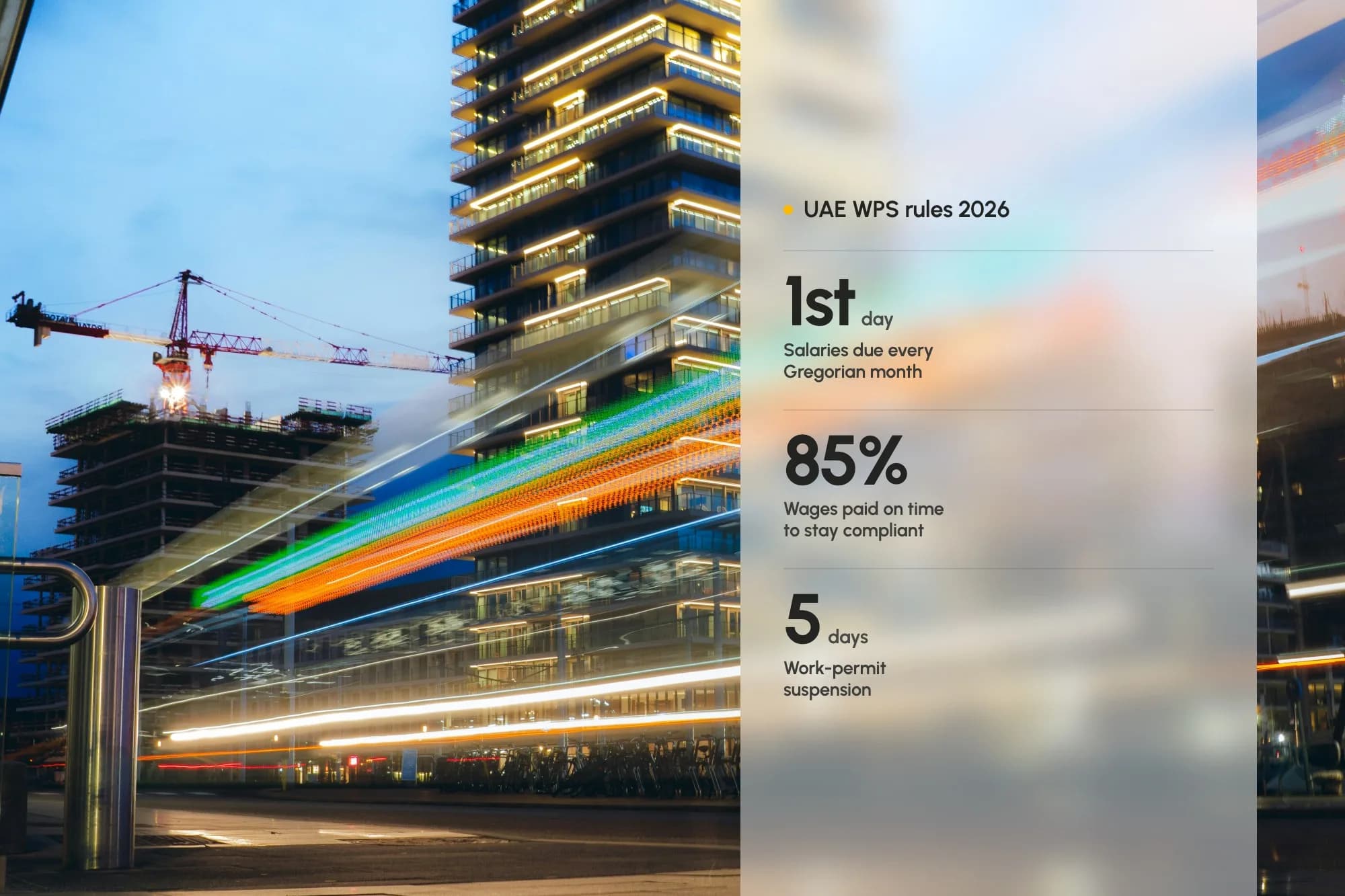
- The grace period is gone. Under Resolution No. 340 of 2026, salaries are due on the 1st of every month, with no contractual flexibility and no 15-day buffer.
- Enforcement is automatic and fast: work-permit suspension from Day 5, fines from Day 11, and prosecution or travel bans by Day 21.
- An 85% compliance threshold now applies at both company and individual level, and every deduction must be lawful and documented.
- HLB HAMT's Nova VU automates the entire UAE payroll cycle (calculation, SIF generation, validation and on-time WPS submission) for error-free, 100% compliant payroll
Effective June 2026, the UAE Wage Protection System (WPS) changed more than it had in over a decade. Ministerial Resolution No. 340 of 2026 abolished the 15-day grace period that employers had relied on for years. Salaries for the previous month are now due on the first day of every Gregorian month, and non-payment is detected automatically.
For UAE businesses, a late or inaccurate payroll run is no longer a quiet administrative slip. It is an instantly visible compliance event that can freeze your work permits within five days and escalate to fines, asset measures and travel bans within three weeks. This guide explains how the WPS works in 2026, who must comply, what the penalties are, and how HLB HAMT's fully automated payroll technology, Nova VU, keeps your payroll 100% on time, accurate and audit-ready every month.

Monitoring
Day 1
Warning
Day 3-5
Work-permit suspension
Day 8-10
Fines
Day 12-14
Labour disputes
Day 17-19
Procecution
Day 21
UAE Wage Protection System
What Is the UAE Wage Protection System (WPS)?
The UAE Wage Protection System (WPS) is the government-mandated electronic salary transfer system that ensures employees are paid their wages in full and on time. Developed by the Ministry of Human Resources and Emiratisation (MOHRE) together with the Central Bank, it requires private sector employers to pay salaries through approved banks, exchange houses and authorised financial institutions.

Introduced in 2009, the WPS was originally designed to protect blue-collar workers. It has since matured into a core compliance obligation for almost every private business in the country. In its current form, often referred to as WPS 2.0, it operates as a live, real-time data environment that links MOHRE, the Central Bank and the national payment infrastructure. Every Salary Information File (SIF) an employer submits is validated against the employment contracts held in MOHRE's registry, so compliance is monitored continuously rather than after the fact.
How HLB HAMT Helps Businesses Meet WPS Requirements
How Does the WPS Work?
At a practical level, the WPS follows a simple, repeatable cycle each month:
Prepare the SIF
The employer completes a Salary Information File listing each employee, their identifiers, and the wage and allowance amounts due for the period.
Submit through an approved channel
The SIF is submitted through an authorised bank, exchange house or financial institution connected to the WPS.
Automatic validation
The system validates the file against MOHRE's contract registry, checking that records match registered employees and obligations.
Salaries are transferred
Wages are credited to employees' accounts or approved payment instruments.
Continuous monitoring
MOHRE monitors the establishment's payment record in real time and automatically flags any shortfall or delay.
Wage Protection System (WPS)
The UAE Wage Protection System (WPS) is an electronic salary transfer system that enables employers to pay wages through CBUAE-approved banks, exchange houses and financial institutions. It is designed to ensure timely salary payments, protect employee rights, and enhance transparency and regulatory oversight.
The WPS cycle
From payroll run to employee bank credit
- 01
Employer
Submits salary file
- 02
Agent / Bank
Validates SIF file
- 03
UAE Central Bank
Routes payment
MOHRE/Free zone
Validate
- 04
Employee Bank
Credits salary
What Changed in 2026? The New WPS Rules Every Employer Must Know
Ministerial Resolution No. 340 of 2026, issued on 12 May 2026 and effective from 1 June 2026, replaced the previous framework (Resolution No. 598 of 2022). It is the most significant overhaul of the WPS since the system began. If your payroll process was built around the old rules, it now needs to change. Here is what is different:
Payday
Wages for the previous Gregorian month must be paid on or before the first day of the following month, for every MOHRE-registered employer, every month.
The 15-day grace period is removed
Previously, due dates tracked individual employment contracts, and a 15-day buffer absorbed late runs and reconciliation. That window is gone. Any payment after the 1st is treated as delayed.
An 85% compliance threshold
An establishment is considered compliant if at least 85% of total wages due are transferred on time (raised from 80%). This applies at both company and individual level, but it is not a licence to underpay. The remaining balance must be a lawful, documented deduction, and employees keep the full right to claim any shortfall.
Real-time, automatic enforcement
With WPS 2.0's live integration between MOHRE and financial institutions, non-compliance is identified almost instantly, with no inspection or complaint required.
UAE Payroll Processing & Compliance
Who Must Comply with WPS in the UAE?
WPS compliance is mandatory for all private sector establishments licensed with MOHRE, regardless of size or industry. This covers the vast majority of mainland companies operating across the Emirates.

What about free zones?
Penalties for WPS Non-Compliance
WPS Penalties and the 2026 Enforcement Timeline
Under the new framework, enforcement is automated and escalates day by day from the moment a salary is overdue. There is no mechanism to pause it for a cash-flow shortfall; the sequence runs regardless of the reason for delay. The table below summarises the escalation:
Wage Protection System (WPS) Enforcement Timeline
What happens
- 01
Day 1
Electronic monitoring begins, and the establishment's payment record is tracked in real time.
- 02
Day 2
MOHRE issues electronic notifications and formal warnings to the non-compliant establishment.
- 03
Day 5
Suspension of new work permits, freezing recruitment, visa renewals and permit amendments until wages are settled.
- 04
Day 11
Administrative fines (applied under existing cabinet regulations, commonly cited at AED 1,000–5,000 per affected worker) and reclassification into the Third Category for repeat violations within six months.
- 05
Day 16
Automatic registration of labour disputes on employees' behalf and extended permit suspension, particularly for larger employers and high-risk sectors such as construction, security and cleaning.
- 06
Day 21
Serious or repeated non-compliance may result in further enforcement measures, including referral to the Public Prosecution and other measures available under applicable UAE law.
WPS Salary Payment Deadlines
When Must Salaries Be Paid Through WPS?
To stay ahead of the deadline, organisations should put in place:
A structured payroll calendar that closes the cycle before month-end
Clear internal approval workflows with accountability at HR and finance level
Robust review and validation of every SIF before submission
A payroll reserve or pre-approved facility to cover any short-term cash-flow gap
Auditable records — contracts, SIFs, transfer confirmations, payslips, and deduction justifications — retained for at least five years
The Real Cost of Manual Payroll Under the New Rules
The old 15-day window was never just slack; it was where reconciliation happened. It was the time a payroll team used to catch a misclassified deduction, a missing new-hire record or a rejected SIF line, and fix it before anyone officially saw the number. Resolution No. 340 of 2026 removed that buffer entirely.
If your payroll still closes in the first week of the month, if attendance is compiled by hand, or if your SIF is built from a spreadsheet, the new rules expose you to real risk every single cycle. The resolution expressly permits employers to delegate payroll to a third-party provider, but it is equally clear that the employer remains fully liable for timely, compliant payment. Outsourcing moves the processing, not the responsibility. That is why your choice of payroll partner now matters more than ever.
Success Stories from Our Valued Clients

General Manager -MICHELIN AIM FZCO
Mr. Reyjie Cruz

When our company opened its AIM headquarters in UAE, setting up payroll and accounting was a key stake. HLB HAMT learned our processes from scratch and took it over fully — knowledgeable, fast, friendly, and most importantly, cost effective.
How HLB HAMT and Nova VU Automate Your Entire UAE Payroll
HLB HAMT combines 25+ years of UAE payroll expertise with Nova VU, our fully automated technology. Together, they remove the manual effort, the last-minute scramble and the compliance risk from your monthly payroll, so salaries are paid accurately and on time, every cycle, without exception.
End-to-end automation, from inputs to WPS submission
Nova VU automates the entire UAE payroll cycle. It ingests your monthly inputs (new joiners, leavers, salary changes, leave, overtime and adjustments), calculates gross-to-net for every employee, generates a bank-ready Salary Information File, validates it, and submits it through your approved WPS channel ahead of the month-end deadline. What used to take days of manual work now happens in a controlled, repeatable workflow.

100% compliance, built in
Nova VU's compliance engine is kept current with UAE statutory requirements, including the Resolution No. 340 of 2026 deadline and the 85% threshold logic. Every SIF is validated against your employee and contract data before it is submitted, so errors are caught before they ever reach MOHRE. The result is payroll that meets the new real-time compliance standard by design, not by luck.
Error-free, accurate payroll
Manual SIF preparation is where most WPS errors begin: a wrong IBAN, a mistyped amount or a missing new-hire record. Nova VU eliminates re-keying by calculating and generating files automatically and applying consistent validation rules across every employee. Fewer manual touchpoints mean fewer rejections, fewer corrections and fewer late-cycle surprises.
Significant time savings
By automating calculation, file generation, validation and submission, Nova VU compresses a multi-day payroll process into a fraction of the time. Your HR and finance teams are freed from spreadsheet wrangling and last-minute reconciliation to focus on people and strategy, while the deadline takes care of itself.
Seamless integration with your HRMS and ERP via API
Nova VU connects directly to the systems you already use. Through secure API integration, it syncs employee, compensation and movement data with leading HRMS and ERP platforms, eliminating double entry and keeping payroll and HR aligned. Supported integrations include:
- SAP SuccessFactors
- Oracle HCM
- HiBob
- Workday
Because data flows automatically from your HR system into Nova VU, every payroll run starts from a single source of truth: accurate, current and ready to process.
Payroll RUN Summary
Corporate Services
Financial Services
</>Technology Division
TOTAL
Department
Corporate Services
- Employees
- 126
- Gross Pay (AED)
- 1,245,860.00
- Deductions (AED)
- 123,450.00
- Net Pay (AED)
- 1,122,410.00
- Status
- Completed
Department
Financial Services
- Employees
- 98
- Gross Pay (AED)
- 2,105,340.00
- Deductions (AED)
- 210,230.00
- Net Pay (AED)
- 1,895,110.00
- Status
- Completed
Department
</>Technology Division
- Employees
- 74
- Gross Pay (AED)
- 1,684,220.00
- Deductions (AED)
- 168,920.00
- Net Pay (AED)
- 1,515,300.00
- Status
- Completed
Department
TOTAL
- Employees
- 298
- Gross Pay (AED)
- 5,035,420.00
- Deductions (AED)
- 502,600.00
- Net Pay (AED)
- 4,532,820.00
- Status
- Completed
SIF Validation
Validated on 2 June 2026 | 10:35 AM
WPS Submission
Submitted on 1 June 2026 | 4:06 PM
SAP · Oracle · Workday · HiBob
Payroll Compliance
On Time
Compliance status: 100%
Why UAE Employers Choose HLB HAMT for Payroll Outsourcing
The HLB HAMT Advantage
Go live in as little as 10 days Includes
statutory configuration mapped to your existing policies.
No minimum contractual lock-in
clients stay because the service works, not because they are tied in.
Scalable from 1 to 10,000+ employees
the same platform and controls, regardless of headcount.
Deep payroll accounting and MIS capability
integrated with WPS, GPSSA and corporate finance reporting.
25+ years of UAE expertise
an in-house team that has seen virtually every payroll and leave configuration in the market.
Audit-ready, always
clean reports, clear calculations and full statutory trails for audits, MOHRE inspections and due diligence.
Integrated professional services
payroll aligned with our tax, audit and advisory functions.
ISO 27001, ISO 9001 and ISAE 3402 (SOC 2) certified
data security and process integrity verified to international standards.
Member of HLB International
a top 8 global advisory network.
The new rules leave no room for late or inaccurate payroll. Let HLB HAMT and Nova VU automate your entire UAE payroll cycle: 100% compliant, error-free and on time, every month. Talk to our payroll outsourcing team today to book a free WPS compliance review.
FAQ
Frequently asked questions
- Maintaining accurate employee records
- Reviewing payroll before submission
- Preparing SIF files correctly
- Following a structured payroll calendar
- Processing salaries before the monthly deadline
- Maintaining adequate payroll funding
These measures support continuous WPS compliance.
| Requirement | Previous Framework – Resolution No. 598 of 2022 | New Framework – Resolution No. 340 of 2026 |
|---|---|---|
| Effective framework | Ministerial Resolution No. 598 of 2022 | Ministerial Resolution No. 340 of 2026 |
| Effective date | Applicable before 1 June 2026 | Effective from 1 June 2026 |
| Salary due date | Based on the employee's contractual wage due date | First day of each Gregorian month for wages relating to the preceding month |
| Grace period | 15-day compliance window under the previous framework | Previous 15-day window removed |
| Establishment compliance threshold | 80% of total wages | 85% of total wages |
| Employee payment threshold | 80% of the registered wage, subject to applicable conditions | 85% of the employee's wage, where any shortfall is attributable to lawful and documented deductions |
| Monitoring | Electronic WPS monitoring | Enhanced electronic monitoring and faster enforcement |
| Payroll impact | Payroll teams had more time to resolve payment and reconciliation issues | Payroll calendars need to be completed earlier to ensure salaries are credited by the new due date |
| Employer priority | Timely WPS submission and maintaining required payment levels | Earlier payroll closure, stronger SIF validation, documented deductions and proactive exception management |
| Area | Manual Payroll | Managed Payroll |
|---|---|---|
| WPS Compliance Risk | High | Low |
| SIF Errors | Common | Automated |
| Deadline Monitoring | Internal | Managed |
| Audit Documentation | Manual | Automated |
| Penalty Exposure | Higher | Reduced |
About the Author

Muhammed Jabir
Assistant Manager · HLB HAMT
Muhammed Jabir is Assistant Manager — Payroll at HLB HAMT, with deep expertise in UAE Labour Law compliance, end-of-service settlement, and payroll system implementation. He works closely with HR and finance leaders across the GCC to design statutory-leave configurations that are audit-ready and built to scale.