

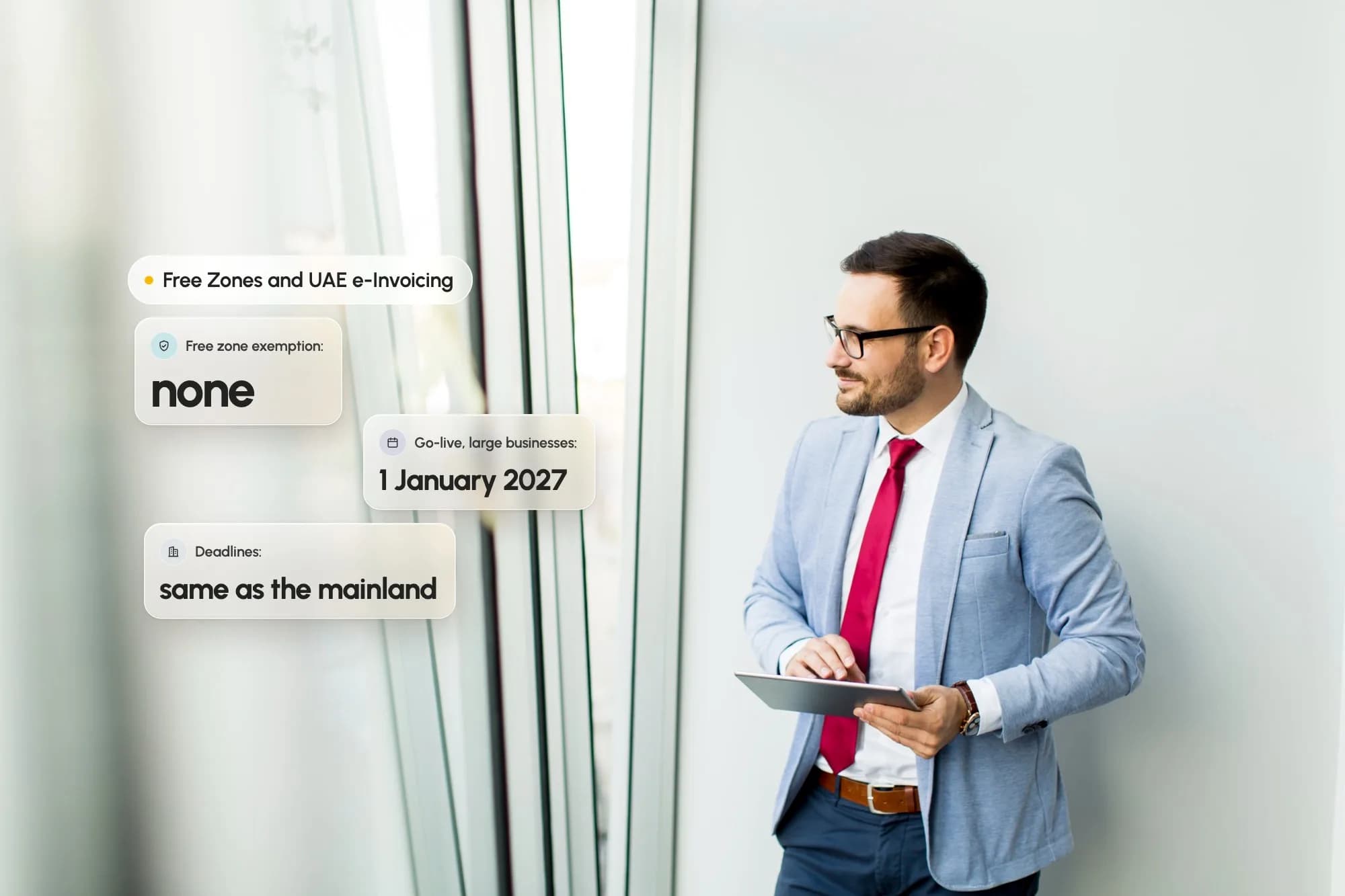
Yes. There is no free zone exemption from UAE e-Invoicing. If your free zone company issues B2B or B2G invoices, it is in scope on the same timeline as an equivalent mainland business. Guidelines Version 1.1 confirmed this explicitly, naming free zones including DMCC, JAFZA, IFZA, RAKEZ, ADGM and DIFC. The common assumption that designated zone VAT treatment carries over into e-Invoicing is wrong. The e-Invoicing mandate is a separate legal instrument, and it does not copy the VAT carve-outs.
Free zone status changes some of your VAT logic. It does not change whether you must issue structured e-invoices. This guide explains why, where the designated zone question actually bites, and how the main transaction flows are treated.

Why free zones are in scope
The obligation flows from Ministerial Decision No. 243 of 2025, which applies the Electronic Invoicing System to all persons conducting business in the UAE, regardless of where they are established or whether they are VAT-registered, unless a transaction is specifically excluded.
There is no clause excluding free zone licence holders.
The mandate is a digital infrastructure requirement, not a VAT relief, so the special status many free zones enjoy for VAT purposes does not create an e-Invoicing exemption.
This is the single most common misunderstanding among free zone finance teams. For VAT, a designated zone can be treated as outside the UAE for certain goods movements. For e-Invoicing, that treatment is irrelevant to whether the underlying business transaction must be documented as a structured e-invoice.
Designated zone or not: what it does and does not affect
Some free zones are classified as designated zones, which affects VAT treatment on certain goods movements. It is worth being precise about what that classification changes:
What it affects:
the VAT treatment and the tax category shown on the invoice. Goods moving between designated zones may fall outside VAT scope; goods moving to the mainland are standard-rated at 5%; services are generally standard-rated regardless of zone.
What it does not affect:
whether an e-invoice is required. A zero-rated or out-of-scope-for-VAT transaction can still be an in-scope e-Invoicing transaction. The invoice carries the appropriate VAT category code and still flows through your service provider and the Peppol network.
How the main free zone transaction flows are treated
Transaction
In scope for e-Invoicing?
Note
- Free zone to mainland (B2B)
- Yes
- Standard e-invoice through ASP and Peppol
- Free zone to free zone (B2B)
- Yes
- In scope; VAT category depends on zone and goods vs services
- Free zone to UAE government (B2G)
- Yes
- In scope on the B2G timeline
- Free zone to overseas customer (export)
- Yes, where a UAE tax invoice is required
- Zero-rated still needs a compliant e-invoice
- Free zone to consumer (B2C)
- No, for now
- B2C is outside the current mandatory scope
The pattern is that scope is driven by whether the transaction is B2B or B2G and whether a UAE tax invoice is required, not by the zone. Even a zero-rated export generally needs a compliant e-invoice carrying the zero-rate category code. B2C is the main relief, and only because B2C sits outside the current mandate for everyone, not because of anything specific to free zones.
Mixed activity: the part-exclusion trap
Many free zone entities run a mix of in-scope and excluded transactions. An exclusion on one revenue stream does not exempt the whole company. If part of your activity is out of scope, you still implement e-Invoicing for the in-scope portion. Planning your setup around the assumption that one exempt stream covers everything is a common and expensive mistake.

Your deadlines are the same as the mainland
Free zone businesses follow the standard phase timeline.
1 January
2027
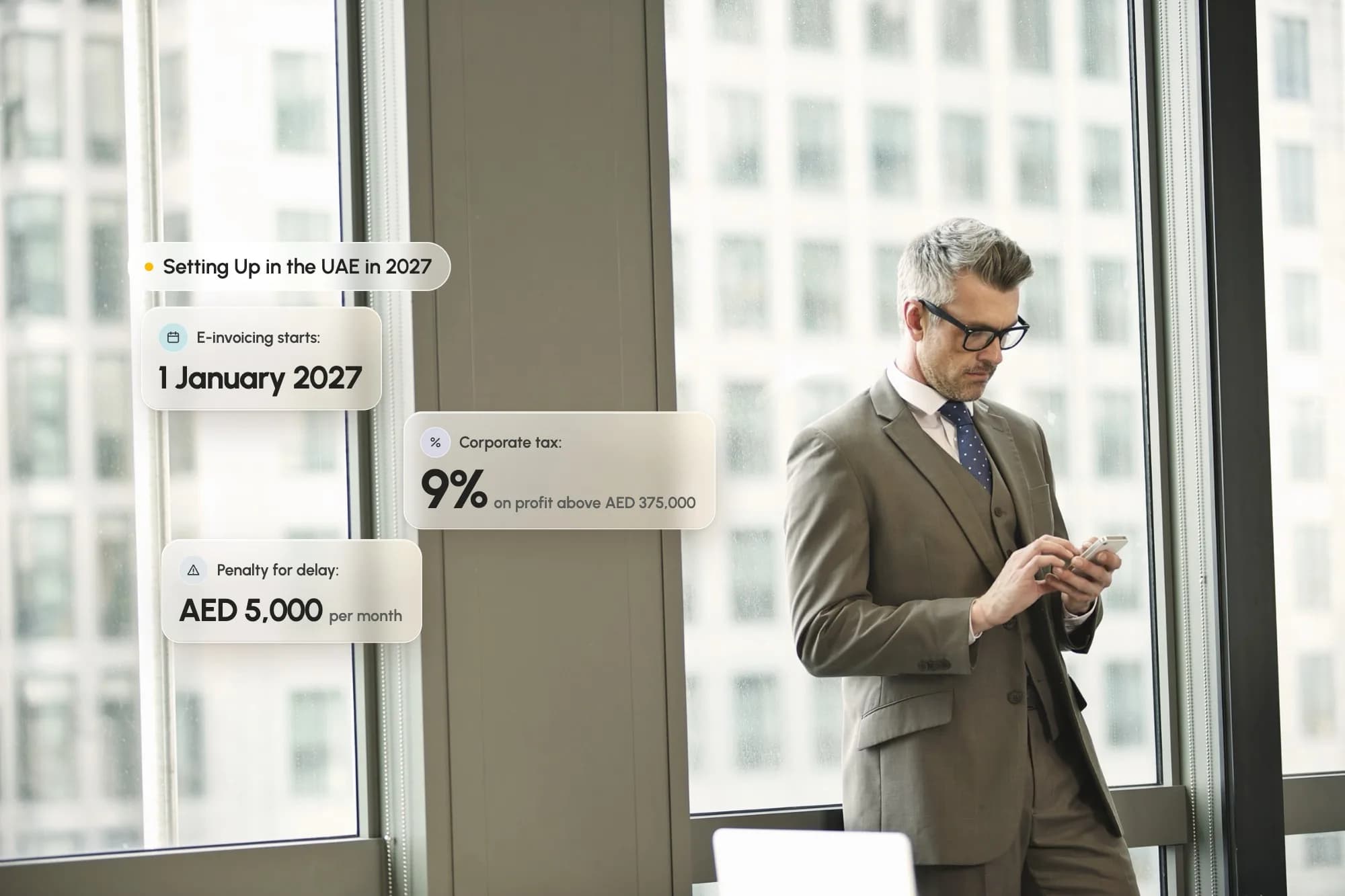
Large businesses with annual revenue of AED 50 million or more appoint a service provider by 30 October 2026 and go live on 1 January 2027.
1 July
2027
Smaller businesses appoint by 31 March 2027 and go live on 1 July 2027.
There is no free zone extension. If you are a large free zone entity, your clock is the same as any large mainland company’s.
Where HLB HAMT helps
Free zone compliance is where VAT logic and e-Invoicing scope pull in different directions, and getting the tax category right on each flow is as important as connecting the technology. HLB HAMT covers both through its tax advisory practice and the Evatra platform, with the firm’s technology division, Hamt Information Technology MoF accredited service provider for e-Invoicing services. For a free zone group with cross-zone and mainland flows, the work is in mapping each transaction type to the correct VAT treatment and confirming it is set up to issue a compliant e-invoice.

That is up to AED 15,000 in a single month from one underlying failure to get ready, before any system-failure penalty is added. Stretch the same position across a quarter and the figure compounds. The point is not the arithmetic of any one line. It is that the framework is designed so that being unprepared is expensive in several directions at once.
Ensure Your Free Zone Business Is e-Invoicing Ready
Whether your company operates in a Free Zone or on the mainland, understanding your e-Invoicing obligations is essential. HLB HAMT, a Ministry of Finance approved e-Invoicing Service Provider, helps businesses assess applicability, achieve compliance, and implement seamless e-Invoicing solutions tailored to their operational needs.