

Key takeaways
- What Oman EOS Gratuity is and who qualifies under the 2023 Labour Law
- How to calculate gratuity accurately based on service period and last drawn basic salary
- Why monthly accruals and financial reporting are important for audit readiness
- Common employer mistakes that can lead to non-compliance and financial misstatements.
- How Nova VU by HLB HAMT automates gratuity accruals, calculations, payments and reporting while reducing manual errors
- API integration with SAP SuccessFactors, Oracle HCM, HiBOB and Workday
Why Employer must Get Gratuity Right
Why Every Employer in Oman Needs to Get Gratuity Right
Every company operating in Oman with expatriate employees carries a statutory financial obligation that grows every month: end-of-service gratuity. For many businesses, gratuity is one of the largest accrued liabilities on the balance sheet. Yet it remains one of the most error-prone areas of payroll management. Miscalculations, missed unpaid leave adjustments, inconsistent monthly accruals and inadequate documentation can expose organisations to legal disputes, failed audits and reputational damage.
With Oman's 2023 Labour Law now in force, regulatory expectations are clearer than ever, as are the risks of non-compliance. This guide answers the key questions finance teams, HR directors and operations leaders need to address about Oman end-of-service gratuity. It explains what gratuity is, who qualifies, how it is calculated and how employers can automate the process to reduce errors.

Gratuity Accural Summary · Jack Corporation Limited
Employee Count
Eligible Employees
New Joinees (YTD): 7 · Resignations (YTD): 3
Average Service (Years)
Monthly Movement
Total Accured Liability
As of 30 Apr 2026
OMR 51,468.58
What Is End-of-Service Gratuity in Oman?
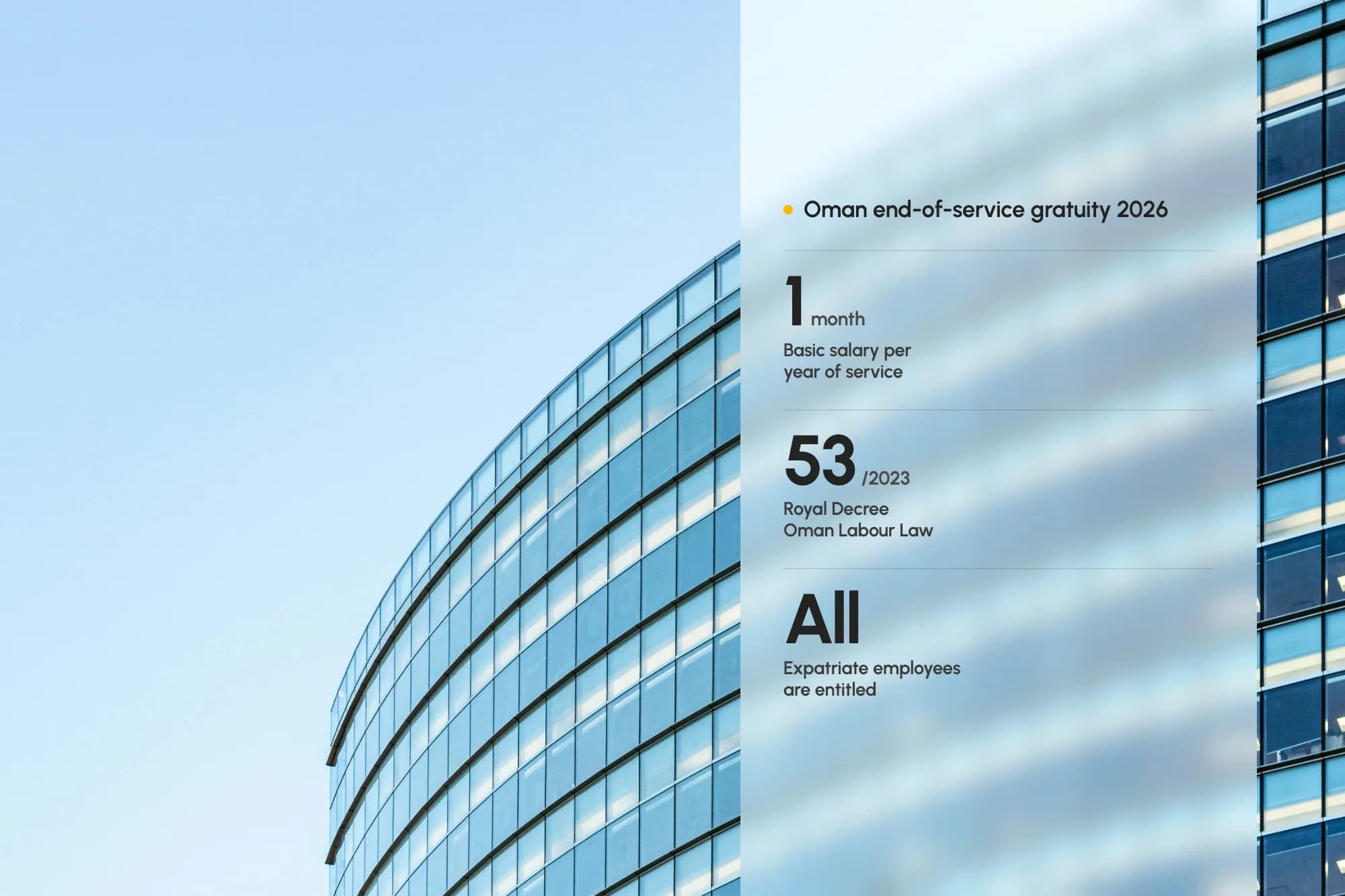
End of Service (EOS) Gratuity is a statutory lump-sum payment that employers in Oman are legally required to make to eligible employees upon the termination or completion of their employment contract. It is governed by the Oman Labour Law (Royal Decree No. 53/2023) and is intended to provide financial support to employees at the end of their service.
Gratuity is calculated based on the employee's last drawn basic salary, not gross salary, and depends on the total length of qualifying service. For employers, this means that the gratuity liability increases as eligible employees continue working and must be accurately recorded in the company's financial records.

Who Is Eligible for Oman End-of-Service Gratuity?
Under Oman Labour Law, end-of-service gratuity applies to expatriate (non-Omani, non-GCC) employees. For 2026, eligible non-Omani employees who are not yet covered by the Social Protection Law savings system remain subject to the employer-paid end-of-service gratuity provisions under Article 61 of the Oman Labour Law. Oman’s Social Protection Law provides for a provident or savings system for non-Omani workers. This system is intended to replace the current EOS gratuity framework when the relevant contribution provisions come into force.
GCC nationals working in Oman are covered under GCC insurance protection extension arrangements rather than being treated in the same way as other expatriate employees.
Employee Name
Nationality / Category
Applicable Benefit
- Alfred Johansson
- Spain (Expatriate)
- End-of-Service Gratuity
- Ahmed Sayed Ibrahim
- Oman (National)
- Social Protection Fund
- Nadia Hameed
- Egypt (Expatriate)
- End-of-Service Gratuity
This classification helps reduce the risk of assigning incorrect benefit categories, a common and costly error for organisations managing employees from different nationalities.
How Gratuity is Calculated
How Is Oman End-of-Service Gratuity Calculated?
Gratuity in Oman is calculated based on the employee's last drawn basic salary, at the rate of one full month's basic salary for each year of qualifying service. Accurate calculations require careful tracking of joining dates, salary changes, unpaid leave periods and partial-year service.
The Oman Gratuity Formula
Effect of Unpaid Leave on Gratuity Calculation
Any period of unpaid leave must be deducted from the total qualifying service period used to calculate gratuity. This adjustment is important because ignoring unpaid leave can lead to over-accrual and an inflated gratuity liability on the company's books.
Nova VU automatically tracks unpaid leave periods for each employee and adjusts both monthly gratuity accruals and final EOS calculations accordingly, reducing the need for manual intervention.
Transition to the Provident Scheme
Oman EOS Gratuity: Transition to the Provident Scheme
The Social Protection Law provides for a savings system that will replace employer-paid EOS gratuity for non-Omani workers. Article 138 also addresses how service completed before the savings contribution provisions commence will be treated.
Period
Treatment
- Service before provident-scheme commencement
- EOS entitlement handled under the applicable Labour Law provisions, subject to the transition rules
- Service after provident-scheme commencement
- Savings or provident contributions apply according to the Social Protection Law
- Transition date
- Employers should monitor SPF implementation announcements and contribution commencement requirements
- 2026 payroll
- Continue accurate EOS accruals while preparing for the provident scheme
Why Monthly Gratuity Accrual matters
Why Monthly Gratuity Accrual Is Non-Negotiable
Many employers treat gratuity as a liability that only needs to be calculated when an employee leaves. This can create significant accounting issues. Under international financial reporting standards (IFRS) and sound management accounting practices, gratuity should be accrued monthly as an expense, with the cumulative liability accurately reflected on the balance sheet.
Monthly accrual ensures your organisation can:
Reflect accurate financial liabilities in monthly and annual management accounts
Pass internal and external audits without material misstatements
Plan cash flow for future EOS payments
Maintain audit-ready documentation throughout the financial year
- Opening balance · 1 Jan 202538,240.00OMR
- Total accrued · FY 20259,850.00OMR
- Payments made · FY 20253,120.00OMR
- Closing balance · 31 Dec 202544,970.00OMR
Employee name
Yusuf Al Hinai
- Hire date
- 12 Apr 2018
- Basic salary
- OMR 950.00
- Accrued gratuity
- OMR 5,890.00
Employee name
Meera Nair
- Hire date
- 03 Aug 2021
- Basic salary
- OMR 710.00
- Accrued gratuity
- OMR 2,187.00
Employee name
Khalid Al Balushi
- Hire date
- 20 Feb 2015
- Basic salary
- OMR 1,250.00
- Accrued gratuity
- OMR 11,750.00
Showing 3 of 70 employees. Full drill-down available in the underlying ledger export.
Reports HLB HAMT Delivers
Gratuity Reports HLB HAMT Delivers Every Month
Transparency and audit readiness are central to HLB HAMT's payroll outsourcing service. Every month, clients receive a comprehensive suite of gratuity reports designed to meet operational and compliance requirements.

Monthly Gratuity Accrual Report
Each monthly report includes a clear, structured breakdown of:
Opening balance for the month
Accrual base amount (last drawn basic salary per employee)
Amount accrued during the month
Gratuity payments made during the period
Closing balance at the end of the reporting month
Annual / Year-to-Date Gratuity Summary Report
For audit and MIS purposes, HLB HAMT provides a full-year summary covering:
- Opening balance for the financial year
- Total accruals across the year
- Total payments made to departed employees
- Closing balance at year-end, reconciled with the final monthly report.
Accounting Entries: Journal Vouchers (JVs)
HLB HAMT provides ready-to-post accounting entries for monthly gratuity accruals and EOS payment transactions. These are formatted to align with your financial systems, including:
- SAP, including SAP S/4HANA and SAP SuccessFactors
- Oracle HCM and Oracle ERP Cloud
- Workday Financial Management
- HiBOB and other HRMS platforms
- Other ERP and accounting systems
All accounting entries are delivered in a system-readable format or through direct API integration. This enables seamless posting into your ERP system without manual re-entry and reduces reconciliation errors.
Common Gratuity Mistakes Employers Must Avoid
Across 25+ years of payroll outsourcing in the GCC, HLB HAMT has seen recurring errors create unnecessary compliance risks and financial misstatements for employers in Oman.
Using gross salary
Gratuity must be calculated on basic salary only, not gross salary or salary inclusive of allowances
Ignoring unpaid leave
Every day of unpaid leave reduces qualifying service. Missing this adjustment inflates gratuity liability
No monthly accrual
Treating gratuity as a one-time calculation can lead to understated liabilities and audit findings
Incorrect hire date
Payroll systems must track the original hire date, not the date of the last salary change
No salary-change recalculation
When basic salary changes, gratuity accrual must be updated retroactively from the hire date
Missing EOS documentation
Audit-ready EOS calculation sheets are essential. Verbal calculations are not sufficient documentation.
Success Stories from Our Valued Clients

Levi’s
Mr. Shanshan Cong

My experience in working with this team is very much a positive one. Their professionalism is refreshing. Thank you for making the Payroll process a very pleasant experience.
HLB HAMT's Gratuity Service
HLB HAMT's End-to-End Gratuity Management Service
HLB HAMT offers comprehensive gratuity management as part of its Oman payroll outsourcing service. From employee onboarding onwards, gratuity calculations, accruals, payments and reports are managed with a focus on accuracy and complete audit documentation.

The service covers:
Monthly gratuity accrual reports for every eligible employee
Journal vouchers (JVs) for gratuity accrual and payment accounting entries
End of Service (EOS) calculation sheets aligned with Oman Labour Law 2023
Annual gratuity summary reports for MIS and external audits.
Support in resolving audit queries and compliance reviews
SPF social security management for Omani nationals, processed in parallel
How HLB Payroll System and Nova VU Support Oman Gratuity Processing
01
Automated Allocation and Accrual
HLB Payroll System classifies employees based on nationality and applicable benefit schemes. It then calculates monthly gratuity accruals using key payroll data such as hire date, basic salary, service period and unpaid leave. The system generates gratuity accrual reports and accounting-ready summaries, which are then sent to Nova VU for review and validation
02
Salary Change Validation
When an employee's basic salary changes, HLB Payroll System automatically recalculates the gratuity liability and updates the reports. Nova VU reviews these changes and identifies unusual variances or potential under-accruals and over-accruals for further review.
03
EOS Calculation Sheets and Final Settlement
When an employee leaves, HLB Payroll System generates detailed EOS calculation sheets covering gratuity, leave encashment, final salary and other settlement components. Nova VU validates the calculations and highlights anomalies before HR and finance approve the final settlement.
04
Technology driven Payroll Validation
Nova VU's advanced Rules Engine reviews payroll and gratuity reports to detect anomalies, inconsistencies and compliance exceptions. This validation layer helps employers improve payroll accuracy, strengthen compliance and maintain an audit-ready payroll process with less manual review.
ERP and HRMS Integration
Seamless ERP and HRMS Integration: Zero Manual Data Transfer
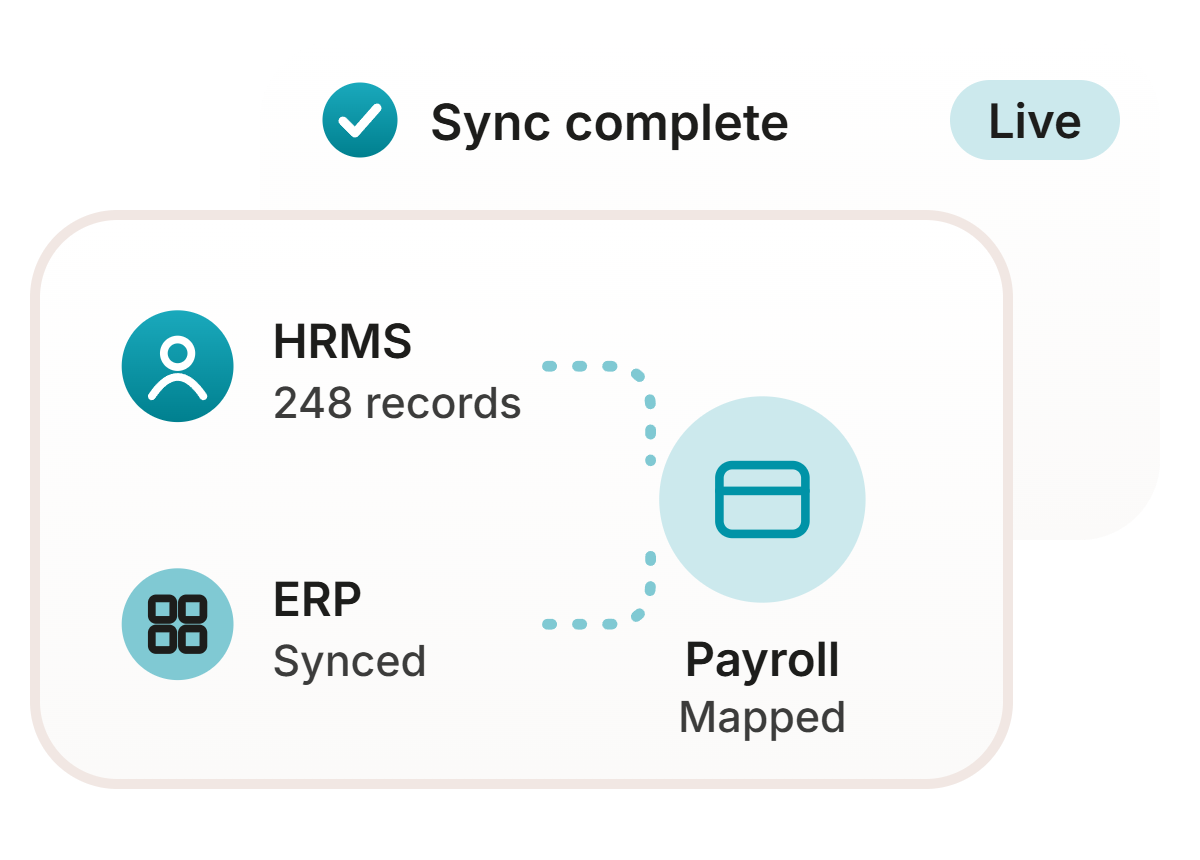
One of the biggest operational risks in payroll management is transferring data between systems. Manual exports, copy-and-paste processes and format mismatches can introduce errors at every stage. Nova VU reduces this risk through direct API integration with leading HRMS and ERP platforms.
- SAP SuccessFactors
- Oracle HCM Cloud
- Workday
- HiBOB
The result: employee data flows automatically from your HRMS into Nova VU, where gratuity calculations are processed and accounting entries are prepared for your ERP system. This reduces manual work for payroll teams during each cycle and helps minimise data entry errors.
Why choose hlb hamt
Why Leading Organisations Choose HLB HAMT for Oman Payroll Outsourcing
Choosing the right payroll partner is one of the most important decisions an HR or finance leader can make. HLB HAMT combines technology, expertise and regional knowledge to help organisations operating in Oman manage a compliant, efficient and scalable payroll function.
OMAN Payroll Processing & Compliance
HLB HAMT Advantages
Go Live in 10 Days
SME payrolls can be activated in as little as 10 days, without disrupting existing operations.
No Minimum Commitment
Stay because the service works, not because you are tied in by contract.
Scales 1 → 10,000+
same platform supports a single employee or an enterprise with 10,000 employees.
HRMS integration
Connects with Oracle, SAP, SuccessFactors and your in-house systems through end-to-end integration.
Audit-ready always
Clean reports, accurate calculations and complete statutory records, available when required.
ISO 27001 · SOC 2
Supports high standards of data security and quality management.
Frequently Asked Questions
- Payroll Register
- Payroll Reconciliation Report
- Headcount Reconciliation Report
- Bank Payment File and Payment Summary
- SIO Contribution Report
- Gratuity Accrual Report
- Leave Liability Report
- Overtime Report
- General Ledger (GL) Journal Entries
- Year-to-Date (YTD) Payroll Summary
- Cost Centre Allocation Report
- Payroll Submission and Approval Confirmations
In addition, HLB HAMT provides a comprehensive suite of audit and management reports, including Gratuity Yearly Summary, Annual Payroll Summary, Salary Increment Summary, Joiner and Leaver Reports, Payroll Variance Reports, Statutory Compliance Reports, and other customized reports to support audits, management reporting, and financial reconciliation.
About the Author

Muhammed Jabir
Assistant Manager · HLB HAMT
Muhammed Jabir is Assistant Manager — Payroll at HLB HAMT, with deep expertise in UAE Labour Law compliance, end-of-service settlement, and payroll system implementation. He works closely with HR and finance leaders across the GCC to design statutory-leave configurations that are audit-ready and built to scale.