

Key takeaways
- Understand what UAE End of Service (EOS) Gratuity is and who qualifies for it
- Learn how to accurately calculate gratuity based on service period and salary
- Understand the importance of monthly gratuity accrual and financial reporting
- Identify key compliance requirements under UAE Labour Law (2026)
- Avoid common mistakes UAE employers make when calculating and managing gratuity.
- Follow best practices for managing gratuity through payroll systems
- Understand how professional payroll partners like HLB HAMT ensure accuracy, compliance, and audit readiness
Why End of Service Gratuity Matters for Employers
End of Service (EOS) Gratuity in the UAE is a mandatory employee benefit governed by UAE Labour Law (Federal Decree-Law No. 33 of 2021). For employers, managing gratuity correctly is not optional; it is a legal, financial, and reputational obligation.

- Ensure legal compliance
- Avoid financial misstatements
- Pass audits smoothly
- Maintain employee trust
Gratuity calculation, accrual, and reporting can become complex, especially for growing organisations. This guide explains UAE gratuity rules, calculation methods, and payroll best practices.
Sigma Corporation Limited · United Arab Emirates · April 2026
Total Employees
Expatriate Workforce
Payroll Partner
ISO 27001 · ISO 9001 · ISAE 3402
Gratuity Accured (Month end)
514,826AED
As at end of reporting month
What Is UAE End of Service Gratuity, and Who Is Eligible?
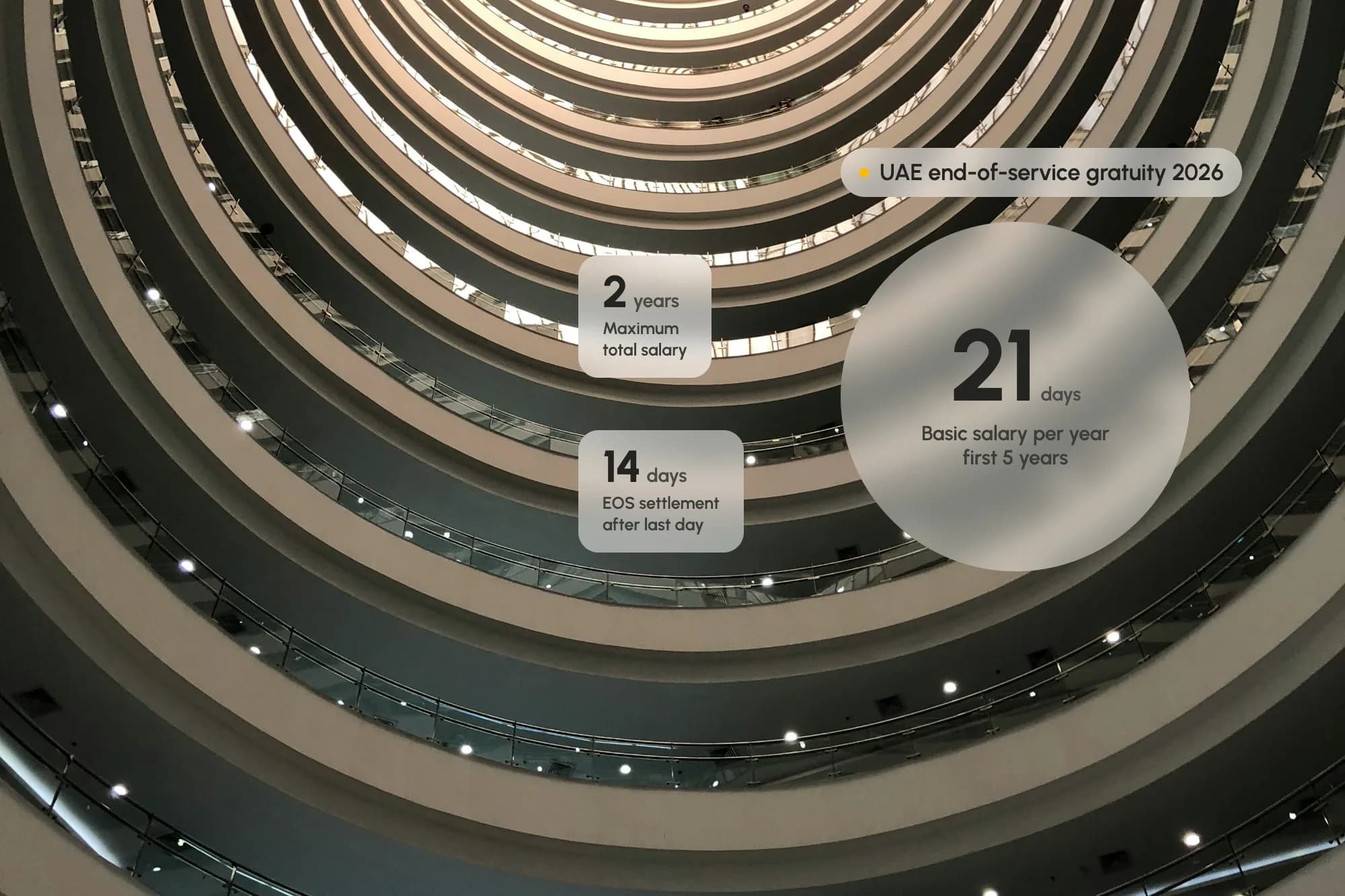
End of Service (EOS) Gratuity is a lump-sum payment made to expatriate employees upon the termination or completion of their employment contract, provided they have completed at least one year of continuous service with their employer.
Gratuity is calculated based on the employee's last drawn basic salary, not gross salary. Allowances, commissions, and overtime are excluded from the calculation base.

How Is Gratuity Calculated in the UAE?
UAE Gratuity Calculation Logic
Service Period · Rate · Basic AED 10000/Month Total Salary : AED 15000
Years 1–5
21calendar days' basic salary for each completed year
21 ÷ 30 × AED 10,000 = AED 7000/year
Year 6 onwards
30calendar days' basic salary for each completed year
Calculation: 30 ÷ 30 × AED 10,000 = AED 10,000 per year.
Maximum Cap
Cannot exceed 2 Years Total Salary — Capped at AED 360,000 (for this example)
Employee Eligibility: Who Gets What?
HLB HAMT's payroll system automatically classifies employees by nationality and allocates them to the appropriate scheme: expatriates to EOS Gratuity and GCC nationals to their applicable Social Security contributions.
Oliver Bennett
Nationality: German · End of Service Gratuity
- Hire Date
- 12 Mar 2021
- Basic Salary
- AED 14,000
- Years of Service
- 4.1 years
- Gratuity Accured
- AED 40,040
Saeed Mansoori
Nationality: Emirati · GPSSA – Social Security
- Hire Date
- 01 Jun 2020
- Basic Salary
- AED 30,000
- Scheme
- Scheme: GPSSA
- Monthly Contribution
- AED 5,250
Amelia Watson
Nationality : American · End of Service Gratuity
- Hire Date
- 15 Aug 2019
- Basic Salary
- AED 11,500
- Years of Service
- 6.7 years
- Gratuity Accured
- AED 64,675
Gratuity Accrual Policy: The Monthly Discipline
Booking gratuity only when an employee leaves is a financial reporting error and a cash flow risk. Sound accounting practices and UAE best practices require gratuity to be accrued monthly as a growing liability on the balance sheet.
This structured monthly accrual approach ensures that financial statements accurately reflect the organisation's gratuity liability at all times. This is particularly important for audits, due diligence, and group-level financial consolidations.

Common Gratuity Mistakes Employers Must Avoid
Many companies face compliance issues, audit findings, and employee disputes because of avoidable errors. Here are some of the most frequent and consequential mistakes:
Using Gross Instead of Basic Salary
Gratuity must be calculated using basic salary only. Including allowances overstates the liability and creates audit discrepancies.
Ignoring Unpaid Leave Adjustments
Unpaid leave periods must be deducted from the total service period. Failing to do so can inflate gratuity entitlement and create compliance risks.
Not Accruing Gratuity Monthly
Booking gratuity as a lump sum at employee separation can lead to financial misstatements and unexpected cash flow pressures.
Skipping Hire-Date Recalculation
When an employee's salary changes, gratuity must be recalculated from the hire date. Overlooking this adjustment can result in inaccurate calculations.
Missing the 14-Day Settlement Deadline
UAE Labour Law requires EOS settlement within 14 days of the last working day. Late payment can create legal exposure.
Inadequate Audit Documentation
Insufficient records can lead to compliance failures during MOHRE inspections and external audit reviews.
 MICHELIN AIM FZCOMr. Reyjie Cruz
When our company opened its AIM headquarters in UAE, setting up payroll and accounting was a key stake. HLB HAMT learned our processes from scratch and took it over fully — knowledgeable, fast, friendly, and most importantly, cost effective.
Voluntary Alternative End-of-Service Benefits Savings Scheme
The UAE's voluntary Alternative End-of-Service Benefits Savings Scheme allows eligible private-sector and free-zone employers to replace the traditional gratuity model for selected employees with monthly contributions to an approved investment fund. Employers generally contribute 5.83% of an employee's monthly basic salary during the first five years of service and 8.33% thereafter. Participation is voluntary and requires registration through the Ministry of Human Resources and Emiratisation (MoHRE) and the selection of an approved fund administrator.
When an employee is enrolled, gratuity accrued before the enrolment date must be calculated and preserved under the traditional system. Future benefits are funded through monthly contributions to the Savings Scheme. When employment ends, the employee is entitled to the employer's basic contributions and applicable investment returns, subject to the scheme's rules. The employee may withdraw the funds or keep them invested. Employers should maintain accurate contribution records and refer to the latest MoHRE Savings Scheme guidance.
Monthly Process
EOS Payment: Timelines & Settlement
As per UAE Labour Law, the timeframe for paying End of Service entitlements, including gratuity, is 14 calendar days from the employee's last working day. HLB HAMT tracks and manages this deadline as part of its standard payroll cycle.
EOS Settlement Record — Sample
Employee Name Alfred García · Last Working Day 31 March 2026 · EOS Amount AED 40,040.00 · EOS Approved Date 03 April 2026
Last Working Day
31 March
EOS Calculated
02 April
EOS Approved
03 April
Payment Settled
09 April
Legal Deadline
14 April
14d
EOS Calculation Sheet
HLB HAMT prepares a fully documented EOS Calculation Sheet for every departing employee, covering gratuity, notice pay, and annual leave encashment. Each sheet is signed off and maintained for audit readiness.
EOS Calculation Sheet · Alfred García · Sigma Corporation Limited · April 2026
Basic Salary: AED 14,000 · Full Salary: AED 20,000 · Employee Signature: A. García · Payroll Team Lead – HLB HAMT: C. D'Souza EOS Approved: April 2026
- End of Service Gratuity · 4 years × 21 days = 84 days AED39,200.00AED
- Gratuity (Partial Year) · 0.1 year × 21 days = 2.1 days AED980.00AED
- Notice Pay · 30 days (1 month) AED20,000.00AED
- Annual Leave Encashment · 12 days accrued AED8,000.00AED
- Total EOS Entitlement AED68,180.00AED
How HLB Payroll System and Nova VU Support UAE Gratuity Processing
Automated Allocation and Accrual
HLB Payroll System classifies employees based on nationality and applicable benefit schemes, then calculates monthly gratuity accruals using key payroll data such as hire date, basic salary, service period, and unpaid leave. It generates gratuity accrual reports and accounting-ready summaries, which are then transferred to Nova VU for review and validation
Salary Change Validation
When an employee's basic salary changes, HLB Payroll System automatically recalculates the gratuity liability and updates the reports. Nova VU reviews these changes and identifies unusual variances or potential under- or over-accruals for further review.
EOS Calculation Sheets and Final Settlement
For employee exits, HLB Payroll System generates detailed EOS calculation sheets covering gratuity, leave encashment, final salary, and other settlement components. Nova VU validates the calculations and highlights anomalies before HR and finance teams approve the final settlement.
Technology-Driven Payroll Validation
Nova VU's advanced Rules Engine reviews payroll and gratuity reports to detect anomalies, inconsistencies, and compliance exceptions. This validation layer helps employers improve payroll accuracy, strengthen compliance, and maintain an audit-ready payroll process with less manual review.
Salary Change Validation
HLB Payroll System classifies employees based on nationality and applicable benefit schemes. It then calculates monthly gratuity accruals using key payroll data such as hire date, basic salary, service period, and unpaid leave. The system generates gratuity accrual reports and accounting-ready summaries, which are then transferred to Nova VU for review and validation
UAE Payroll Processing & Compliance
HLB HAMT Way of Gratuity Processing: Reports & Deliverables
HLB HAMT provides a comprehensive suite of gratuity reports to ensure transparency, accuracy, and ease of compliance for employers.

Monthly Gratuity Accrual Report
Opening balance for the month
Accrual basis amount (basic salary)
Amount accrued during the month
Gratuity paid during the period
Closing balance as of the reporting month
Year-to-Date / Annual Report
- Opening balance for the year
- Cumulative accrual base amounts
- Total accrued during the year
- Total gratuity paid during the period
- Closing balance in an audit-ready format
EOS Calculation Sheets
- Full EOS calculation as per UAE Labour Law
- Gratuity, notice pay, and leave encashment
- Signed off by the payroll lead
- Employee acknowledgement captured
- Delivered within the payroll cycle
Accounting Entries & Journal Vouchers
Monthly JVs for accrual and payment
Compatible with SAP / Oracle, and SuccessFactors
System-readable or API integration formats
Reduces manual re-entry risk to zero
Maintains a clean, reconciled gratuity ledger.
HLB HAMT Payroll Platform
Sync →
- Employee: Nadia El-Masri
- Monthly Accrual: AED 1,150.00
- Journal Entry: Dr. Expense / Cr. Provision
- Status: Ready to sync
Client ERP System
- GL Code: 2340 — Gratuity Provision
- Amount Posted: AED 1,150.00
- Posting Date: 30 April 2026
- Status: No manual entry needed
- SAP · Oracle · SuccessFactors · Other ERPs
HLB HAMT Advantages
Why Choose HLB HAMT for Payroll Outsourcing?
Go Live in 10 Days
SME payrolls can be activated in as little as 10 days without operational disruption.
No Minimum Commitment
Stay because the service works, not because you are tied to a contract.
Scales 1 → 10,000+
same platform supports a single hire or an enterprise with 10,000 employees.
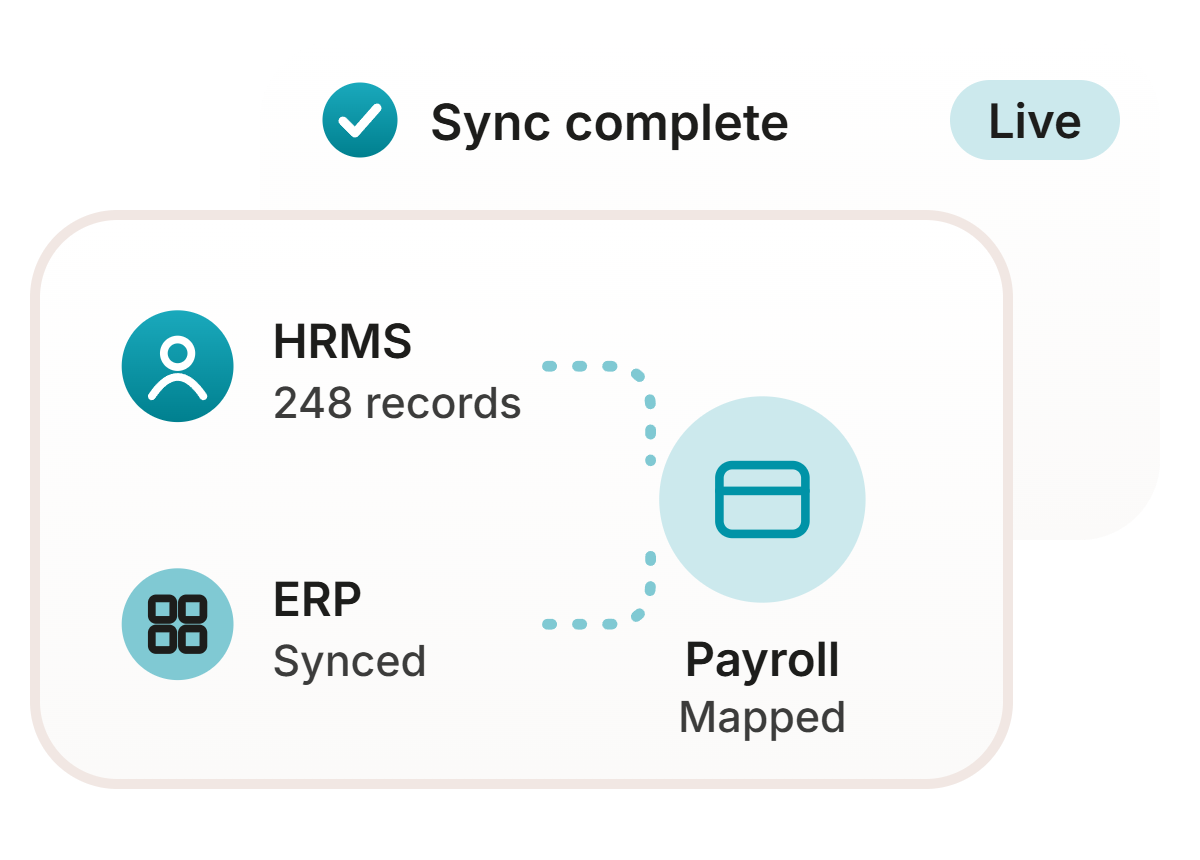
HRMS integration
Connects with Oracle, SAP, SuccessFactors, and in-house systems from end to end.
Audit-ready always
Clean reports, clear calculations, and complete statutory records available on demand.
ISO 27001 · SOC 2
High standards of data security and quality management certification.
Frequently Asked Questions
- Preparing monthly gratuity accrual reports
- Providing accounting entries and monthly journal vouchers (JVs)
- Preparing EOS calculations in line with UAE Labour Law
- Preparing annual gratuity summary reports for audit and MIS purposes.
- Supporting employers in addressing audit queries and compliance reviews
Traditional UAE Gratuity vs Alternative Savings Scheme
| Feature | Traditional EOS Gratuity | Alternative Savings Scheme |
|---|---|---|
| Structure | Lump-sum statutory benefit at the end of employment | Employer contributions to an approved investment fund |
| Payment timing | Exit | Monthly |
| Employer contribution | No fixed monthly contribution rate | Generally 5.83% for the first five years and 8.33% thereafter |
| Existing accrued benefit | Calculated under the traditional system | Benefit accrued before enrolment is preserved |
| Future benefit | Statutory gratuity based on service and last basic wage | Fund contributions and applicable investment returns |
| Employee outcome | Paid as EOS entitlement at separation | Funds may be withdrawn or remain invested, subject to scheme rules |
| Investment return | No | Yes |
| Accounting impact | Provision | Contributions |
| Participation | Statutory framework | Voluntary alternative scheme for eligible employers and employees |
About the Author

CMA Muhammed Naseer
Associate Director – Payroll · HLB HAMT
Cost and Management Accountant (CMA), ICMAI · 16+ years in finance, payroll and HR compliance
Naseer is a qualified Cost and Management Accountant (CMA) from the Institute of Cost and Management Accountants of India (ICMAI) and a seasoned payroll specialist with over 16 years of professional experience in Finance, Payroll Processes, and HR Compliance.
As an Associate Director of Payroll at HLB HAMT, he works closely with a diverse portfolio of multinational and regional clients, developing strong and long-standing relationships through consistent service excellence and a deep understanding of organizational needs. He currently oversees comprehensive payroll operations for companies across the GCC, ensuring accuracy, statutory compliance, and robust process optimization.