

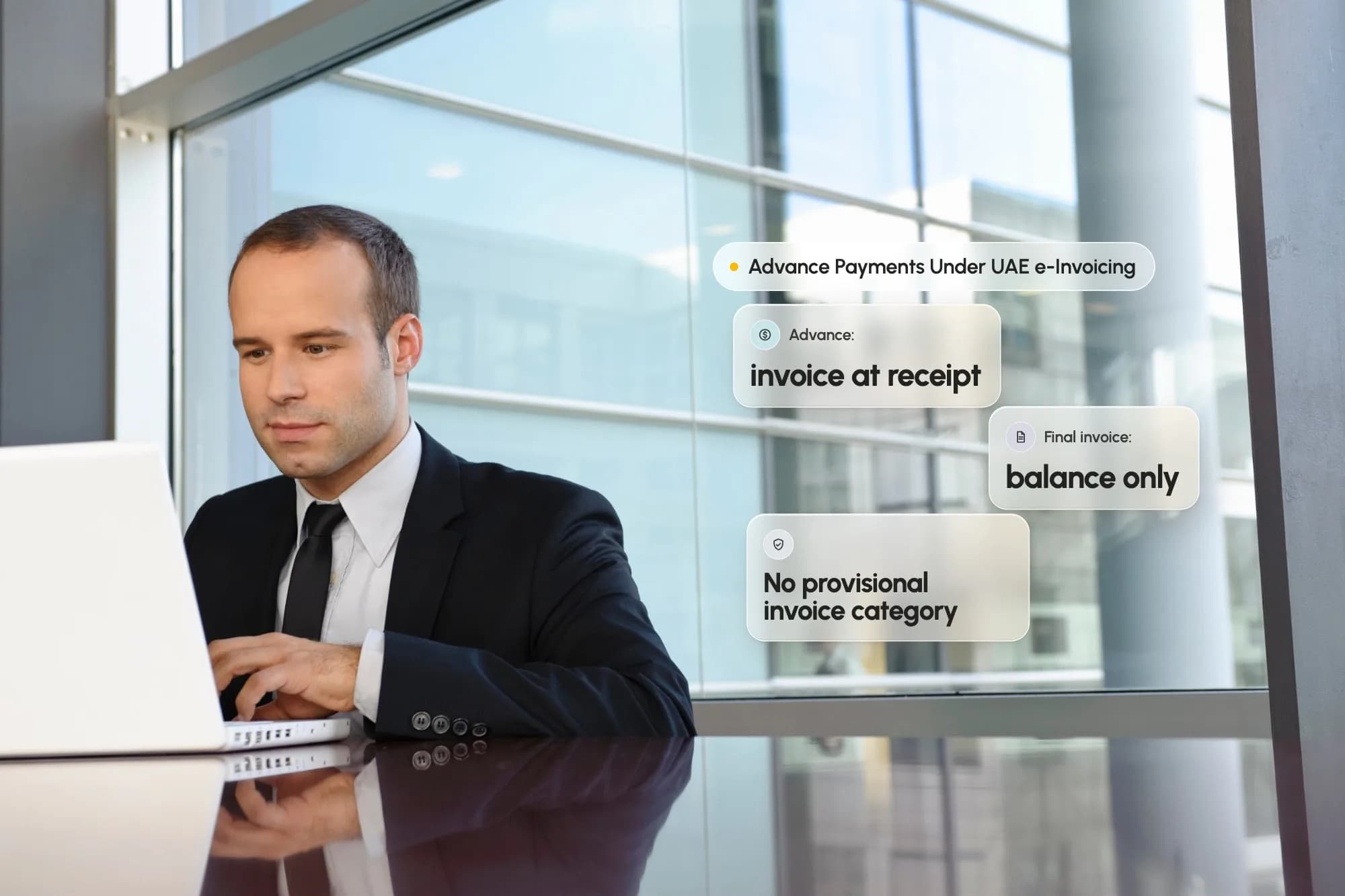
When you receive an advance payment, you issue an electronic tax invoice at the time of receipt, when VAT becomes due, not when you finish the work. The final invoice then covers only the remaining balance, not the full contract value, and references the earlier advance invoice so the VAT already declared is not charged twice. This is set out in Guidelines Version 1.1, Appendix 5 (1 June 2026). There is no separate provisional invoice category; every invoice you issue is an electronic invoice.
Advances and deposits are routine in construction, manufacturing, events, hospitality and professional services. The original framework did not spell out how they flow through e-Invoicing. Version 1.1 fixed that. Here is the sequence and a worked example.

The rule: invoice the advance when VAT becomes due
When a business receives an advance payment, a tax invoice must be issued at the point of receipt, because that is when VAT on the advance becomes due.
You do not wait until final delivery.
When the supply is completed, the final invoice covers only the outstanding balance, since a tax invoice has already been issued for the advance portion.
The two documents are linked so the transaction reconciles cleanly and the advance is not taxed a second time.
A worked example
Take a contract of AED 10,000 plus 5% VAT, with an advance of AED 1,000 taken upfront.
Item
Amount (AED)
- Contract Value (Excluding VAT)
- 10,000.00
- VAT @ 5%
- 500.00
- Total Contract Value (Including VAT)
- 10,500.00
- Advance Payment Received
- 1,000.00
- Remaining Balance Payable
- 9,500.00
The advance invoice carries AED 1,000 plus AED 50 VAT. The final invoice carries AED 9,000 plus AED 450 VAT and references the advance invoice. Across both, the full AED 10,000 plus AED 500 VAT is accounted for once, with the VAT on the advance declared at receipt and the balance declared at completion.
How to link the two invoices in PINT-AE
Linking the advance and the final invoice is mandatory. Appendix 5 sets out how to do it using the PINT-AE fields:
Reference the advance invoice on the final invoice.
A reference to the original advance invoice can be included in the reference fields, or provided as a note, so the final document points back to the advance.
The final invoice shows only the balance.
Because the final invoice reflects only the outstanding amount, the prepaid-amount field can be left blank; the balance-only total already accounts for the advance without a further adjustment.
The aim is to link the documents and show amounts already invoiced and paid, so there is no double taxation and no reconciliation gap between the advance and the final invoice. This is primarily an ERP configuration point, so confirm your system can carry the reference and output the balance-only final invoice.
Advances and retention together
Construction and long-term project contracts frequently combine an upfront advance with retention on progress claims. The two are handled by related rules in the same appendix. The advance is invoiced at receipt with the final invoice referencing it; retention is deducted on progress invoices and invoiced separately when released. If your contracts carry both, map them together so the advance, the progress claims and the retention release all reconcile to the contract total.

What to do before go-live
- 01
Identify every contract type where you take deposits or advances.
- 02
Configure your system to issue an electronic tax invoice at the moment an advance is received, not at final delivery.
- 03
Set the final invoice to output the balance only, with a reference to the advance invoice.
- 04
Replace any informal provisional or pro-forma billing with proper electronic invoices.
- 05
Where advances and retention combine, test the full contract lifecycle end to end.
Where HLB HAMT helps
Advance-payment invoicing is where the VAT time-of-supply rules and the ERP configuration have to agree, and the linkage between the advance and final invoice is exactly the kind of detail that causes double-taxation errors when it is set up wrong. HLB HAMT works across both through its advisory practice and the Evatra platform, with the firm’s technology division, HAMT Infotech, Ministry of Finance accredited service provider for e-Invoicing services in the UAE. For businesses that routinely take deposits, configuring this before go-live prevents reconciliation problems across every advance contract.

Ensure Advance Payments Are e-Invoicing Compliant
Managing advance payments under the UAE’s e-Invoicing framework requires accurate processes and the right technical setup. HLB HAMT, a Ministry of Finance approved e-Invoicing Service Provider, helps businesses implement compliant workflows, integrate ERP systems, and meet the latest regulatory requirements with confidence.