

Key takeaways
- Essential factors for running compliant payroll in the DMCC in line with local labor laws
- Clear guidance on DMCC social security regulations and compliance obligations
- Practical guidance on End of Service Benefits (EOSB) in the DMCC
- Overview of statutory leave and employee benefits under DMCC Labour Law
- How structured payroll accounting supports better financial control, transparency, and reliable MIS reporting
- How Nova VU — HLB HAMT's AI-powered payroll engine — automates every stage of DMCC payroll processing
- How HLB HAMT acts as a trusted payroll partner, helping organisations manage DMCC payroll processing with confidence, compliance, accuracy and meaningful reporting
- Native API integrations with SAP SuccessFactors, Oracle HCM, Workday and HiBOB, eliminating double-entry
Managing payroll inside the Dubai Multi Commodities Centre (DMCC) is not a routine back-office task. It is a multi-layered compliance obligation. Between GPSSA contributions for UAE nationals, mandatory WPS salary transfers, end-of-service gratuity accruals, and the full spectrum of statutory leave and overtime rules, even a small miscalculation can expose a business to regulatory penalties, employee disputes and audit failures.
This guide answers every material question a DMCC employer is likely to ask about payroll compliance in 2026. It also explains precisely how HLB HAMT’s Nova VU payroll platform automates each obligation end to end, so your finance and HR teams never have to chase numbers manually again.

What Makes DMCC Payroll Compliance Different?
Established in 2002, the DMCC is the world’s most interconnected Free Zone and one of the UAE’s most dynamic business addresses. Companies licensed within the DMCC operate under a layered regulatory framework. The overarching Federal Decree-Law No. 33 of 2021 (UAE Labour Law) applies in full, complemented by DMCC-specific employment and licensing rules. Since 2023, DMCC has also mandated participation in the UAE Wage Protection System (WPS), a requirement that had previously not applied to free zones except JAFZA.
The result is a compliance landscape that touches social security, salary transfer timelines, end-of-service calculations, multi-leave-type management and detailed payroll accounting. All these elements must operate in sync every month, without error.
Social Security Contribution
GPSSA Social Security for UAE Nationals in the DMCC
How Are GPSSA Contributions Calculated?
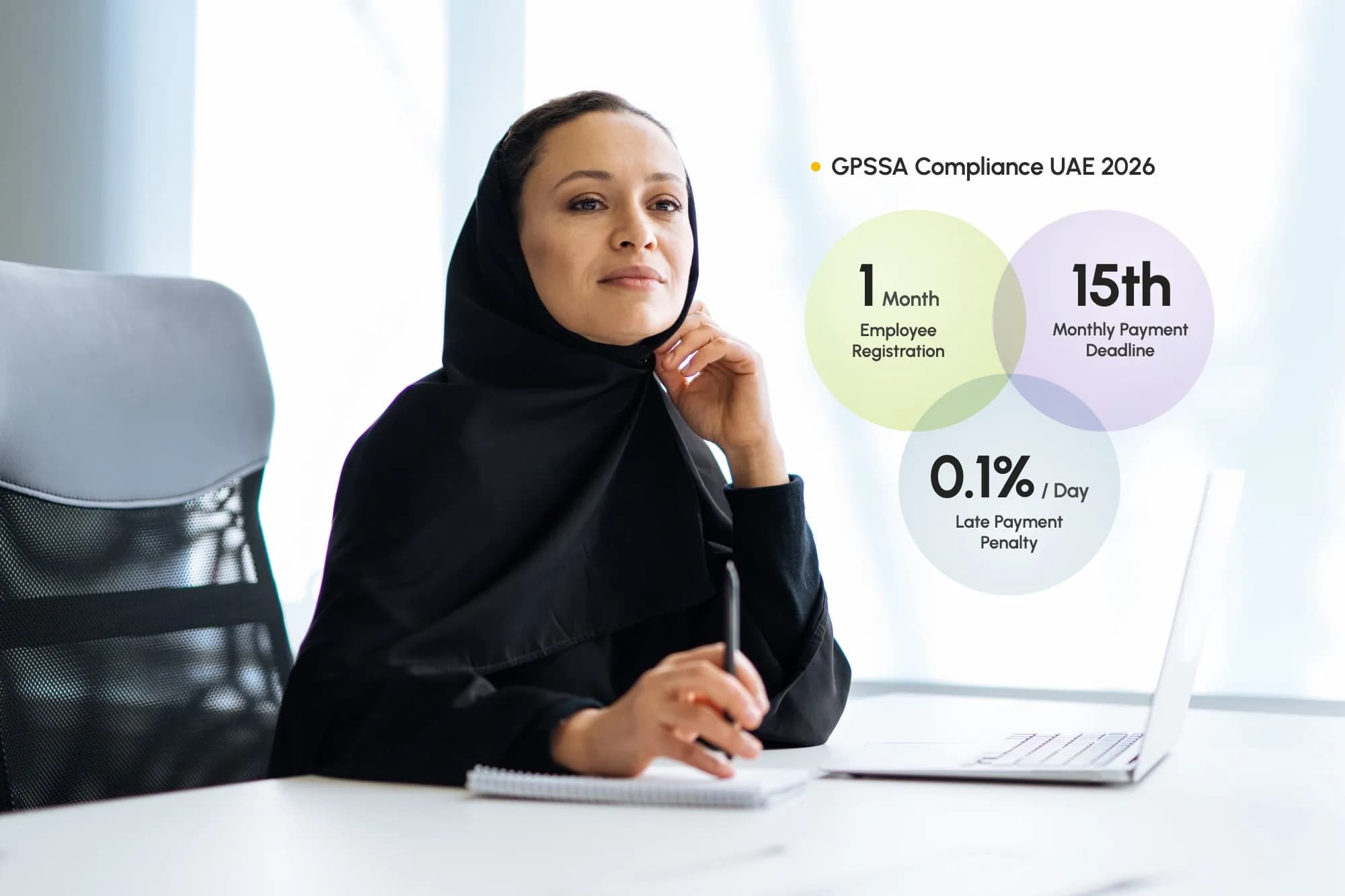
Employers must register UAE national employees with the General Pension and Social Security Authority (GPSSA) within one month of their joining date. Contribution rates differ depending on which law governs the employee:
Old Law (Fed. Law No. 7/1999)
New Law: Salary ≤ AED 20K (Fed. Law No. 57/2023)
New Law: Salary > AED 20K (Fed. Law No. 57/2023)
Framework
Old Law (Fed. Law No. 7/1999)
- Applicable To
- Nationals employed before 31 October 2023
- Salary Cap
- AED 50,000
- Employee
- 5%
- Employer
- 12.5%
- Govt
- 2.5%
- Total
- 20%
Framework
New Law: Salary ≤ AED 20K (Fed. Law No. 57/2023)
- Applicable To
- Nationals joining from 31 October 2023
- Salary Cap
- AED 70,000
- Employee
- 11%
- Employer
- 12.5%
- Govt
- 2.5%
- Total
- 26%
Framework
New Law: Salary > AED 20K (Fed. Law No. 57/2023)
- Applicable To
- Nationals joining from 31 October 2023
- Salary Cap
- AED 70,000
- Employee
- 11%
- Employer
- 15%
- Govt
- N/A
- Total
- 26%
What Are an Employer's GPSSA Obligations in the DMCC?
Employers must manage the following GPSSA responsibilities:
- Accurately calculate both employer and employee contribution portions every month.
- Deduct contributions from payroll on time and remit them to GPSSA before statutory deadlines
- Validate and generate the pro forma invoice for each monthly cycle
- Register new hires and deregister leavers through the GPSSA portal
- Maintain an auditable contribution trail at all times
DMCC Wage Protection System (WPS): What You Must Know
Is WPS Mandatory for DMCC Companies?
Yes. Since 2023, the DMCC Wage Protection System has been mandatory for all DMCC-registered businesses. WPS requires employee salaries to be transferred through UAE Central Bank-approved banks, exchange houses or financial institutions, creating a verifiable electronic record of every salary payment. It is the primary mechanism through which the UAE government monitors payroll compliance and protects employee wage rights.

What Are the Penalties for WPS Non-Compliance?
Non-compliance with WPS requirements can result in:
- Restrictions on new visa issuance, renewals and amendments
- Financial penalties imposed by the authorities for repeated or wilful non-compliance
The WPS Cycle
From payroll submission to employee salary credit.
- 01
Employer
Submit Salary File
- 02
Agent / Bank
Validate SIF
Validation
- 03
Central Bank
Route Payment
- 04
Employee Bank
Salary Credited
End of Service Gratuity in the DMCC: Calculation, Accrual and Compliance
Who Is Eligible for DMCC End of Service Gratuity?
End of Service Gratuity is a statutory entitlement under Article 51 of Federal Decree-Law No. 33 of 2021. It applies to expatriate employees in the DMCC who have completed a minimum of one continuous year of service. GCC nationals are not eligible for gratuity, as they are covered under their respective national social security pension schemes.
How Is Gratuity Calculated?
Gratuity is based on the employee’s last drawn basic salary, excluding allowances and variable pay:
01 · First Five Years of Service
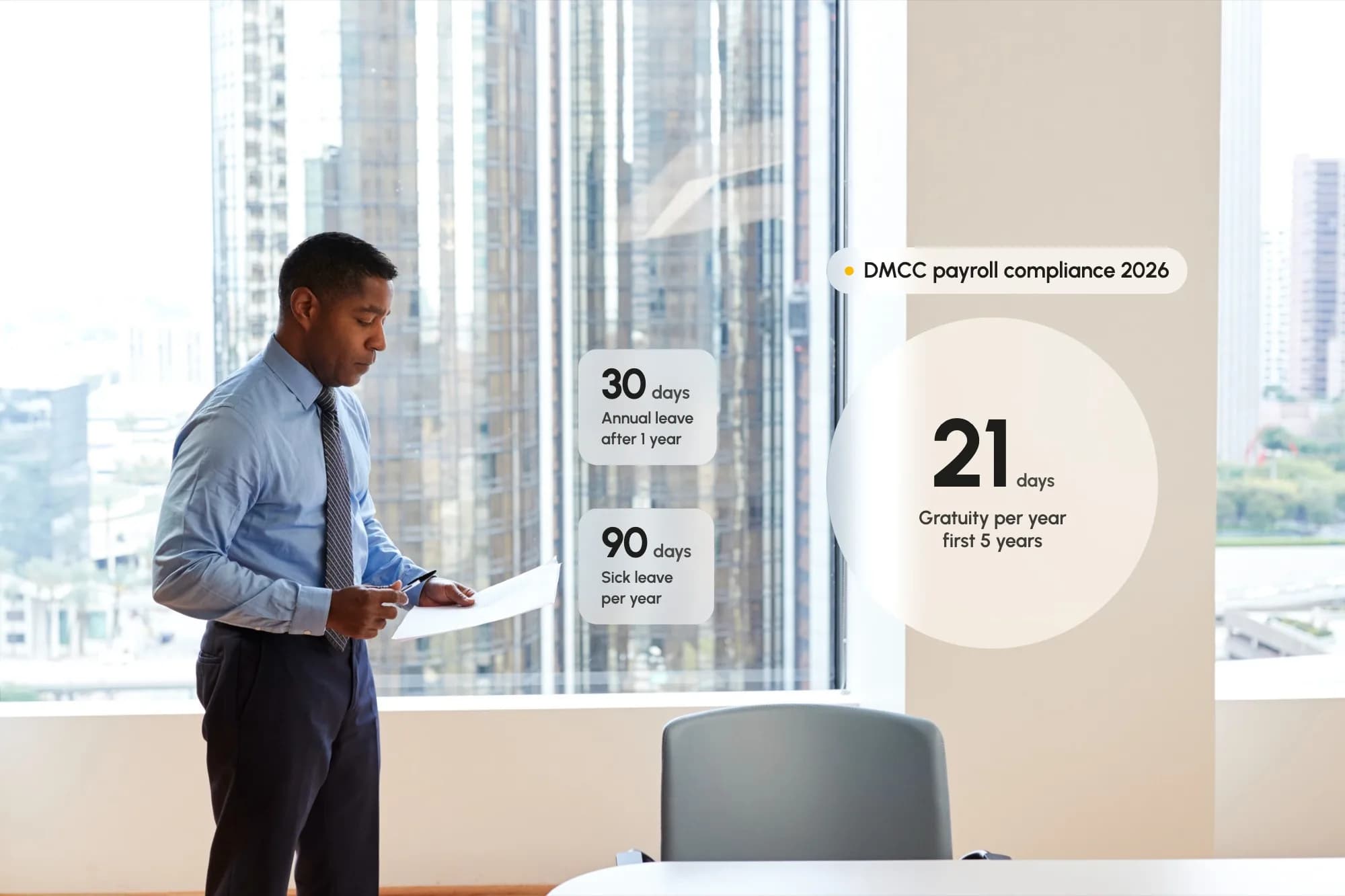
21 days' basic salary per completed year
02 · From the Sixth Year Onwards
30 days' basic salary per completed year
03 · Maximum Cap
Total gratuity is capped at two years' total salary
04 · Unpaid Leave Impact
Any unpaid leave periods are deducted from the total service period used in the calculation
What Is Included in a Full End of Service Settlement?
A full end-of-service settlement may include:
- End of Service Gratuity calculated under UAE Labour Law
- Repatriation air ticket, where applicable under the contract or company policy
- Notice period salary or payment in lieu of notice
- Payment for all unutilised annual leave days
- Any outstanding earnings, recoveries or payroll adjustments
- Unprocessed salary up to the last working day
Michael Carter
Nationality: American · End of Service Gratuity
- Hire Date
- 12 Mar 2021
- Basic salary
- AED 14,000
- Years of Service
- 4.1 years
- Gratuity Accured
- AED 40,040
Sophie Müller
Nationality: German · End of Service Gratuity
- Hire Date
- 15 Aug 2019
- Basic salary
- AED 11,500
- Years of Service
- 6.7 years
- Gratuity Accured
- AED 64,675
Mariam Al Suwaidi
Nationality : Emirati · GPSSA - Social Security
- Hire Date
- 01 Jun 2020
- Basic salary
- AED 30,000
- Scheme
- Scheme: GPSSA
- Monthly Contribution
- AED 5,250
Statutory Leave Entitlements Under DMCC Labour Law
What Leave Must DMCC Employers Provide?
The DMCC mandates the following minimum leave entitlements for eligible employees:
Leave Type
Entitlement
- Annual Leave
- 30 days/year (after 1 year of service); 2 days/month (after 6 months, before 1 year)
- Sick Leave
- First 15 days: full pay │ Next 30 days: half pay │ Next 45 days: unpaid
- Maternity Leave
- First 45 days: full pay │ Next 15 days: half pay │ Next 45 days: unpaid
- Parental Leave
- 5 working days
- Study Leave
- 10 days per year
- Sabbatical Leave
- Paid leave for UAE national employees performing national service
- Bereavement Leave
- 5 days (spouse); 3 days (parent, child, sibling, grandparent, grandchild)
Mahra Mansoori · Sales
- Annual Leave18/30 D
- Sick Leave15/90 D
- Maternity Leave18/60 D
- Parental Leave5/5 D
Submitted
Line Manager
Approved
Dpt. Manager
Approved
HR Manager
Pending
HLB HAMT's leave management engine automatically tracks balances across all leave types and triggers the correct payroll deduction at the appropriate rate, whether full pay, half pay or unpaid, without requiring manual input from your HR team. The integrated Employee Self-Service (ESS) portal allows employees to apply for leave online, with configurable approval workflows routing requests through your defined hierarchy. Once fully approved, the leave entry is pushed directly into the payroll engine, updating the payslip calculation in real time.

Overtime Rules in the DMCC: Rates, Calculation and Automated Processing
How Is Overtime Calculated in the DMCC?
Overtime applies to all hours worked beyond the standard daily working hours defined under UAE Labour Law. It may not exceed two additional hours per day unless specific circumstances permit otherwise:
+25%
Standard overtime
Normal hourly wage plus an additional 25%
+50%
Special overtime
Overtime between 10 pm and 4 am, or on rest days and public holidays: normal hourly wage plus an additional 50%
Overtime is typically calculated on the employee’s basic salary. However, HLB HAMT’s payroll system can be configured to base calculations on basic salary plus selected fixed allowances, accommodating company-specific overtime policies within the boundaries of UAE Labour Law.
The ESS portal allows employees to submit overtime requests digitally, with approval routed through predefined workflow hierarchies. Once approved, overtime hours flow automatically into the payroll engine. They are calculated at the correct rate, itemised on the payslip and reported by department, with zero manual re-entry.
Salary Components, Pay Cycles and Multi-Currency Payroll
What Salary Components Are Common in the DMCC?
UAE Labour Law does not prescribe mandatory salary components, giving employers flexibility in structuring compensation packages. Typical DMCC pay structures include:
Fixed Components
Basic salary, housing allowance, transport allowance, and other contractual allowances
Variable Components
Overtime, sales commissions, performance bonuses, incentives, relocation allowances, mobile allowances
The HLB Payroll system supports unlimited pay codes. Clients can add any number of earnings and deduction components at any time, without additional charges or technical change requests. Payroll can be processed in multiple currencies within a single pay run, making it ideal for organisations with cross-border payroll obligations or expatriate employees paid in their home-country currencies.
Are There Mandatory Deductions in the UAE?
Employee Benefits: Medical Insurance, ILOE and Air Tickets
Is Medical Insurance Mandatory in the DMCC?
Yes. Employers in the DMCC are required to provide medical insurance coverage to all employees for the duration of their employment. Coverage for dependants is not mandatory under UAE law, although many organisations extend this as part of a competitive benefits package.
What Is ILOE Insurance, and Who Must Be Covered?
The Involuntary Loss of Employment (ILOE) insurance scheme is mandatory for all eligible employees in the UAE, including nationals and expatriates across the public and private sectors. It provides temporary financial support to employees who lose their jobs for reasons beyond their control. While the subscription obligation rests with the employee, many DMCC employers absorb the premium as an added benefit. Nova VU can track and administer ILOE deductions or employer-funded contributions as a standard pay code within the payroll run.
How Are Air Ticket Benefits Managed?
Air ticket benefits are not a statutory obligation under DMCC Labour Law, but they are an established market practice, particularly for expatriate-heavy workforces. The HLB Payroll system automates air ticket entitlement management. It calculates entitlements by grade, applies approved routes and standard rates, supports self, self + spouse, and family eligibility structures, and releases payments automatically in the designated payroll cycle. This eliminates manual tracking and reduces the risk of missed or incorrect payments.

Payroll Accounting, GL Integration and MIS Reporting
Why Does Payroll Accounting Matter for DMCC Businesses?
Payroll accounting ensures that every salary payment, accrual and statutory contribution is accurately reflected in your financial statements. For DMCC companies, particularly those subject to UAE corporate tax, transfer pricing oversight or group-level consolidation, clean and timely payroll accounting is not optional. It is the backbone of audit readiness, cost control and regulatory transparency.
What Payroll Accounting Capabilities Does Nova VU Deliver?
Fully automated General Ledger (GL) posting aligned with your chart of accounts
GL mapping and cost allocation rules configured by department, cost centre, or project
Dynamic GL remapping to accommodate employee transfers and departmental restructures
Automated monthly accruals for End of Service Gratuity, annual leave liability, air ticket provisions, and bonus/incentive provisions
Classification of payroll expenses as direct or indirect costs, with multiple GL codes assignable to a single pay component
Monthly payroll accounting packs, including journal vouchers, ledger summaries, and MIS reports — ready for your finance team or auditors
GL Posting Summary
JE Type
Salaries
- Department
- Technology
- Debit
- AED 2,150,480
- Status
- Posted
JE Type
Gratuity
- Department
- Technology
- Debit
- AED 55,200
- Status
- Posted
JE Type
Leave Accrual
- Department
- Technology
- Debit
- AED 28,140
- Status
- Pending
JE Type
Salaries
- Department
- Operations
- Debit
- AED 1,845,900
- Status
- Posted
JE Type
Salaries
- Department
- Marketing
- Debit
- AED 986,500
- Status
- Posted
Payroll VS Budget
Total Payroll
Technology
Operations
Marketing
Category
Total Payroll
- Actual
- 2,150,480
- Budget
- 2,250,000
- Status
- -2.3%
Category
Technology
- Actual
- 2,150,480
- Budget
- 2,285,600
- Status
- 92%
Category
Operations
- Actual
- 55,200
- Budget
- 55,500
- Status
- 85%
Category
Marketing
- Actual
- 28,140
- Budget
- 24,500
- Status
- 74%
Budget Utilisation
92%
Technology
85%
Operations
74%
Marketing
HRMS and ERP Integration: Connecting Nova VU to Your Technology Stack
One of the most significant operational challenges in payroll management is the disconnect between HR systems and payroll engines. This forces teams to manually re-enter employee data, transfer hours worked or reconcile system-level discrepancies. Nova VU eliminates this entirely through native API integration with leading HRMS and ERP platforms used across the DMCC and wider GCC market.
Native API Integrations: Nova VU Connects With:
- SAP SuccessFactors
- Oracle HCM Cloud
- Workday
- HiBOB
- Microsoft Dynamics
- Oracle ERP Cloud
- SAP S/4HANA
- Custom ERP via API
What Does HRMS Integration Achieve in Practice?
01
Automated Employee Data Sync
New hire records and grade, department or salary changes in your HRMS are reflected in Nova VU automatically, with no manual re-entry
02
Time and Attendance Data Flow
Approved attendance, leave and overtime records from your HRMS pass directly to Nova VU for payroll calculation
03
Bidirectional Payroll Data Export
Finalised payroll output, including cost allocations, accruals and GL entries, is pushed back into your ERP for seamless financial reporting
04
Real-Time Reporting Consistency
Because HR and payroll data share a single integration layer, finance, HR and operations teams always work from the same numbers
Whether your organisation runs SAP SuccessFactors as its core HCM platform, uses Oracle HCM Cloud for workforce planning, manages the employee lifecycle on Workday or runs HR operations through HiBOB, Nova VU’s API framework connects without bespoke development work. This reduces integration timelines from months to days.
HLB HAMT Advantages
Why Choose HLB HAMT for DMCC Payroll Outsourcing?
Payroll outsourcing is a strategic decision, not just an operational one. The right partner does not simply run your payroll. They protect your compliance, reduce your risk and give your finance and HR teams time back for higher-value work. Here is what distinguishes HLB HAMT:
Go Live in 10 Days
SME payrolls activated in as little as 10 days, without operational disruption.
No Minimum Commitment
Stay because it works, not because you’re tied in by contract.
Scales 1 → 10,000+
same platform supports a single hire or an enterprise of 10,000 employees.
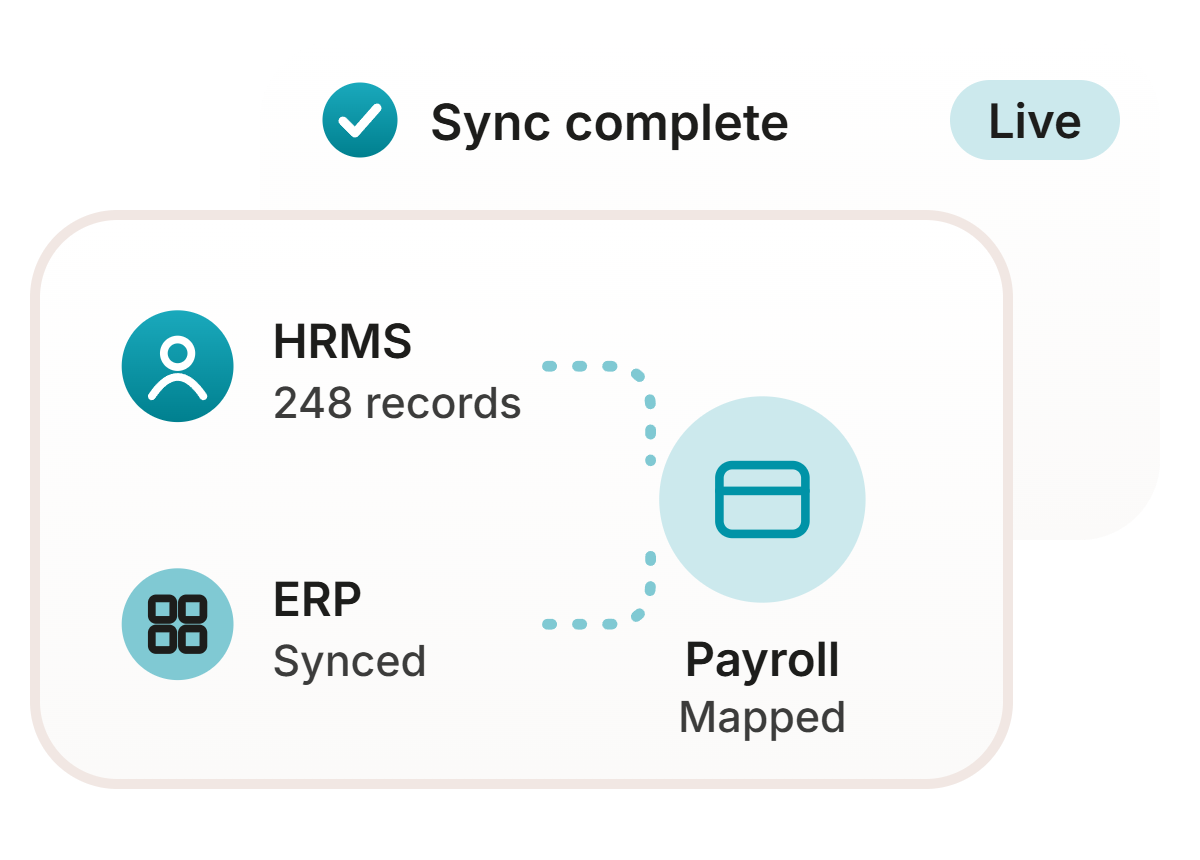
HRMS integration
Connects with Oracle, SAP, SuccessFactors and your in-house systems end to end.
Audit-ready always
Clean reports, clear calculations and full statutory trails on demand.
ISO 27001 · SOC 2
High standards of data security and quality management certification.
Frequently Asked Questions
- Payroll Register
- Payroll Reconciliation Report
- Headcount Reconciliation Report
- Bank Payment File and Payment Summary
- GPSSA Contribution Report
- Gratuity Accrual Report
- Leave Liability Report
- Overtime Report
- General Ledger (GL) Journal Entries
- Year-to-Date (YTD) Payroll Summary
- Cost Centre Allocation Report
- Payroll Submission and Approval Confirmations
In addition, HLB HAMT provides a comprehensive suite of audit and management reports, including Gratuity Yearly Summary, Annual Payroll Summary, Salary Increment Summary, Joiner and Leaver Reports, Payroll Variance Reports, Statutory Compliance Reports, and other customized reports to support audits, management reporting, and financial reconciliation.
– Confirm all employees are paid through WPS.
– Register eligible UAE nationals with GPSSA within the required timeline.
– Apply the correct GPSSA contribution rate based on the employee’s applicable law.
– Calculate gratuity for expatriate employees using basic salary and completed service.
– Track annual leave, sick leave, maternity leave, parental leave, study leave and bereavement leave.
– Calculate overtime using the correct rate and approved working hours.
– Maintain payroll records, WPS files, GPSSA reports, gratuity accruals and GL entries for audit review.
By outsourcing payroll services in DMCC to an experienced provider like HLB HAMT, businesses gain access to payroll specialists who manage the entire payroll lifecycle, including salary calculations, WPS salary processing, GPSSA administration for UAE nationals, gratuity accruals, leave and overtime calculations, payroll accounting, HRMS integration, management reporting, and secure payroll record management.
Outsourcing payroll helps DMCC companies:
- Ensure compliance with UAE Labour Law and DMCC payroll requirements.
- Process salaries accurately and on time through the Wage Protection System (WPS).
- Reduce payroll errors and compliance risks.
- Strengthen payroll data security and confidentiality.
- Lower administrative costs and eliminate dependency on in-house payroll expertise.
- Scale payroll operations efficiently as the business grows.
- Enable HR and finance teams to focus on strategic business initiatives instead of routine payroll administration.
With over 25 years of payroll outsourcing experience across the GCC, HLB HAMT provides technology-driven, compliant, and scalable DMCC payroll outsourcing services that help businesses achieve accurate payroll processing while minimizing operational risk.
| Factor | In-House Payroll | Payroll Outsourcing |
|---|---|---|
| WPS Compliance | Internal responsibility | Managed by payroll specialists |
| GPSSA Administration | Internal management | Managed by payroll specialists |
| Regulatory Changes Handling | Risk of missed updates is high | Managed by payroll experts |
| Payroll Accuracy | Depends on internal expertise | Specialist oversight and validation |
| Reporting | Often manual and time-consuming | Automated reporting and MIS insights |
| Scalability | Limited by internal resources | Easily scalable with business growth |
About the Author

Sajin Rasheed
Partner – Payroll & HR · HLB HAMT
Sajin has been associated with HLB HAMT since 2005. He heads the Payroll Outsourcing Division and is responsible for making strategic decisions for the overall Division. He has over 20 years of experience in the field of finance and payroll. His dynamic initiatives at HLB HAMT have been pioneering for the industry. Under his leadership, the division commenced its transformational journey, reaching out to customers across the GCC and MEA region.